« My daughters will not be circumcised» Aminata Camara
UNICEF and the Swiss National Committee for UNICEF support the Ministry for the Promotion of Women, Children and Vulnerable Persons in promoting the abandonment of female genital mutilation (FGM) in the Basse-Côte regions

- Français
- English

A threatened future for thousands of girls
The future of every girl in Guinea is precious. Yet for many, it is overshadowed by the persistent threat of female genital mutilation (FGM). While the prevalence among children aged 0 to 14 has declined slightly from 45.5% in 2012 to 39% in 2018, the pace of progress remains too slow.
To accelerate change and ensure a future free from violence for all girls, UNICEF, with financial support from the Swiss National Committee and as part of the joint UNFPA-UNICEF programme, is supporting the implementation of the project “Contributing to the abandonment of female genital mutilation (FGM) practices in the regions of Boké, Kindia and Conakry.”
Breaking the cycle of suffering
Despite the deep cultural roots of this practice, quiet but powerful voices are rising to challenge it. These are the voices of mothers like Aminata Camara, a 43-year-old saleswoman and mother of five, children four of whom are girls. «I was circumcised at the age of 12. It left me broken,»Aminata shares. «But I said no for my daughters. They will not go through what I went through.» Despite pressure from her in-laws, she stood firm. Today, her daughters are continuing their education and openly discuss the dangers of FGM, even though the topic remains taboo. Her daughters, Aminata (18) and Marie Louise (16), recall having to use clever tactics to avoid being cut. Thanks to their mother’s unwavering support, they are safe. «They say it stops girls from chasing boys, but that’s a lie,» says Marie Louise.
Inspiring model families
These courageous voices are multiplying across the region. In Kagbélen, a suburb of Conakry, Denise Leno, a saleswoman and mother of three, made a bold decision: “I realised that circumcising a girl is stealing part of her childhood. I chose to protect my daughter, and I want to help other mothers do the same.” In Dixinn, one of Conakry’s 13 municipalities, teacher Fatoumata Diaouné goes further by educating families in her neighborhood about the long-term consequences of FGM. «What protects a girl is not pain it’s education, » she insists. «My eldest daughter is staying with her grandmother during the holidays, and I have warned her to be careful, because I am very afraid that something might happen. »
Holidays without excision: raising awareness and preventing risks for girls
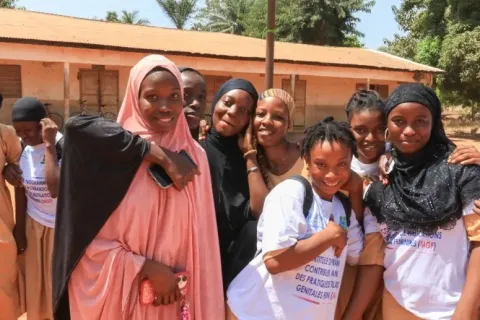
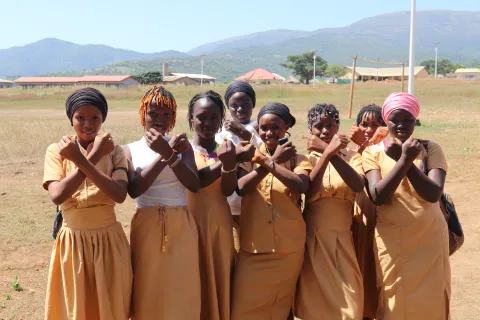
The risk of FGM increases during school holidays, when some families send girls to rural areas or to relatives with the intent of having them circumcised. To counter this, the project partners organize an annual campaign called «Holidays Without Circumcision» to inform and raise awareness among parents and children. This year, a team of U-Reporters joined the movement, spreading messages at markets, bus stations, docks, and roundabouts in Conakry. They also use social media platforms like Facebook, TikTok, WhatsApp, and Instagram to amplify their message.
These women are pillars of change and are part of the «Model families» supported by the project. They are breaking silence, educating others, and showing that a different path is possible for girls.
Femail genital mutilation is a violation of girls’ fundamental rights. Thanks to education, community dialogue, youth engagement, survivor advocacy, and the promotion of model families, the social norms are shifting; and must continue to shift so that every girl in Guinea can grow up free, strong, and protected.