Luna and Estrella: smiling again after migration
Protection and support for returned children

- Español
- English
Inside the mobile unit, Luna and Estrella sit side by side, drawing, laughing, and proudly showing off their colorful pictures. At first glance, they look like any other 10-year-old girls. But not long ago, the twin sisters barely spoke. Theylived trapped by fear—afraid to go outside, frightened by loud noises, unable to sleep peacefully, and even fearful of interacting with their own brothers.
They slept restlessly, cried constantly, and often hid in silence.
"Before, I didn't want to talk. I didn't want to leave the house," Estrella says.
"Now I feel happy. I feel calm when I go outside," says Luna.
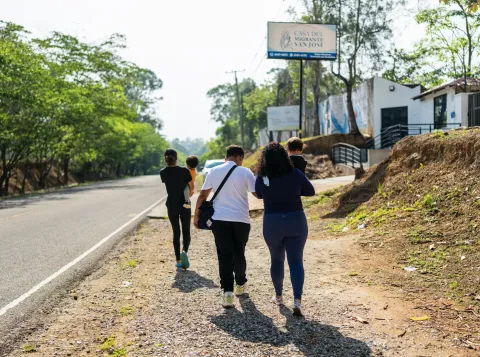
In Guatemala, thousands of returned children and adolescents face the emotional consequences of migration and violence. According to the Guatemalan Migration Institute (IGM), 1,904 children and adolescents were returned tothe country in 2025 alone. Luna and Estrella's story shows how support for family reintegration within their community of origin can transform fear into hope.


The family's story began to unravel long before they returned.
In Guatemala's Quiché department—one of the areas with a high number of returned children and adolescents—the family lived with constant violence at home.
The father of Luna, Estrella and their two older brothers became increasingly violent. Humiliation and threats against their mother escalated until one day she and her children were left homeless.
"He left us with nothing—no home, nothing at all. One night we even slept in a park," recalls Mimi, Luna and Estrella's mother.
With four children to care for, she made a desperate decision: to migrate. She was searching for a different future for her children. She was trying to survive. Like many Guatemalan families, she fled violence while hoping to findbetter opportunities for her children.
But the journey to the United States was marked by fear, more violence and new trauma.
While traveling through Mexico, both Mimi and her daughters experienced traumatic events that deeply changed them. Their journey ended before reaching its destination, and after enduring violence during transit, the family wasreturned to Guatemala.

"When I came back, I was completely devastated," Mimi remembers. "Fortunately, my husband was no longer at the house, so we were able to move back in. But I didn't want to leave my room anymore. I stayed in the dark. I didn'twant to bathe or even look at myself in the mirror."
The girls also carried the emotional impact of the journey.
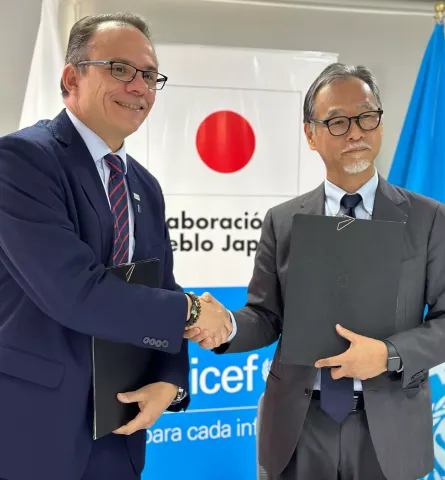
According to Olga Pérez, a psychologist working through a programme supported by UNICEF with funding from the Government of Japan, the twins arrived living with constant fear and severe emotional distress.
"They were afraid to go outside. They were afraid someone would hurt them. They showed deep sadness and struggled to speak. Family relationships had also been severely affected," she explains.
Stories like Luna and Estrella's reflect the reality faced by hundreds of returned children and adolescents.
According to the IGM, in 2025, 1,262 children and adolescents returned accompanied by a family member, while 642 returned unaccompanied. Many faced multiple protection risks both during the migration journey and uponreturning to their communities.
In response, UNICEF and its partners, with funding from the Government of Japan, are strengthening child protection systems for returned children and adolescents and their families by providing psychosocial support, facilitatingaccess to education, creating safe spaces, and strengthening coordination of services at the departmental, municipal and community levels to support their recovery and reintegration.

Through the programme, Luna and Estrella's family received psychosocial support, home visits, and assistance to reconnect with health and education services. The girls returned to school. They received school supplies, backpacks, and emotional support delivered in their own language and in a culturally appropriate way.
Little by little, things began to change.
"Thanks to the support we received, now we can write, speak and smile," the twins say.
Today, Luna dreams of becoming a doctor so she can care for people who are sick. Estrella wants to become a police officer to protect people living in fear. They have friends at school, complete their homework, draw together, and once again allow themselves to imagine the future.
Their mother has also rebuilt her life. She now works as a literacy facilitator and runs a small business. She says she has found hope again.
"I thought I would never be able to move forward on my own with four children," Mimi says. "But now we spend time together, we laugh, we watch movies as a family. The sadness we once carried has turned into happiness."
Their home is no longer filled with silence and closed doors. Instead, there are hugs after school, homework shared with laughter, and dreams slowly taking shape again. Little by little, fear gave way to something that once seemedimpossible: the peace of feeling like a family again.
Luna and Estrella no longer hide. Today, they speak, play, study and dream about the future.
Their story is a powerful reminder that even after violence, displacement and fear, timely support can help returned children and adolescents and their families rebuild their lives.
Above all, there is one sentence the twins repeat together—almost like both a promise and a victory: "Now we are a united and happy family."