Evaluation of the UNICEF Component of the Global Water Leadership Programme (2021–2025)
Understanding how UNICEF’s Global Water Leadership Programme is strengthening climate-resilient WASH systems and accelerating adaptation to climate change

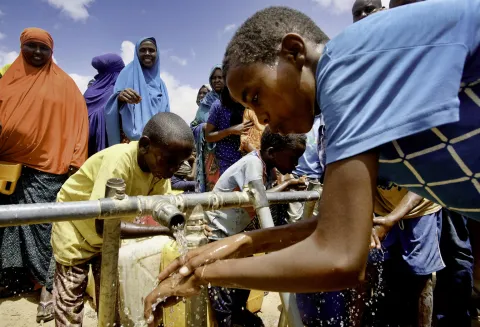
Climate change is increasingly threatening access to safe water, sanitation and hygiene (WASH) services worldwide. Droughts, floods, shifting rainfall patterns and growing water scarcity are putting millions of children and communities at risk, particularly in low-income and fragile settings. To respond to these challenges, UNICEF supports countries in strengthening climate-resilient WASH systems and mobilizing the financing needed for climate adaptation. This evaluation examines UNICEF’s contribution to the Global Water Leadership (GWL) Programme, funded by the United Kingdom’s Foreign, Commonwealth & Development Office (FCDO). The UNICEF component of the programme was implemented in 11 countries between 2021 and 2025. The evaluation assesses how effectively it supported governments and partners in strengthening policies, institutions, capacities and investments for climate-resilient WASH services. Drawing on extensive document reviews, stakeholder interviews and case studies in Chad, Nepal and Sierra Leone, the evaluation provides a comprehensive account of achievements, challenges and lessons to inform future programming.
What the evaluation finds
The evaluation finds that the programme was highly relevant to the growing climate risks facing the WASH sector. By focusing on systems strengthening, climate governance, cross-sector collaboration and access to climate finance, the programme addressed some of the most significant barriers preventing countries from building resilient WASH services.
Overall, the programme achieved strong results, with most targets met or exceeded. One of the programme's most significant achievements was its catalytic effect on financing. With relatively modest investment, the programme helped mobilize substantial climate-resilient WASH funding from climate finance mechanisms and national governments. The evaluation also highlights how the programme accelerated UNICEF's own transition towards climate-resilient programming and strengthened its position as a leading actor in climate adaptation and water security.
At the same time, the evaluation identifies important areas for continued attention. While climate resilience became more deeply embedded in policies, institutions and sector planning processes, sustaining momentum will require continued investment, political commitment and capacity development. The findings also show that gender, equity, disability inclusion and human rights considerations were not always integrated through deliberate and measurable approaches, highlighting opportunities to strengthen future programming.
Key lessons and the road ahead
A central lesson emerging from the evaluation is that transforming WASH systems to become climate resilient is a long-term undertaking. Lasting change requires sustained engagement across policy, institutions, financing, coordination mechanisms and local implementation. Short project cycles alone are unlikely to achieve this level of transformation.
The evaluation emphasizes the importance of predictable and flexible funding, strong cross-sector partnerships, continuous capacity development and high-level political commitment. It also highlights the need to balance national policy and systems-strengthening efforts with practical field-level demonstrations that generate evidence and help accelerate adoption of climate-resilient approaches.
Looking ahead, the recommendations call for UNICEF to continue strengthening climate-resilient WASH programming through improved learning and knowledge management, stronger monitoring systems, enhanced coordination across sectors, and more intentional integration of gender, equity and inclusion considerations. The evaluation also stresses the importance of securing long-term financing and institutionalizing climate-resilient approaches across countries and programmes.
Why this matters
Climate change is rapidly reshaping the challenges facing water and sanitation systems worldwide. As countries seek to protect essential services and build resilience for future generations, understanding what works – and why – is increasingly important.
This evaluation demonstrates how targeted investments in systems strengthening, institutional capacity and climate finance can help accelerate the transition towards climate-resilient WASH services. It provides practical evidence and lessons for UNICEF, governments, donors and development partners working to ensure that children and communities have access to safe, sustainable and climate-resilient water and sanitation services in an increasingly uncertain future.
We look forward to sharing the forthcoming evaluation report soon.
For further information, please contact: Elke Johanna de Buhr