Albena is now a calm and fearless student
Young girl breaks barriers and starts school with professional help under the European Child Guarantee pilot project in Bulgaria.

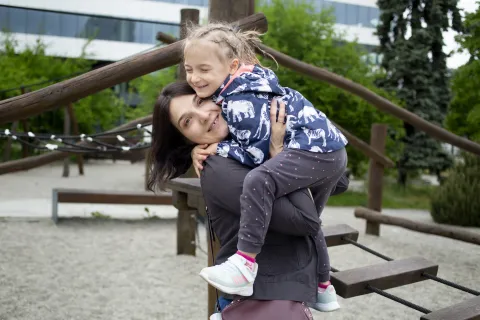
It’s exactly 7.30 am as the bell in the only school in the small Bulgarian mountain town of Tvarditsa rings. Classes will start in a minute. A little girl with a big pink princess bag runs up the stairs, holding her mother tightly by the hand. Together, they walk up to the classroom and give each other a hug, then another, before they finally part ways.
The girl’s name is Albena, she is seven years old, and is in the first grade. For all children, this is perhaps the most difficult time, but for her it is even harder. She has a developmental disability and communicates only with those people closest to her, using very few words. She is does not trust anyone she doesn’t know and dislikes anything that is new. Since she was little, she has almost always sought the comfort of calm, secluded and quiet places. She cannot bear noise and large groups of people gathered in one place.
”When we started coming to school, Albena was so scared and startled by the sound of the bell that she even covered her ears! I was terribly worried about the first grade. It wasn’t even about the writing, I was terrified she’d refuse to stay in class.”
This is what Maria Radneva, Albena’s mother, who takes her to school every morning and picks her up at lunchtime, tells us.
“Today, one month later, she comes to school visibly relaxed and stays on even until the last class,” adds Maria in a trembling voice, which shows that she too finds it difficult to believe what is happening. “No one ever thought this might happen.”
Her Mother believes that her progress is mostly due to the team efforts of the professionals who worked with Albena in her final year of pre-school. At that time, a psychologist was assigned to work at Albena’s kindergarten under the pilot testing of the European Child Guarantee in Bulgaria. The project is funded by the European Commission and is implemented, with UNICEF’s support, across 30 kindergartens in the regions of Burgas, Sliven and Stara Zagora through the employment of 45 new professionals, including speech therapists, psychologists and resource teachers.
The newly appointed psychologist at Albena’s kindergarten, Plamen Gagamov, and the resource teacher from the Regional Centre for Support of Inclusive Education in Sliven, Nadka Shalaverova, worked together to draw up a plan to help Albena prepare for her first year in school. Their goal was to teach her school and classwork habits she would need to adapt more readily to the new routine and environment, which, in her case, was not an easy task at all. According to her first kindergarten teacher, Ivanka Svetieva, Albena had a very hard time following rules and preferred to be on her own.
“With no proper preparation, she would have been totally unfit to learn. When I first saw her, she was doing puzzles alone, away from the other children. The key thing about her is that her focus disappears very quickly,” recalls Plamen Gagamov in connection with their first meeting. At that time, he set as his first goal to encourage her to start interacting with others.
“At the beginning, we played a special game of hide-and-seek between the pine trees at one end of the schoolyard. Then she started to trust me and we began another game, with two balls. She watched what I was doing when I wanted to pass the balls to her and tried to mimic my movements when passing them back to me, and like that, little by little, she started to interact more actively. She liked this, and then she was happy for us to do things together that were far less fun but would help become better prepared to learn and grasp colours, numbers and figures, and even letters, which we were learning together,” says Gagamov.
The key to understanding Albena lies in her favourite activities, and they also underpin the work of her resource teacher, Nadka Shalaverova.
“Things happen when we start using our hands. She likes to draw. Drawing is her way of self-expression. Children like her, they show us how to work with them,” says Shalaverova.
The team made a concerted effort to help the young girl develop her speech and expression. During their first meetings, she was only able to utter isolated words, unrelated to her surroundings.
“One thing I’ll never forget is once we were coming back from an outdoor party which we went to together. It was starting to drizzle. She took my hand and said “Ma’am, it’s raining.” I just can’t describe the way this short but clear and spot-on sentence made me feel,” says Shalaverova.
To facilitate the transition from kindergarten to school, the team began to take Albena to her future classroom and the Director’s office, and to walk with her among the children in the corridors. “The first sight of the school building and her wow! is something we’ll never forget,” recalls Nadka Shalaverova. Then came the hard part: there were many students in the corridors, the sound of the school bell, a lot of noise, and new teachers. Nevertheless, with the psychologist and the resource teacher by her side, all of the efforts made in last year in kindergarten have eventually paid off. A month after her first day of school, Albena is sitting at her desk in the classroom and carefully repeating the letter the teacher has just taught together with the rest of her classmates. Next to her is the assistant teacher assigned to her class to help Albena and other children who need support.
“In the beginning, it was very difficult - she wouldn’t stay for more than a lesson. During those first days, we asked both the psychologist and the resource teacher for help. But, every single day, her attention span in class grew,” says Albena’s teacher, Rositsa Ivanova. She is convinced that the results are due to the professional help and all of the effort made.
“I was so happy when she first took a pen and started to draw strokes and curves,” says Ivanova.
“The letter A, the letter L, the letter B...”
We can hear Albena’s tiny voice, and she isn’t just writing her name, but also saying it out loud at the end:
“AL-BE-NA!”
These are the happiest moments for her mother too, who had many times in the previous years been discouraged about Albena’s development.
“I didn’t think we’d come such a long way. At one point, I even considered removing her from kindergarten and quitting my job to focus entirely on her. But we would have been socially shut out, and that would have been too much to ask from Beni. This past year has really shown me that, as a parent, I need to stay positive.”