
UNICEF AI Strategy 2025-2030: AI for every child
Responsible AI to accelerate results for children and protect their rights

Artificial Intelligence is already reshaping how societies learn, communicate, govern and deliver services. For children, AI presents enormous opportunities, but it also raises serious concerns around privacy, safety, discrimination and exclusion.
To address both the opportunities and risks, UNICEF’s AI Strategy 2025–2030: AI for every child is a roadmap designed to ensure AI works in the best interests of children everywhere.
The strategy positions AI not simply as a technological tool, but as an accelerator for results for children while safeguarding their rights.
UNICEF AI strategy main pillars
Al for programme impact
Deliver quality, effective programme impact at scale for children and communities.
Al for operational efficiency and effectiveness
Improve readiness, productivity and business process efficiency across UNICEF.
Child rights advocacy on Al
Ensure children’s rights, voices and safety shape Al governance at every level.
Six core capabilities areas
To turn ambition into action, UNICEF has identified six core capabilities required to deliver sustainable and scalable AI implementation:
1
Strategy and value realization
Focus Al on measurable benefits for children.
2
Data and AI core
Trusted data, platforms and infrastructure.
3
AI risk management
Guardrails, guidance and tools for responsible use.
4
People and adoption
Skills, culture and new ways of working.
5
Partnerships
Work with public, private, civil society and UN partners
6
Advocacy and foresight
Shape the future Al agenda for child rights.
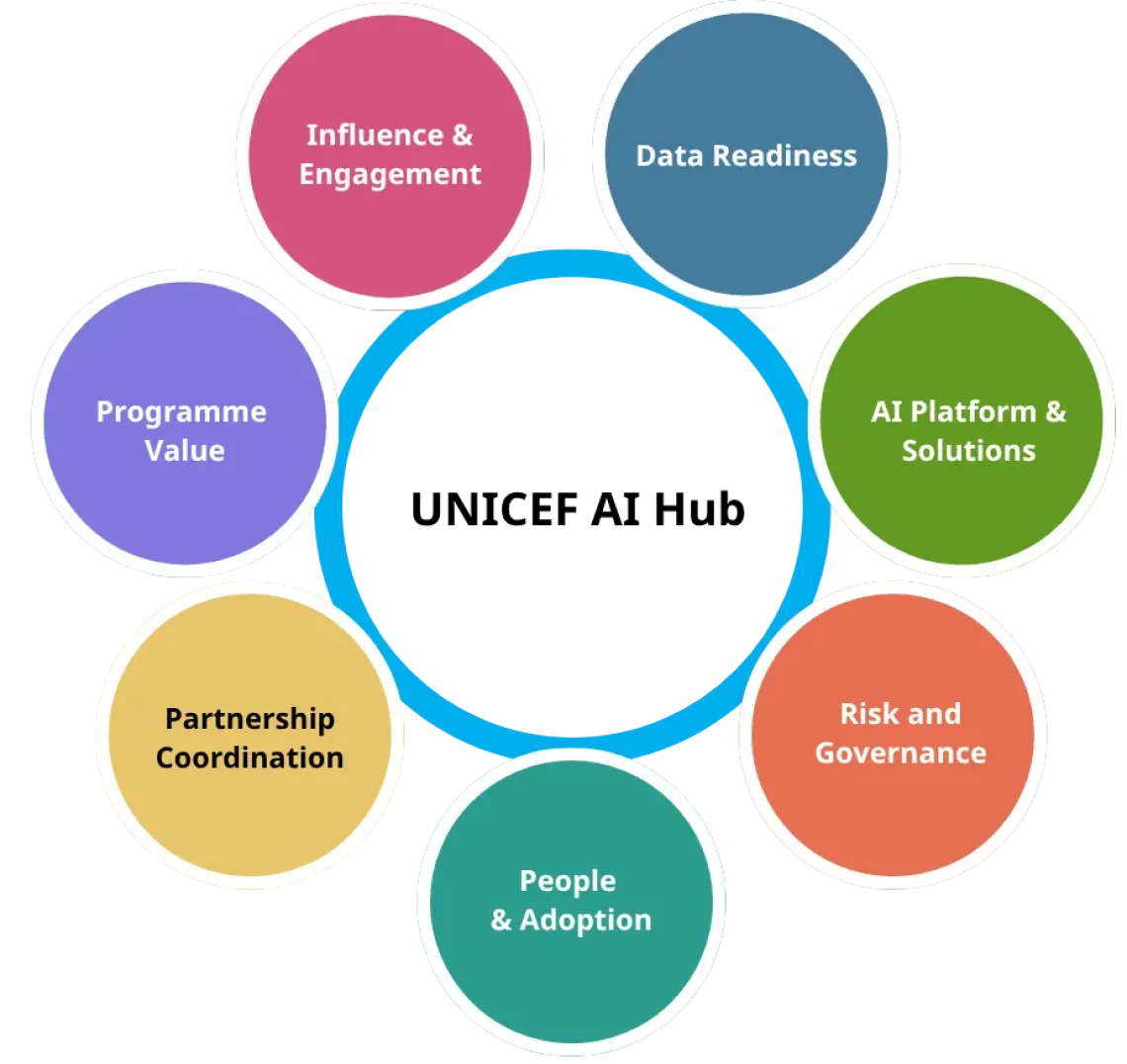
The UNICEF AI Hub
The UNICEF AI Hub links country, regional and HQ teams through seven thematic AI circles.
Responsible Al principles
UNICEF’s AI strategy adopts the “Principles for the Ethical Use of AI in the UN system” to establish strong responsible AI guardrails. The strategy is guided by ten key principles:
- Define purpose, necessity and proportionality
- Do no harm
- Safety and security
- Fairness and non-discrimination
- Sustainability
- Right to privacy, data protection and data governance
- Human autonomy and oversight
- Transparency and explainability
- Responsibility and accountability
- Inclusion and participation
These safeguards aim to build trust while reducing the risks associated with AI deployment.
Our AI vision for 2030
By 2030, UNICEF envisions becoming an AI-mature organization with:
- Trusted digital foundations
- Clear governance frameworks
- Skilled and AI-ready teams
- Strong global partnerships
- A leading voice for child-centred AI

Download
Click the link below to download the UNICEF AI Strategy 2025–2030: