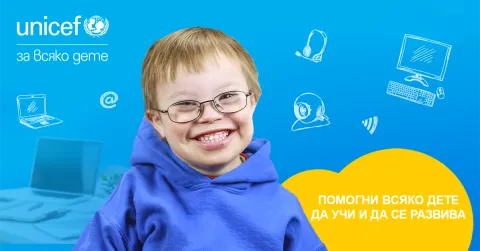
A Voice for Every Child
Non-verbal children have so much to say - help them express themselves

- Български
- English
Who are the non-verbal children?
Non-verbal children are children with disabilities or developmental difficulties for whom the verbal communication channel is limited and have communication difficulties. They are often out of school or unable to efficiently participate in the learning process. Non-verbal children have much to say if they are supported in expressing themselves. Therefore, aids for Assistive and Augmentative Communication (ACC) are needed. Teachers and specialists are making great efforts; however, they need additional support and training to use and implement these assistive technologies in work practice.
The situation in Bulgaria
According to the latest data of the Ministry of Education and Science, there are over 24,000 children with special educational needs in Bulgaria.
Nearly 15,000 children enrolled in our education system have multiple disabilities, with cerebral palsy, sensory difficulties, and autistic spectrum disorder - conditions in which verbal communication with others is difficult or limited.
For about 5,000 of the non-verbal children, assistive AAC is often the only opportunity for them to be heard, understood, and socialized.
The inclusion of children with special needs in kindergartens and schools, without tools to facilitate communication with others and without sufficient training and support for specialists and teachers, is ineffective and often even impossible. The introduction of AAC guarantees the right of non-verbal children to education as at the same time, it contributes to addressing the stigmatisation of such children in terms of their potential to participate in the educational process.
Assistive technologies for non-verbal children
The tools for augmentative and alternative communication support the functional communication of children, increasing their opportunities to be active participants in the educational process and to develop their full potential. These tools can be different - from low-tech tools such as books and symbol boards that support communication, to complex high-tech devices for speech synthesis and eye control.
The knowledge and skills of the teachers and the parents are key to the effective introduction of assistive technologies. In 2024, UNICEF Bulgaria conducted a second consecutive survey to track the level of competence in the field of AAC in Bulgaria and the use of assistive technologies in practice. The final data of the survey show that AAC tools are practically unknown and not used by specialists at a sufficiently good level. They rate their familiarity and frequency of use of DAC funds as very low.
• 44% of the specialists are not even familiar with the low-tech tools for AAC. High-tech AAC tools, on the other hand, give the greatest opportunities to children with complex communicative needs, however the specialists who use these types of assistive technologies in their practice are only 9%. This means that a large number of professionals do not have the necessary knowledge and skills to use these tools in their work with children or to train other people (e.g. their teachers and parents) to use them, as this requires good knowledge and practical experience with them.
• 48% of professionals rarely or never use AAC tools in the process of assessing children's individual education needs and including AAC tools in their support plans.
UNICEF solution
UNICEF aims to sustainably implement and use assistive technologies for augmentative and alternative communication in Bulgarian kindergartens and schools, so that all children can learn and communicate with their peers. ‘Voice for Every Child’ aims to enable children with disabilities to communicate easily through Augmentative and Alternative Communication tools such as Cboard.
Cboard application is an AAC tool that supports communication through symbols and text-to-speech. The Cboard application was created with the support of UNICEF and is the only free, high-tech tool adapted in Bulgarian.
Since 2021, the application supported the inclusion and learning of over 300 non-verbal children, and over 1,500 children were supported through their trained teachers, parents, and specialists.
In Bulgaria, Cboard is one of the most preferred AAC solutions by specialists and parents, with over 4,000 users in the country.
>> Download from here free application for assistive communication Cboard
>> Download from here manual for Cboard in Bulgarian language
Key achievements in the project "Voice for every child" 2021 – 2024
- 300 non-verbal children were directly supported, including through the provision of means of communication, and over 1,500 children were supported through their trained teachers, parents and specialists
- More than 1,000 parents, teachers and specialists have gone through training to improve their knowledge and skills for AAC. Communities for professional support of teachers and specialists working with children with educational and developmental difficulties were established in 13 regions of the country (Burgas, Vidin, Vratsa, Gabrovo, Montana, Pernik, Ruse, Sliven, Smolyan, Stara Zagora, Sofia, Targovishte, Yambol)
- In 2023, the first National team of trainers for AAC in Bulgaria was established. The team consists of 28 highly qualified specialists working with children with disabilities and developmental difficulties in schools, kindergartens, and centers across the country. The establishment of a National AAC team will significantly speed up the process of introducing AAC technologies into the inclusive education system for the benefit of children with complex communicative needs, as specialists are skilled to assess the needs, consult and train children with complex communicative needs, and also to consult and train colleagues and parents.
UNICEF has developed a set of AAC resources to support parents
To support parents, short video resources were created on using the Сboard communication application.
Handbook "First steps in AAC" for every parent, teacher or specialist who takes his first steps in AAC and wants to support the communication of a child with difficulties in functional communication through AAC tools.
Other useful AAC resources:
>> Catalogue "Assistive technologies for augmentative and alternative communication"
>> Global Symbols platform
>> AAC online training - designed for anyone who support very young children with severe speech and language difficulties, and who need to use other methods of communication such as signs and assistive technology. The training is divided into levels, organized to support basic, intermediate and more advanced knowledge and skills for the VET related to the European Qualifications Framework.
>> A set of "Typically Bulgarian symbols" - symbols uniquely developed for Bulgaria, with symbolic images of typically words related to Bulgaria, national traditions and cuisine, folklore and national holidays are presented. The set contains 347 typically Bulgarian symbols.
>> Boardbuilder – web application for creating communication boards and modifying existing symbols. Ready-made templates can be used to create communication boards or unique ones.
>> First research on competence and attitudes on AAC among specialists in the education system
Key partners
UNICEF implements the activities to support children with communication needs in cooperation with partners with key roles in terms of legislation, teacher training, direct work with children and advocacy:
- Ministry of education and science
- Regional Centers to Support the Process of Inclusive Education in the country
- Centers for Special Educational Support
- Foundation “ASSIST – Assistive technologies”