Protecting children amid overlapping crises in the Great Lakes appeal
Humanitarian Action for Children
UNICEF’s Humanitarian Action for Children appeal helps support the agency’s work as it provides conflict- and disaster-affected children with access to water, sanitation, nutrition, education, health and protection services. Return to main appeal page.
Great Lakes snapshot
Appeal highlights
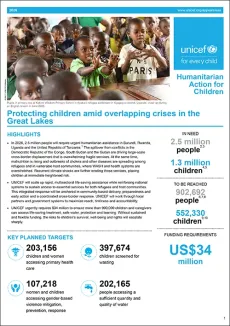
- In 2026, 2.5 million people will require urgent humanitarian assistance in Burundi, Rwanda, Uganda and the United Republic of Tanzania. The spillover from conflicts in the Democratic Republic of the Congo, South Sudan and the Sudan are driving large-scale cross-border displacement that is overwhelming fragile services. At the same time, malnutrition is rising and outbreaks of cholera and other diseases are spreading among refugees and in vulnerable host communities, where WASH and health systems are overstretched. Recurrent climate shocks are further eroding those services, placing children at immediate heightened risk.
- UNICEF will scale up rapid, multisectoral life-saving assistance while reinforcing national systems to sustain access to essential services for both refugees and host communities. This integrated response will be anchored in community-based delivery, preparedness and early action and a coordinated cross-border response. UNICEF will work through local partners and government systems to maximize reach, timeliness and accountability.
- UNICEF urgently requires US$34 million to ensure more than 900,000 children and caregivers can access life-saving treatment, safe water, protection and learning. Without sustained and flexible funding, the risks to children’s survival, well-being and rights will escalate sharply.
Key planned targets

203,156 children and women accessing primary health care

397,674 children screened for wasting

107,218 women and children accessing gender-based violence mitigation, prevention, response

202,165 people accessing a sufficient quantity and quality of water
Funding requirements for 2026
Country needs and strategy
Accordion
Across Burundi, Rwanda, Uganda and the United Republic of Tanzania, more than 2.5 million people, including 1.3 million children, require humanitarian assistance. Children in the Great Lakes subregion continue to experience the worst effects of a convergence of conflict-driven displacement, recurrent public health emergencies and intensifying climate pressures that are deepening humanitarian needs. The protracted conflict and upsurge of violence in eastern Democratic Republic of the Congo in 2025 is the primary driver of cross-border displacement, with more than 920,000 Congolese refugees hosted in the four countries. The crises in the Sudan and in South Sudan further compound needs in Uganda, which now hosts more than 1.9 million refugees, making it the largest refugee-hosting country in Africa and increasing pressure on essential services and systems.
Adolescent girls are at heightened risk of sexual violence and child marriage. Increasing numbers of children are being driven into harmful coping mechanisms, including child labour and recruitment by armed actors. Education is a critical protective factor, yet overcrowded classrooms, limited learning materials and inadequate WASH are shutting children out of safe learning spaces, leaving them more vulnerable to violence, exploitation and irreversible learning loss. Malnutrition is rising among new refugee children, reflecting deepening food insecurity and exhausted coping capacities.
Recurrent public health emergencies further compound the crisis. Cholera, measles, mpox and risks of viral haemorrhagic fevers (including Ebola virus disease and Marburg virus disease) are spreading across porous borders, as mobile populations settle in displacement sites where safe water, sanitation and surveillance systems remain weak. While capacities for outbreak detection and response are stronger because of investments in laboratory infrastructure, enhanced surveillance systems, capacity building and the deployment of novel vaccines and therapeutics, recent outbreaks of Ebola virus disease, Marburg virus disease and mpox have exposed critical gaps in early detection and rapid response. There is a need to further reinforce cross-border coordination and community-based surveillance and to further strengthen health systems.
Fragile and overstretched national systems continue to struggle to meet growing needs amid inflation and limited fiscal space. Across the subregion, countries face mounting pressure, with services for both refugees and host communities overstretched.
At the same time, climate shocks are accelerating displacement and eroding resilience. In Burundi, more than 90 per cent of internal displacement is now climate-induced, driven by floods, landslides and environmental degradation. Rwanda and the United Republic of Tanzania face recurrent cycles of drought and flooding that undermine livelihoods, while Uganda is experiencing climate-linked epidemics and crop failures in refugee-hosting districts. These climate pressures are further weakening already fragile coping mechanisms and deepening children’s vulnerability to hunger, disease and violence.
UNICEF’s humanitarian strategy in the Great Lakes subregion prioritizes immediate, life-saving support and protection for children and their caregivers, while strengthening preparedness and early action to respond to new displacement, epidemics and climate-related shocks. The strategy aligns with Regional Refugee Response Plans and national coordination frameworks; it focuses on those with the most severe and urgent needs and leverages UNICEF’s comparative advantage in child-centred humanitarian response. In line with the Humanitarian Reset, the strategy is focused and needs-driven. It prioritizes high-impact interventions that safeguard lives and dignity today while creating pathways toward durable, community-led solutions where conditions allow.
UNICEF will deliver integrated, multisectoral humanitarian assistance in the areas of health, nutrition, WASH, protection, education and social protection to preserve children's lives, safeguard their dignity and prevent further harm. Preparedness, early warning and early action are central to the approach, enabling rapid and flexible response to new displacements, disease outbreaks and floods or landslides. This includes pre-positioning supplies, strengthening community-based surveillance and referral systems and supporting shock-responsive mechanisms that help prevent crises from escalating.
UNICEF aims to create conditions for continuity and stability of essential services – so that children can keep learning, receive care and remain protected even during crisis. By working through and alongside local authorities, front-line workers, community structures and national systems, UNICEF will contribute to maintaining and reinforcing the services that children depend on, bridging emergency response and sustainable solutions where possible.
UNICEF’s decentralized field presence, strong operational footprint and long-standing partnership with line ministries, national and international NGOs, community-based organizations and other United Nations agencies will underpin implementation of programmes. These partnerships are well-established, trusted and consistently recognized for their effective coordination and complementarity. They are central to ensuring a coherent and dignified community-driven response while maintaining continuity of essential services even in volatile settings.
Across the response, UNICEF maintains a strong commitment to accountability to affected populations, protection from sexual exploitation and abuse, gender and disability inclusion and conflict-sensitive, child-centred programming. This ensures that humanitarian assistance remains principled and protective and paves the way for longer-term recovery and resilience under a broader nexus approach.
Programme targets
Find out more about UNICEF's work
Highlights
Humanitarian Action is at the core of UNICEF’s mandate to realize the rights of every child. This edition of Humanitarian Action for Children – UNICEF’s annual humanitarian fundraising appeal – describes the ongoing crises affecting children in the Great Lakes region; the strategies that we are using to respond to these situations; and the donor support that is essential in this response.