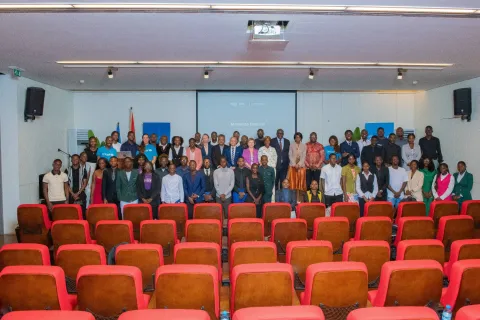
Before, I hardly spoke to anyone.
The transformation of a young person through the Minha Kamba program.

- Portuguese
- English
For a long time, he was known as the quietest young man in the group. Reserved, shy and almost always silent, he spent his days between school and home without sharing much about what he felt or thought. Talking to classmates, asking questions in class or expressing his ideas was something he avoided. For many, he was simply "the quiet boy".
This is the story of 19-year-old Graciano Tandela, one of the beneficiaries of the Minha Kamba program residing in the province of Icole Bengo, Municipality of Calumbo (Zango - Boa Esperança neighborhood).
But everything began to change when he started participating in the Minha Kamba program, a training initiative aimed at youth, which addresses topics such as positive masculinity, respect, sexuality and social responsibility.
"Since I started on the Minha kamba program, so much has changed in me," she says.
Minha Kamba, which is funded by the Finnish Committee for UNICEF and supported by partnerships with the Ministry of Social Action, Family and Women's Promotion (MASFAMU) and civil society, which works to prevent teenage pregnancy through knowledge about sexual and reproductive health and rights in Angola.
The change began within him. Gradually, the young man who previously avoided speaking began to feel more confident to express his ideas, share feelings and dialogue with others. Today he says he has learned something that once seemed difficult: opening up to people and learning to listen.
This transformation was not only in his personal life. At school, teachers also began to notice the difference. Before, he almost never participated in classes. Now he asks questions, gets more involved in discussions and tries to understand the content better.

At home, the change was also felt. The dialogue with his parents became more open and family life became closer. According to him, his family members recognize that his participation in the program brought clear benefits to his training and growth.
One of the most striking learnings was understanding how to support adolescents who face difficult situations, such as early pregnancy. Instead of judgment or withdrawal, he learned that the most important thing is to welcome, talk and help these young women to remain calm and find ways to move forward.
Training in positive masculinity has also transformed the way he understands what it means to be a man.
For him, being a man is not about demonstrating superiority or strength over others, but rather acting with respect, responsibility, and empathy. It means collaborating with family, supporting friends, and contributing to the well-being of the community.
"Being a man is also knowing how to help, respect and be present to solve problems in a positive way," he says.
Today, he already participates in community activities, talking to teenagers and girls about sexuality, respect and healthy relationships.
With the knowledge acquired in training, she also hopes to work more and more with boys, helping them to develop a healthier and more responsible view of masculinity.
For the young people in his community, he leaves a simple but profound appeal: that they learn to treat girls and adolescents with more respect, affection and empathy, and that they are willing to help those who face difficult times.
Because, as he himself has learned along this journey, a change in attitude can transform not only a person's life, but also an entire community.