Training Midwives to Improve Maternal Health Outcomes in Remote Areas
Train midwives at the Higher Institute of Health Sciences in Ibb Governorate
- English
- العربية
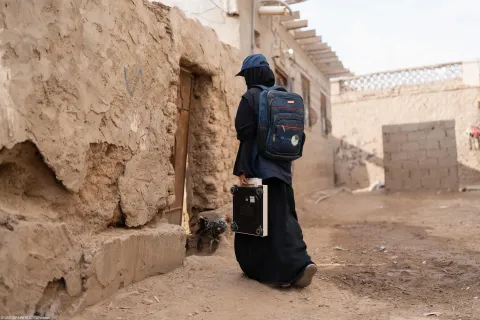
In remote villages of Yemen, the absence of midwives and health centres has resulted in traditional midwives delivering babies without sterilization or proper knowledge of prenatal care. To address this issue, UNICEF, with support from the European Union, initiated a project to train midwives at the Higher Institute of Health Sciences in Ibb Governorate.
The project aimed to provide midwives with the necessary training, knowledge, and skills to ensure that pregnant women receive adequate care, follow-up, and awareness. The three-year project focused on improving access to healthcare in remote villages, enabling midwives to provide vital services to remote villages and improve their own financial situation.
A humanitarian profession

Wafa’a Mohammad Al-Salmi, head of the midwifery department, has worked at the Institute since 2001.
"We have students from Ibb Governorate and twenty students from Taizz Governorate, which suffers from a severe shortage of midwives,” she explains. “We train the students to graduate as midwives, or trainers, who will be deployed to hospitals and health centres."

Recalling a situation soon after her graduation, she says, “I was called to help deliver our neighbor’s baby. Her condition was difficult, and the fetus was breech. I was able to help her to give birth naturally.”
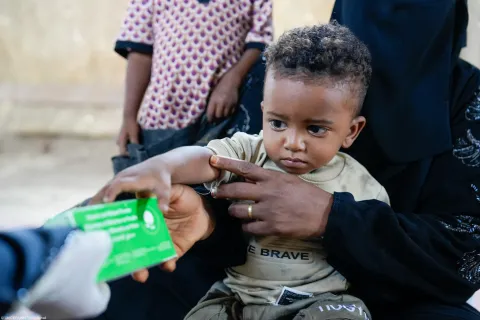
Wafa’a sees benefits to both her students and their communities. “The midwifery profession is financially feasible, and most organizations employ female students, especially in villages. Most of our trainees are from remote areas. The organizations provide financial support and provide them with well-equipped clinics to provide obstetrics, care for pregnant women, family planning services, and vaccination.”

Students face difficulties, including a lack of essential equipment and the small size of the midwifery laboratory. The program runs for three years and awards a technical diploma in midwifery. Students begin by learning basic nursing skills, followed by specific midwifery training, including obstetrics, antenatal and child care, and family planning.
A community service
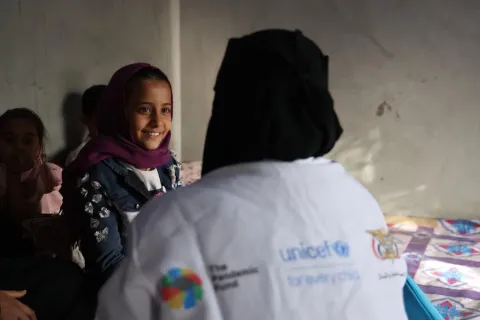
Arwa Zaid Yahya Ali, 22, enrolled in midwifery because she lived in a remote area without health care.

UNICEF/UNI476413/Al-Kamali
“Although I specialized in midwifery, I learned how to treat patients, deal with accidents and bleeding, install urinary catheters, treat malnutrition, and provide supplementary nutrition for pregnant women.”
“People may not accept me because I am new, but I will gain their trust, benefit financially, and provide service to anyone in need.”
A lifetime opportunity

Asma’a Muqbil Sallam, from Taiz Governorate, joined because her area lacked midwives.
“UNICEF gave us this opportunity. Being a midwife means providing service to my region. I have gained experience and a profession that I will benefit from.”
Lifesaving

Asala Abdul Rahman Al-Bahairi, 22, decided to study midwifery to help mothers in her village.
She says, “I will open a clinic in my village. This diploma will help me financially change my life for the best.”
Vital skills

Najwa Muhammad Dahan, 20, comes from Taizz Governorate. “In our village, midwives traditionally deliver babies, often without sterilization. During our training, we were taught how to use needles, provide first aid, treat shock and bleeding, and examine anemia, glands, breasts, abdomen, and varicose veins in the legs. We will also get prepared for child delivery in the second term.”
Job opportunities

UNICEF/UNI476407/Al-Kamali
Khalid Mohammad Hashem Ba Alawi has taught general and therapeutic nutrition at the Institute since 1998.
“We teach general and therapeutic nutrition in the midwifery department according to the curriculum prescribed by the Ministry of Health and the Higher Institute of Health Sciences, in addition to the curriculum approved by UNICEF, and we implement a practical application for the midwives so that they can work during field visits.”

UNICEF/UNI476409/Al-Kamali
He says the programme is also leading to practical benefit. "Our female graduates found job opportunities with highly rewarding salaries."
Khalid faces difficulties, including a lack of updated references and tools necessary for training. Nevertheless, he is committed to his task. “The trainer must be qualified to convey his information correctly and be informed of the annual updates in the program. I send a message to the midwives to pass on what they have learned to the community.”