Learning Pathways Rescue Children from Labour
This UNICEF & Japan supported programme aims to improve learning outcomes for in-&-out of school children through provision of sustained education services in Taiz
- English
- العربية
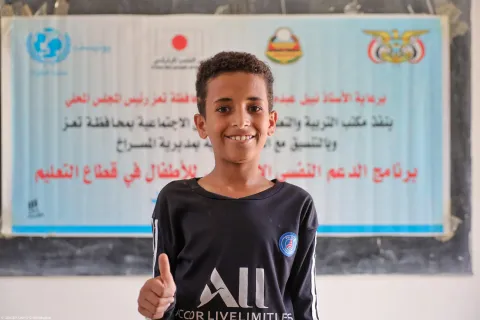
On a narrow street in Taiz, where the sounds of daily survival often drown out childhood dreams, 14-year-old Abdulrahman once spent his days working to support his family.
“I was out of school for four years, during which I worked selling eggs, ice cream, and vegetables to support my family”,
said Abdulrahman. During that time, school had become a distant memory—a chapter he thought was closed forever.

Abdulrahman dropped out of school four years ago, when he was still in the fifth grade. Like 3.2 million children in Yemen, Abdulrahman was out of school. His story is similar to many children where they are forced into work at a young age. Abdulrahman’s family needed help with daily expenses, and education became an unaffordable luxury. Yet today, Abdulrahman is back in a classroom—this time, surrounded by peers of different ages, all bound by a shared second chance.
His story is one of many shaped by a collaborative effort between UNICEF and the Government of Japan, aimed at rescuing children from child labour by restoring their right to learn.
“When I grow up, I would like to become a programmer or a doctor,”
he says quietly, his eyes steady with determination.
Child Labour in Yemen
Child labor remains a significant challenge in Yemen with 12.5% of children aged 5–14 are engaged in child labor, a figure that rises sharply to 15.4% in rural areas, highlighting deep geographic disparities[1]. These findings, produced by Yemen’s Central Statistical Organization in collaboration with UNICEF, underscore how poverty, limited access to education, and ongoing conflict continue to push children—especially in rural communities—into work, often at the expense of their schooling and well-being. The higher prevalence in rural areas reflects greater economic vulnerability and fewer educational opportunities, reinforcing a cycle in which children are more likely to enter labor early and remain excluded from formal education.
Rebuilding Pathways to Education
In Taiz, the UNICEF-Japan programme is aimed at improving learning outcomes for both in-school and out-of-school children through a comprehensive education strategy built on four pillars, where 947 children were reached through social and behavioral change activities (SBC) to promote right-age school enrollment, 6,000 at-risk students were supported with interventions to prevent dropout, and 1,669 out-of-school children were engaged through alternative and remedial learning pathways.
Additionally, 290 teachers were trained and equipped with essential skills in early grade reading and numeracy, strengthening overall education quality and support systems. The programme also included a child protection component, where psychosocial support and case management of providing child protection services were provided.
Through this multi-layered approach, children who had fallen through the cracks are gradually being welcomed back into learning environments—structured, supportive, and hopeful.
From Labour to Learning
For Abdulrahman, joining an accelerated learning programme marked a turning point. Despite the age gap between him and some of his classmates, he showed unwavering commitment.
“He proved his seriousness about learning, consistently attending school daily and excelling academically,” says his teacher Jehad Abdulhaq. “He is acquiring reading and maths skills at a remarkable pace.”
Across the city, other children share similar journeys.
Abdullah, 11, recalls the difficult decision to leave school behind:
“I was attending school, but I had to drop out for a year because my father could not afford to buy me the school basics like a school bag, notebooks, and pens.”

UNICEF/UN0867100/Mohammed
Abdullah, 11, reads during a class in his school, Taiz, Yemen, April 2026. Abdullah dropped out of school for one year. Today he was enrolled in the UNICEF programme and he is officially back to learning.
For many families, the choice is not between school and work—it is between survival and education.
Children deserve support
Fatima, just eight years old, represents a different kind of resilience. Growing up in a household with no source of income, she faced overwhelming barriers. For a long time, reading and writing were beyond her reach.
Through the UNICEF supported remedial classes, Fatima learned to read and write—skills that are opening doors she never imagined possible.

“She is an outstanding student,” her teacher Kawkab says proudly.
Her story reflects a broader truth echoed by many children in the programme:
“Through the remedial classes, I learned how to read and write. I dream of becoming a doctor,”
said Fatima with a shy smile.
“I realized that every child needs a helping hand, encouragement and support to keep going,” said the teacher.
A Shared Commitment
Thanks to the support from the government of Japan, this UNICEF programme is doing more than improving education—it is restoring dignity, hope, and opportunity. By addressing both immediate barriers and systemic challenges, it helps children transition away from labour and back into learning.
The impact extends beyond individual lives. Communities begin to see education not as an unreachable ideal, but as a tangible path forward.
A Future Reimagined
As the world marks the Day Against Child Labour on June 12, the stories of children like Abdulrahman and Abdullah serve as powerful reminders: behind every child labour statistic is a dream deferred—but not lost.
With the right support, these dreams can be reclaimed.
[1] Multiple Indicator Cluster Survey (MICS) 2022–2023