Clean Water projects in Al-Makha bring back life and hope to families
Helping the most vulnerable children and families in Al-Makha

- English
- العربية
The needs for people in Al-Makha, Taiz, Yemen, are considered extreme in the severity scale for water and sanitation needs[1]in Yemen. The ongoing conflict, natural disasters, food insecurity and epidemic outbreaks made at least 15.2 million people (including 4.1 million girls and 4.3 million boys[2]) are in urgent need of water and sanitation services.

“The children suffered most because they had to carry water for a distance of one kilometer or more, sometimes... it took them the whole day, from morning until evening.”
This was not just a physical hardship. It is just another brick on the wall that separates the whole country from its bright future.
Haiel Mohammed remembers a time when the situation was desperate: “We were suffering from a water shortage to the point that we couldn't find drinking water”.
Impact on children’s education
Like many parents, Abdullah Ali, a 30-year-old father of four, understands the direct impact of the water crisis on education: “Children were late for school because they had to fetch for water and travel long distances. The well was three hours away from the house.”
Another resident from Al-Makha, Qasim Iesa, a 57-year-old teacher said: “We suffered a lot to get water, as we would walk for three-four hours to get just 50 liters of water.
With a family of eight depending on him, providing water was not an easy thing to do. “Obtaining water was difficult for our children and us, especially in this very windy and hot weather”.

More than a Glass of Water
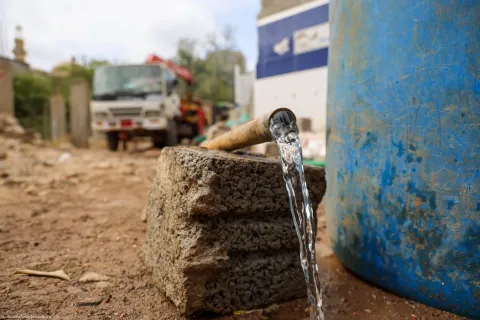
To help the most vulnerable children and families in Al-Makha, UNICEF with support from UNOCHA’s Central Emergency Response Fund (CERF), built a sustainable, modern water infrastructure in five locations: three in rural areas: Dar Al-Shuja, Al-Kadiha and Al-Mashqar, and two in urban areas: Al-Gaidiaa and Al-Mughini.
The projects were completed by December 2025. They combine high-capacity water storage with renewable energy use and supply. The projects also included the installation of integrated solar power systems for sustainable pump operation, construction of new water networks with a substantial combined total length of 56 kilometers, the construction of two tower tanks and rehabilitation of concrete water tanks, each with a capacity of 60 cubic meters. The five projects are serving 18,150 people of vulnerable families, replacing hours of grueling labor with the simple turn of a tap.
Engineer Yasser Saeed, a consultant for the water projects, explains the scale of the work: “The project consists of a solar-powered pumping unit consisting of 41,600 watts, with 60 solar panels, and a distribution network consisting of 25,000 linear meters”.

The heart of the system is a 12-meter tower tank capable of holding 60,000 liters of water. “It has a network of pipes to deliver water to homes, and it has water meters,” notes the engineer. He speaks about Dar Al-Shujaa where the interview took place with him that “over 300 homes in Dar Al-Shuja village now have access to safe and clean water”. A luxury, so many people take for granted worldwide".

It is more than just the ability to drink a glass of water whenever needed. Before the project, the water available to these people was often a source of disease, an additional strain on the already struggling healthcare system in the region.

“Some children were suffering from diarrhea due to water contamination, but now the water is clean, and the situation is fine,” explains Abdullah Ali. “We used to suffer from water pollution with dust and from serious illnesses, but now the situation is safe”.
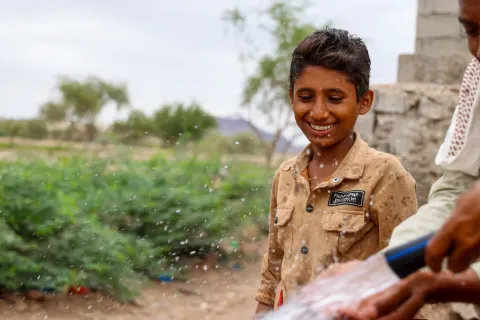
The WASH project affected the lives of local children, who can finally go back to their schools instead of spending their days walking kilometers under the sun.
“The water has reached the houses... and the children can simply take the bottle and fill it from the water meter,” adds Haiel Mohammed, explaining how greatly families’ lives changed thanks to the UNCEF efforts.

UNICEF/UNI926156/Al-Zeiadi
Haiel Mohammed with his five children joined by children in the neighborhood near by the Dar Al-Shuja WASH project, Al-Makha, Yemen, January 2026.
The long walks are finally over
The sound of water flowing through pipes in Al-Makha is a testament to the power of partnership. Such projects are the ultimate acts of restoration that bring hope to families that lost everything to war and political crisis.
For the families of Al-Makha, the "long walk" is finally over. And for UNICEF and its partners, the journey continues. Destination is a future where children can be students, parents can be providers, and everyone in Yemen lives in the safety of their homes, where clean water is a right, not a luxury.