Nearly a quarter of a billion children’s schooling was disrupted by climate crises in 2024 – UNICEF
Education affected by heatwaves, cyclones, floods and storms
- English
- Tiếng Việt
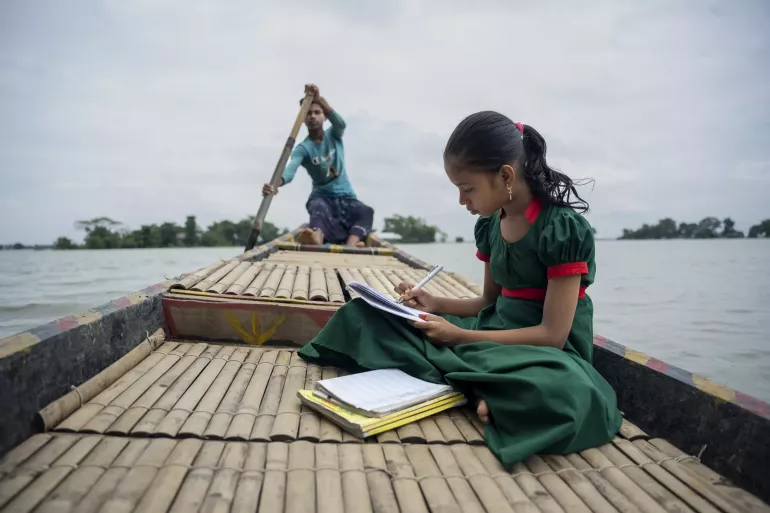
NEW YORK/HANOI, 24 January 2025 – At least 242 million students in 85 countries had their schooling disrupted by extreme climate events in 2024, including heatwaves, tropical cyclones, storms, floods, and droughts, exacerbating an existing learning crisis, according to a new UNICEF analysis released today.
For the first time, Learning Interrupted: Global Snapshot of Climate-Related School Disruptions in 2024 – released on International Day of Education – examines climate hazards that resulted in either school closures or the significant interruption of school timetables, and the subsequent impact on children from pre-primary to upper secondary level.
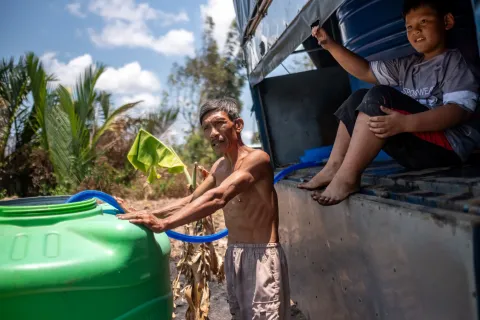
Heatwaves were the predominant climate hazard shuttering schools last year, with over 118 million students affected in April alone, according to the data. Bangladesh and the Philippines experienced widespread school closures in April, while Cambodia shortened the school day by two hours. In May, temperatures spiked to 47 degrees Centigrade/116 degrees Fahrenheit in parts of South Asia, placing children at risk of heat stroke.
“Children are more vulnerable to the impacts of weather-related crises, including stronger and more frequent heatwaves, storms, droughts and flooding,” said UNICEF Executive Director Catherine Russell. “Children’s bodies are uniquely vulnerable. They heat up faster, they sweat less efficiently, and cool down more slowly than adults. Children cannot concentrate in classrooms that offer no respite from sweltering heat, and they cannot get to school if the path is flooded, or if schools are washed away. Last year, severe weather kept one in seven students out of class, threatening their health and safety, and impacting their long-term education.”
Some countries experienced multiple climate hazards. For example, in Afghanistan, in addition to heatwaves, the country experienced severe flash floods that damaged or destroyed over 110 schools in May, disrupting education for thousands of students.
Meanwhile, the most frequent climate-induced disruptions occurred in September - the start of the school year in many parts of the world. At least 16 countries suspended classes at this critical academic point due to extreme weather events, including Typhoon Yagi, which impacted 16 million children in East Asia and the Pacific. In Viet Nam, a total of 2,210 schools were affected, with eight schools completely destroyed or heavily damaged, and1,866 schools partially damaged.
According to the analysis, South Asia was the most affected region with 128 million students facing climate-related school disruptions last year, while in East Asia and the Pacific, 50 million students’ schooling was affected. El Niño continued to have a devastating impact on Africa, with frequent heavy rainfall and floods in East Africa, and severe drought in parts of Southern Africa.
Rising temperatures, storms, floods, and other climate hazards can damage school infrastructure and supplies, hamper routes to school, lead to unsafe learning conditions, and impact students’ concentration, memory, and mental and physical health.
In fragile contexts, prolonged school closures make it less likely for students to return to the classroom and place them at heightened risk of child marriage and child labour. Evidence shows that girls are often disproportionately affected, facing increased risks of dropping out of school and gender-based violence during and after disasters.
Globally, education systems were already failing millions of children. A lack of trained teachers, overcrowded classrooms, and differences in the quality of – and access to – education have long been creating a learning crisis that climate hazards are exacerbating.
The analysis shows almost 74 per cent of affected students last year were in low and lower-middle income countries, but no region was spared. Torrential rains and floods hit Italy in September, disrupting schooling for over 900,000 students as well as Spain in October, halting classes for 13,000 children.
The report notes that schools and education systems are largely ill-equipped to protect students from these impacts, as climate-centered finance investments in education remain strikingly low, and global data on school disruptions due to climate hazards is limited.
UNICEF works with governments and partners to support the modification and construction of climate-resilient classrooms to protect children from severe weather. In Viet Nam, children are being impacted by droughts, floods and storms, with the country hit by Typhoon Yagi in September 2024. In response, UNICEF provided learning supplies to more than 22,200 affected children and is working with the Government of Viet Nam and partners to strengthen climate-smart education, as well as enhance resilience in school and communities.
In November, UNICEF warned in its State of the World’s Children report that climate crises are expected to become more widespread between 2050 - 2059, with eight times as many children exposed to extreme heatwaves, and three times as many exposed to extreme river floods, compared to the 2000s.
UNICEF is calling on world leaders and the private sector to act urgently to protect children from increasing climate impacts by:
- Ensuring national climate plans – including Nationally Determined Contributions and National Adaptation Plans – strengthen child-critical social services, such as education, to be more climate smart and disaster resilient, and contain adequate emission reduction pledges to prevent the worst impacts of climate change.
- Investing in disaster resilient and climate-smart learning facilities for safer learning.
- Accelerating financing to improve climate resiliency in the education sector, including investing in proven and promising solutions.
- Explicitly integrating climate change education and child-responsive commitments across the board.
“Education is one of the services most frequently disrupted due to climate hazards. Yet it is often overlooked in policy discussions, despite its role in preparing children for climate adaptation,” said Russell. “Children’s futures must be at the forefront of all climate related plans and actions.”
#####
Notes to editors:
Download multimedia content.
Estimates in the report are conservative due to data limitations including under-reporting.
Link to State of the World’s Children Report 2024.
NEW: Subscribe to UNICEF’s global media updates on WhatsApp.
For further information, please contact:
Nadia Samie-Jacobs, UNICEF, New York, +1 845 760 2615, [email protected]
Raquel Fernandez, UNICEF, Viet Nam, +84 985 499 748, [email protected]
Media contacts
About UNICEF
UNICEF promotes the rights and well-being of every child, in everything we do. Together with our partners, we work in 190 countries and territories to translate that commitment into practical action, focusing special effort on reaching the most vulnerable and excluded children, to the benefit of all children, everywhere. For more information about UNICEF and its work for children, visit https://www.unicef.org/vietnam
Follow UNICEF on Facebook, Instagram, X, Youtube, LinkedIn and TikTok