The blue shirt: Naibelis’s dream after the earthquake in Venezuela
The earthquake damaged her home and affected the secondary school where she hoped to begin her first year. Now living with her family in a temporary camp in La Guaira, 12-year-old Naibelis remains clear about her next goal: to keep studying.
- Español
- English
The dream of the blue shirt
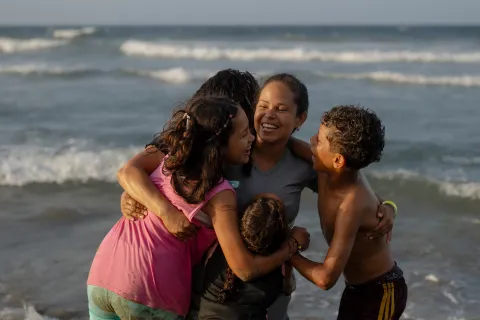
LA GUAIRA, VENEZUELA — The brush passes again and again through her sister Franyelis’s hair. Naibelis, 12, separates a strand, gathers it and adjusts a ribbon.
“I play with my sister. She’s my best friend. I love her so much. I love helping her and doing her hair,” she says of nine-year-old Franyelis.
Now she does this in the temporary camp set up at César Nieves baseball stadium, where she has been living with her family since the earthquake on 24 June. As she does her sister’s hair, Naibelis also thinks about school and a blue shirt she still does not know when she will be able to wear for the first time.
“I play with my sister. She’s my best friend. I love her so much. I love helping her and doing her hair,” she says of nine-year-old Franyelis.
“I dream of having my blue shirt,” she wrote during an activity at the UNICEF-supported child-friendly space. In her letter, she put into words several of the dreams she hopes to fulfil.
In Venezuela, the school uniform changes from white to blue when students leave primary school and begin secondary education. For Naibelis, that shirt represents an educational milestone she has earned through her own efforts.

Naibelis completed sixth grade shortly before the earthquake. She did not have the graduation ceremony her family had hoped for, but she did take part in a get-together and the traditional signing of classmates’ shirts. The person preparing the certificates, medals and other materials for the ceremony lost his home and everything he had already prepared.
“I wanted to see her graduate, but I couldn’t. She couldn’t receive her medal or her certificate,” recalls her mother, Nayibi.

The uncertainty continued. Naibelis had hoped to begin her first year of secondary school where her older sister had studied, but the building was affected by the earthquake. “I was going to study, but the building collapsed and I couldn’t study there. We’ll see where my mum enrols me,” she explains.
When the earth changed her routine
When the ground began to move, Naibelis was at her grandmother’s house with a friend and her sisters. They were waiting for a phone to charge so they could watch a film. Her older sister showed her an alert, and at that moment the shaking began.
“I started screaming. I was scared,” she recalls.
Her aunt helped them get out to the stairs. “I was frightened because I thought the house was going to fall on us.”
The floor and several walls cracked; in the bathroom, a falling block broke the washbasin. Afterwards, the family spent a few days at her aunt’s small house, sleeping outside on mattresses. About four or five days after the earthquake, they moved to César Nieves baseball stadium.
At the stadium, which has been turned into a temporary camp, Naibelis lives with her mother, her two sisters and other relatives. She sleeps with her mother and younger sister on a mattress on the floor of a tent.
Outside, the family has set up a small stove on a stand made from wooden planks. “The stove goes on top, and we keep the food underneath,” she explains. She, her mother and her aunt take turns cooking.
Before, her mornings began at five. She would do her own hair, help Franyelis get ready, find their uniforms and prepare to go to school. In the tent, she says, she gets up around six or seven, helps her mother with household chores.
What she misses most cannot be captured in a timetable: “I used to spend time with my classmates and talk to them. Now they’re not here for me to talk to.”

The earthquake struck during the final weeks of the school year, and classes were suspended because of its magnitude. La Guaira is the state with the greatest damage to school infrastructure, explains Ana Montesdeoca, Education Officer at UNICEF Venezuela. Some children and adolescents may not be able to return to their schools immediately because the buildings were destroyed or structurally weakened.
A place to keep learning
While she waits to find out whether her school will reopen or whether she will need to enrol in another secondary school, Naibelis has found a place in the camp where she can learn, play and spend time with others: the UNICEF-supported child-friendly space. There, she paints, plays volleyball, receives guidance and takes part in educational activities with other children and adolescents.
But she does more than take part. She also helps the activity facilitators and supports the younger children. “I help the children here learn new things and help them paint,” she says.

Naibelis talks about becoming a doctor—a dream she links to her grandmother’s work in health care—and learning to do manicures, like her mother. At the child-friendly space, she has added another possibility: becoming an activity facilitator. “I’d like to be an activity facilitator. I love it because I help the children here,” she says.
In emergencies, UNICEF helps keep children learning by providing materials, training teachers, offering semi-structured activities and, when schools are lost, setting up temporary learning centres. It also supports national and local authorities in preparing for the return to school. In Venezuela, financial support from the Government of the Republic of Korea contributes to these efforts, helping children access safe, protective learning environments and supporting their psychosocial recovery and well-being.

“Beyond the infrastructure, school is that dialogue with your teacher,” says Montesdeoca. “Education saves lives, but it also transforms us.”
Nayibi knows the impact a prolonged interruption can have. She completed secondary school after becoming a mother and remembers the educational difficulties her daughters faced during the pandemic. “Yes, I’m afraid she won’t be able to study,” she admits. At the same time, she imagines Naibelis’s first morning at secondary school: “I’m excited for that day to come, when she goes to secondary school.”

Naibelis still does not know where she will start classes, but she speaks about that future with confidence. “I know I’m going to study at a secondary school I love, meet lots of classmates and learn lots of things I enjoy,” she says. For her, studying is what enables her to “move forward and keep pursuing your goals”.

For now, the blue shirt is a wish in her letter. Reading it aloud, Naibelis returns to her opening words and adds two more wishes: to learn new things and help her teachers. The secondary school where she will begin classes is still uncertain. Her determination to keep learning is not.