Anita overcame malnutrition with UNICEF's help and today continues to receive comprehensive support
The intervention of UNICEF and its implementing partners helped Anita regain her health and today she continues to receive support through education and protection programs.

- Español
- English
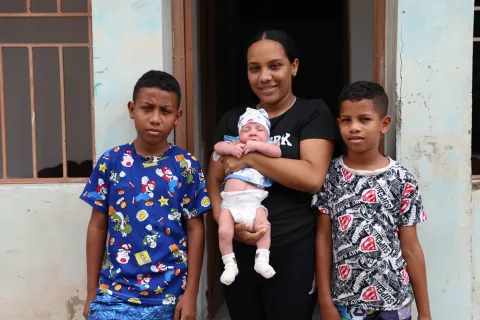
Anita lives in the Etnia Guajira sector, a Wayuu settlement near the city of Maracaibo, Zulia state, Venezuela. She smiles, plays, and attends school regularly. But four years ago, her situation was very different: she was affected by acute malnutrition and her relatives feared she would not survive. The intervention of UNICEF and its implementing partners helped her regain her health and today she continues to receive support through education and protection programmes.

In these difficult conditions, she was identified by Maribel Fernández, community promoter of UNICEF's implementing partner, Center for the Integral Promotion of Children, so she was referred to receive care in a nutritional recovery program. Jeanette Makenga, director of CEPIN, described her condition as follows: "When we saw the girl we took her to the doctor: four years old, six kilos, she was skin on the bone."

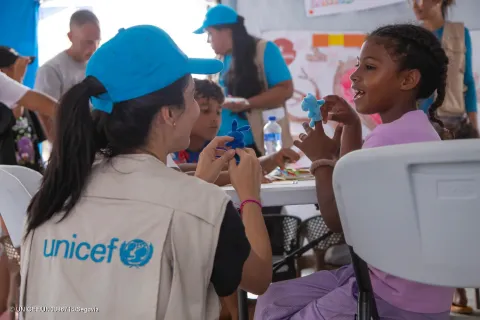
At CEPIN, she was provided with nutritional supplements and multivitamins, in addition to daily follow-up by community promoters to check her progress. In a month, Anita had managed to gain 800 grams, she began to sit down and take her first steps. Healthcare helped her to overcome satisfactorily and in a short time she was showing vivacity and energy.
However, other vulnerabilities cast a shadow over Anita's development possibilities. The Etnia Guajira community is built in a very precarious environment, where children and adolescents must face other risks such as lacking identity documents due to not having access to the civil birth registry, difficulties in receiving health services, being out of school and being exposed to violence.
For Anita, these risks were even greater because her mother left the community when she was just a baby and left her in the care of her aunt Olga González. "She told me: ‘You take care of her for a while because I come in the afternoon’. And she never returned. Then a neighbor told me that she had left on a bus that was going to Colombia," says González, about the day she was left in Anita's care.
With the intermediation of CEPIN and the Child Protection services supported by UNICEF, Anita's identity documents were issued, an action that has also benefited another 1,800 children and adolescents from this community.

"Anita is already legally my daughter, and I take great care of her. I want her to study," says González, who has had Anita under her care for 5 years.
More than 10,000 people from this community and others near to it, thanks to training and awareness-raising, have been able to increase their knowledge of protection issues and have managed to appropriate new attitudes and practices related to responsibilities towards children and adolescents.
The holistic approach with which UNICEF and its implementing partners have approached the problems of this community has also made it possible to provide more favourable conditions for Anita's development. Currently, she studies at the Escuela San Juan, an institution attended by 1,200 children and adolescents, which has been prioritized to receive other UNICEF interventions, such as WASH rehabilitation, as well as the implementation of learning recovery programs.
"I like school, and I also like playing," says Anita, in short words between Wayuunaiki and a little Spanish.

"Today Anita is studying, she is in first grade, which shows us that barriers can be broken down, when there is awareness, when she is trained, when it is taught that things can improve," says Fernández.