“I would like to go to school because I want to learn more”
Ángel, 13, attends a UNICEF-supported Temporary Learning Space in Delta Amacuro, where he is acquiring the knowledge and skills to reintegrate into the school system.

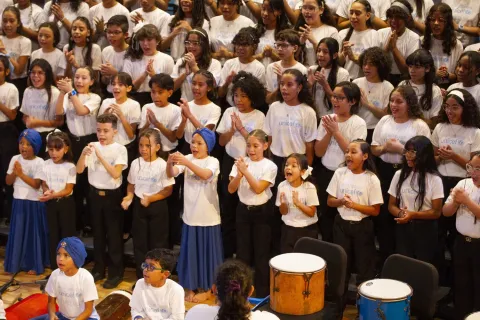
A group of children of various ages smiles and chats while learning the basics of reading, writing, and mathematics in a Temporary Learning Space supported by UNICEF, which operates in a community built on palafitos, typical structures of the Warao indigenous group that rise above the waters of the mighty Orinoco River, in the municipality of Pedernales, Delta Amacuro state.
Among them is Ángel, 13, who divides his attention between what the facilitators are explaining and one of the books provided at the center. “I would like to go to school because I want to learn more,” he says seriously. “I learned the alphabet, addition, and multiplication,” he lists when asked to talk about his achievements as a student.
Temporary Learning Spaces aim to support children and adolescents in consolidating their knowledge so they can return to school, while also strengthening their socio-emotional skills to promote reintegration into formal education.
"In this municipality, there is a significant group of children who are out of school, who have either dropped out or have not had the opportunity to begin," explains Mariella Adrián, Education Officer for UNICEF Venezuela. "The majority are children from the Warao community and are beginning a literacy process, working with facilitators who are also from the community."
This Temporary Learning Space has been operating in this community, which is characterized by having access only by river, for more than four months, offering daily support with teachings adapted to the Warao language and culture.
“This space has been significant, and I believe it should continue,” says Neyibel Rivas, a facilitator of the learning recovery for the children who attend the center. The idea, she adds, is that "they enter a school and those who have been left out enter as well, so that no one is left behind."
In 2024, UNICEF supported over 4,000 children and adolescents with temporary learning spaces, of whom more than 2,000 subsequently returned to school. So far, in 2025, 966 children have received care at this type of center.
Maigualida Quiroz, aidamo, a Warao word for a community leader, highlights the positive impact the initiative has had, especially for the most vulnerable children who have never attended school, either due to a lack of identity papers or because they come from families who have also been out of school.
“I want to become something, I don't know, a doctor, something like that,” Ángel explains when asked to talk about his dreams for the future.