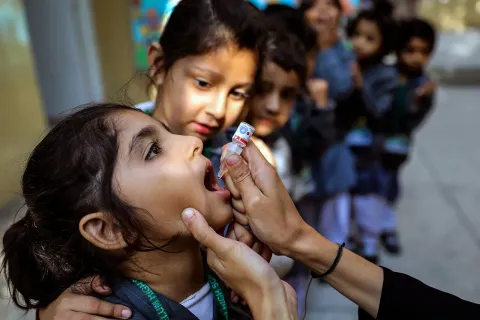
Switching from ten-dose to five-dose vials may equal more children vaccinated from measles
How a simple yet impactful packaging choice can protect more children from a deadly and debilitating disease and reduce wastage.

Measles is a deadly and a highly contagious virus, and it can cause great damage on unvaccinated children. Measles-containing vaccines protect children for life, and they have saved nearly 100 million lives in the past 50 years. The more children who are vaccinated, the more lives are saved.
One simple way to improve measles vaccine coverage is to switch from ten-dose to five-dose vials. A ten-dose vial contains ten doses of vaccine. Once opened, it must be used within six hours and cannot be saved for later use.
So, if only three children show up for the measles vaccination, the health worker has to open the ten-dose vial to use the three doses necessary for those children. The other seven doses have to be discarded if no more children can be vaccinated within six hours.
Avoiding missed opportunities
Especially when stock is limited, health workers sometimes ask themselves if it is worth opening a vial to vaccinate only one or two children and waste the remaining doses if no other children turn up for vaccination.
Parents who bring children for vaccination can then be told to return later to avoid vaccine wastage or stockouts. Unfortunately, many never come back, and children risk being missed out.
Lowering the number of doses in a vial is aimed at encouraging health workers to open vials more frequently. A study in Zambia in 2018 found that health workers were more willing to open a five-dose vial. Districts using the five-dose vial saw a 3.5 per cent increase in the number of children who were fully vaccinated as well as reduced vaccine wastage.
Fortunately, UNICEF provides five-dose vials that can help solve this problem. Just as the ten-dose vials, they are pre-qualified by WHO and are offered as measles vaccine only, or as a combined vaccine against measles and rubella or measles, mumps, and rubella.
Switching to five-dose vials can have several advantages such as:
- They lower health workers’ hesitancy to open a vial in certain contexts, leading to an increase in vaccination coverage.
- It is cost-effective because reduced wastage helps offset the higher price of five-dose vials, and the impact on cold chain requirement.
Over the past two years, UNICEF and partners have supported countries to assess the benefits of the five-dose vial in their specific contexts, and multiple countries have decided for the switch.