One Shot, Two Vaccines: Protecting Guinea-Bissau's Children Through Immunization
Vaccination campaign against Measles and Rubella is reaching every child in Guinea-Bissau thanks to mass social mobilization in 10 days

- English
- Portuguese
“Mothers, don’t let your children fall sick. Vaccinate them”, says Salimatu Mara. The 51-year-old mother delivers a heartfelt speech during the launch of the national vaccination campaign against measles and rubella, sharing an important message to all parents.
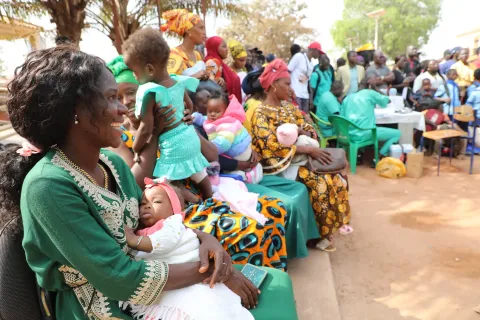
The Measles and Rubella vaccination campaign launch was a vibrant celebration in the Hafia neighborhood of Bissau, the capital of Guinea-Bissau. The event leveraged music, dancing, and theater performances to promote vaccines uptake, to draw children from nearby schools and communities to participate, and to immunize the eligible children. This nationwide effort aims to protect close to 900,000 children against measles and rubella—two serious diseases threatening this small West African nation of 2 million people. In addition to the vaccines, children also receive Vitamin A supplementation and Albendazole tablets to protect them from intestinal worms.
The goal of the campaign is ambitious, but feasible—to reach approximately 900,000 children aged six months to 14 years over 10 days. Achieving this requires a collaborative effort involving several partners: GAVI, the Vaccine Alliance, as the main donor, Plan International, the World Health Organization and UNICEF, which was responsible for the delivery of more than one million doses of Measles-Rubella vaccines to the country, through UNICEF Supply Division. Together, the partners are working alongside the government, through the Ministry of Public Health, to effectively protect every child in Guinea Bissau against preventable diseases.
This campaign is particularly critical: the last national measles vaccination campaign was in 2019. Since then, the country has faced two measles outbreaks, in 2021 and 2022. Measles is one of the most contagious diseases, with the potential to cause severe complications such as pneumonia, blindness, or even death, particularly among under 5 children. Rubella, on the other hand, poses devastating risks to pregnant women, potentially leading to congenital malformations for their babies. Vaccination is the only effective way to prevent these diseases and this combined vaccine is an advantage.


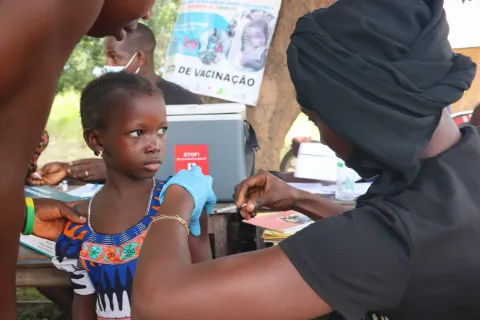
Actions speak louder than words, and Salimatu leads by example. She proudly lines up her children to be the first to get immunized. Her youngest daughters, Katia and Aissatu, aged three and four, took Vitamin A drops and Albendazole tablets without hesitation. With a single shot, her daughters are now protected from two life-threatening illnesses. One shot, two vaccines.
Building trust within the community is a vital part of the campaign, explains 49 year old nurse Segunda Indjucan, who has participated in countless vaccination campaigns—“more than I can count,” she says, with joyful laughter. She has observed that communities are far more receptive when they recognize and trust the vaccination teams. Segunda believes including community health workers as mobilizers in vaccination campaigns has been a game-changer.
By providing accurate information and raising awareness about the severe effects of measles and rubella, as well as the benefits of vaccination, these community health workers help to dispel myths and counter rumors. “One of the most common rumors in communities is that girls who are vaccinated become infertile”, which is not true, explains Maria de Jesus Vieira, a 59-year-old nurse. She emphasizes the importance of communication, including explaining the potential side effects of vaccines, to prevent the spread of misinformation.
“The key is to sensitize mothers. Everything depends on how you talk to the mothers,” Maria says.
For the past three days, Mansata Turé, a community health worker has been tirelessly visiting households to amplify and spread the message in Hafia’s bustling street markets, with a megaphone: “Take your children to the vaccination posts!” A 29-year-old community health worker and a local resident, Mansata finds it easy to connect with her neighbors. “I already know everyone in Hafia, so it’s natural for me to talk to them,” she says, confidently.

For Salimatu Mara, no convincing was necessary. When Mansata Turé, the community health worker of Hafia, knocked on her door a few days before the campaign began, she immediately agreed to vaccinate her children. Salimatu takes pride in the fact that all her nine children are fully vaccinated and have never suffered from a serious illness.
"If your child is vaccinated, the diseases will not be strong enough to make her sick”, she explains.

While Salimatu’s children receive their vaccines, the line in the vaccination post continues to grow. Parents in Hafia have heard the message loud and clear—whether from Mansata, other neighbors, the radio, local community leaders, or schools in the area. In Hafia alone, Segunda and Maria expect to vaccinate around 160 children per day over the 10-day campaign. “It could be more,” Maria de Jesus says, with a smile. “We might vaccinate 200 in a single day,” she adds. Segunda reflects on the progress:
“It’s heartwarming to see parents trust us with the health of their children.”