Mobilizing all to protect children and adults from vaccine-preventable diseases
National vaccination campaign uses strong mobilization efforts to deliver Meningitis A and COVID-19 vaccines

- English
- Portuguese
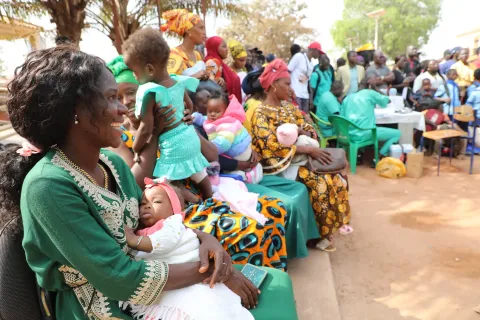
You can tell you are in the right place: Orphanage Casa Emanuel, Bissau. A finely tuned orchestra of little voices, laughter and cries, while children play and get vaccinated. It is an important day for them, and they welcome it with the light-hearted joy of their age: today they are receiving the vaccine against Meningitis A. This serious threat is out of their lives permanently. But It's also a significant day for adults: the latest national campaign has facilitated the integration of the COVID-19 vaccine into regular immunizations, with many patiently lining up to receive their shots. This ten-day campaign was amplified in unison by local and national radio stations, the national TV channel, social media, community mobilizers and volunteers, including youth groups knocking door-to-door to spread the message.
As the health workers methodically administer the vaccines, the children effortlessly turn a moment of duty into an arena of play. The adults’ towering figures become unintended pillars in the kids' spontaneous games. They dart and weave through the lines, using the larger silhouettes as shields and lookouts in their playful escapades.
The orphanage is buzzing with life: all the children living in the shelter were already vaccinated and it is now the turn of the children living in the neighbourhood. The campaign's message on prevention and vaccine benefits has resonated with parents. Many were encouraged to take their children aged 1 to 7 years to vaccination posts as soon as possible to receive the newest Meningococcal A Conjugated Vaccine (MenAfriVac), which protects the little ones against Neisseria meningitidis serogroup A.
This vaccine shields not only the vaccinated children but also the wider community from a deadly disease that's a significant public health challenge in Guinea Bissau. Bordering the meningitis belt, this West African nation faces heightened risks due to a combination of large population movements, poor living conditions, overcrowding, and strained health services. These conditions create a fertile ground for epidemics, underlining the crucial role of vaccination in disease prevention. The infection, in fact, is transmitted from person-to-person through droplets of respiratory or throat secretions from carriers, making vaccination crucial in its prevention.
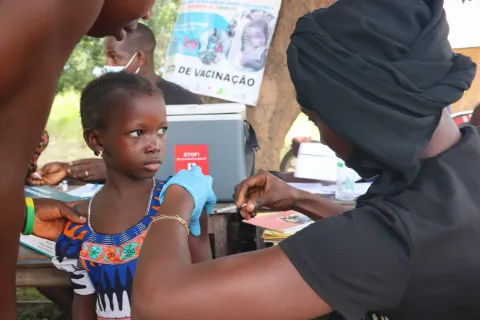
Back to the line, it's now the turn of 2-year-old Djumara. She sits bravely on her father's lap, whispering to herself to be brave and not to cry like the other children. However, the sting of the needle challenges her resolve. It's just a fleeting moment, though, and with the nurse's caring touch and her father's, Dauda Ndja, soothing embrace a smile once again brightens her face.

“After the awareness campaign, I realized the vaccine is very important for children”
“After the awareness campaign, I realized the vaccine is very important for children”, says Dauda. In addition to the little Djumara he also brought four nieces and nephews to be vaccinated. "I stopped by my brother's house to pick up his children to be vaccinated and they all agreed," he explained, highlighting how he advocated also with the rest of his family and with neighbours. The campaign also opened doors for many to receive the COVID-19 vaccine. Dauda, already vaccinated, stresses the importance of widespread immunization against this threat. The successful integration of the COVID-19 vaccine into routine immunizations, a move that swayed the hesitant, was enabled by the support of Global Affairs Canada, that allowed UNICEF is collaboration with the Government of Guinea Bissau to manage COVID-19 as an acute global emergency, setting the stage for a more resilient future against health crises.

Most notably, for this vaccination campaign, Guinea-Bissau had the essential support of UNICEF, the World Health Organization, the World Bank, GAVI, the People and Government of Japan, the Bill and Melinda Gates Foundation, Solina, the Center for Disease Prevention and Control for Africa and from the Government of Canada, who contributed to COVAX.
To ensure maximum coverage, vaccination posts were placed in every neighborhood of the capital, Bissau, and key points in all the regions of the country.
Volunteer sensitizers, familiar faces within their own communities, navigated daily the villages to guide residents to their nearest vaccination post. Dauda discovered the campaign through these efforts. Youth volunteers, empowered by UNICEF's training in key messaging and advocacy, became the backbone of the awareness drive. They embarked on a door-to-door mission, earnestly engaging families with compelling reasons to vaccinate their children against Meningitis A and protect adults from COVID-19.
In addition, their message was reinforced by the daily video reports and news about the campaign on social media being published by the Network of Children and Young Journalists. Their coverage, including interviews near vaccination posts, was an ideal complement for the work of the national TV channel and of 32 radio stations. Lastly, with UNICEF’s guidance, young boys and girls with influencer status used social media as an awareness tool and lent their voice and popularity to an important common cause.
By the end of the campaign, more than 309.000 children had received their Meningitis A vaccine, equivalent to 72,6% of the target, and around more than 132.000 adults received the COVID-19 vaccine. Around 22.000 of those were in the maximum priority group because of pre-existing diseases, age, or because they were health workers or professionals acting on the front line. UNICEF's ongoing commitment to sensitization and misinformation combat played a pivotal role in this campaign. Awareness efforts commenced days before the vaccinations, significantly involving religious and traditional leaders to address and dispel prevalent myths, such as unfounded fears about vaccine-induced sterility.

The generous Canadian support, not only is helping to increase equitable access to and uptake of COVID-19 vaccines but is also strengthening the resilience of the national health system, while reaching the global recommended level of vaccination.
Djumara is back on her feet, the little tears are long gone, and she now waves to the other children playing in the yard. Hand in hand with her father, she now heads home, leaving the threat of Meningitis back for good.