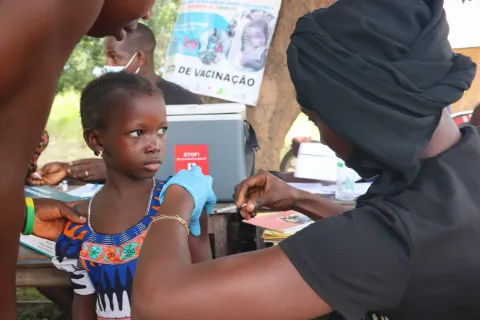
Baby Fatumata receives first lifesaving malaria vaccine in Guinea-Bissau
A historic milestone in the country’s fight against malaria.

- English
- Portuguese
As part of efforts to expand access to lifesaving vaccines for children in Guinea-Bissau, UNICEF, the World Health Organization (WHO), and the Global Alliance for Vaccines (GAVI) supported the Ministry of Health in introducing the malaria vaccine for the first time in the country. The vaccine is already in use in 25 malaria-endemic countries worldwide. In addition to procuring the vaccines, UNICEF led community engagement initiatives and behaviour change communication activities to support the introduction. The malaria vaccine rollout was officially launched on 28 January 2026. This story highlights the first child to receive the malaria vaccine in Guinea-Bissau, marking a historic milestone in the country’s fight against malaria.
Cadi Mané smiles while holding five-month-old Fatumata, the first child to receive a malaria vaccine in Guinea-Bissau.
On the morning of 28 January, Cadi Mané, a midwife at Gabú Regional Hospital and a mother of three children, walked proudly to the malaria vaccine rollout site in Gabú town, the largest city in the eastern region of the country. It was a day of celebration and pride for her. Her five-month-old girl, Fatumata, was about to make history as the first child in Guinea-Bissau to receive a malaria vaccine.
It's a [feeling of] pride because we know that it will improve her health, she said.
Dressed in a bright pink outfit with a matching bow, Fatumata looked on as health workers prepared vaccines and hundreds of parents queued with their infants and young children.
As Mané held her daughter close, a health worker gently administered the vaccine in Fatumata’s upper leg.

In that moment, Fatumata became Guinea-Bissau’s first child to receive a malaria vaccine, marking a major milestone for the country.
For Mané, the moment is deeply personal. She sees a future full of possibilities for her daughter.
My wish for Fatumata is to have a degree in the area of health, like I did," she said. "But I am not sure what she will decide.
Like Mané, other parents had come to protect their children from a disease that is one the leading causes of illness and death among children under 5 in Guinea-Bissau.
Taking every possible measure to prevent malaria
As a health professional, Mané understands how devastating malaria can be for children. She is committed to doing everything possible to protect her daughter.

Although, Mané, her husband and their children all sleep under insecticide-treated nets (ITNs), malaria recently struck at household. When an eight-year-old boy staying with them developed symptoms, she promptly did a rapid diagnostic test and took him immediately to the hospital for treatment.
The experience underscored an important and critical reality: while existing malaria prevention measures, such as seasonal malaria chemoprevention and ITNs are effective, they are not always sufficient to prevent malaria on their own.
According to the World Health Organization (WHO), the vaccine increases protection when added to malaria prevention methods. Further evidence from other African countries underscores that, when combined other prevention measures, malaria vaccine significantly reduces severity of illness and deaths among children.
History is made and the vaccine rollout is underway
Local and regional government authorities, civil society representatives and frontline health workers were key to planning the rollout in each region. For the first day, Health workers administered the vaccine to approximately 58,000 children aged 5 to 59 months across 19 health areas and 24 health centres. The vaccination rollout will continue with additional doses in the coming months prior to the rainy season.

The country’s high burden of malaria places a tremendous significant pressure on the health system, with the disease accounting for more than one-third of all consultations and hospitalisations in public health facilities.

This malaria vaccine came to reinforce the other family practices that we were already doing before, such as sleeping under the mosquito nets, cleaning our house, and seasonal chemoprevention, said Neusa Mendes Samy, Director, National Immunization and Epidemiological Surveillance Service.
Looking toward a malaria-free future
This milestone represents an important step forward in the country’s fight against malaria.
Together with the existing prevention and treatment measures like seasonal malaria chemoprevention and sleeping under bed ITNs, the vaccine is expected to decrease malaria incidence and prevent severe malaria disease in children.
Going forward, children will receive the malaria vaccine as part of their routine immunizations, starting at five months old.
Gavi is proud to support Guinea-Bissau in protecting children through vaccination. We work closely with the Government and partners to ensure malaria prevention efforts are comprehensive and complementary, reaching the families who need the most, said Mr. Marius Keller, the Gavi Liaison Officer for Guinea-Bissau.