Making Sudan open defecation free to ensure healthier communities
Many households across Sudan now have a latrine in their home, providing them with a safe and hygienic environment.
- English
- العربية
Open defecation, where people defecate outside instead of in a toilet, is a major challenge in Sudan with over ten million people resorting to this practice and resulting in grave public health implications including potential disease outbreaks. Sudan ranks number one in the Middle East and North Africa (MENA) region in the practice of open defecation. Open defecation affects women and girls the most exposing them to health risks, insecurity and to the risk of sexual harassment.
UNICEF supported the Government with the development and high-level launch of the National Roadmap for the Elimination of Open Defecation in Sudan. The Roadmap is a clear budgeted action plan for making Sudan open defecation free by 2022.
Community led total sanitation (CLTS) – an approach relying on full community engagement – has been deployed to make communities open defecation free and has had increasing success in Sudan. In addition, UNICEF has also supported the development of a faecal sludge management study to address the disposal of human waste in a more environmentally friendly manner.
UNICEF supports 226 communities that have been certified open defecation free across the country. As a result, over 450,000 people, including about 275,000 women/girls, now use latrines and live in a clean and hygienic environment. The results represent a six-fold increase over the previous year and clearly demonstrate an increased willingness among the states/localities/communities to advance the sanitation agenda towards making Sudan open defecation free by 2022.
The direct impact of these sanitation efforts can be found in the improved cleanliness of local communities, reduction in diarrhoeal related incidences in children under-five and more importantly improved protection for women as having latrines at home has afforded women safety and dignity and also more time at their disposal.
With thanks to all the partners for their contributions to the sanitation agenda in Sudan, UKAID, Sudan Humanitarian Fund (SHF), the Government of Sweden, the United States Agency for International Development (USAID), the Government of Japan, the United Nations Central Emergency Response Fund (CERF), the Government of Germany German Cooperation, the Government of the Netherlands and the European Humanitarian Commission (ECHO).
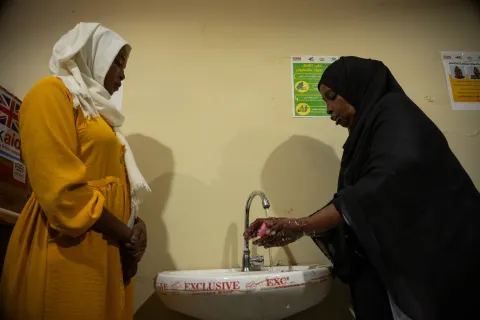
Zalengei, Central Darfur is one of the most active communities in combating open defecation, meet this household in Hai Jebelain locality, who now have access to a latrine and handwashing station.


"When I was pregnant, it was difficult to walk far and at night I get scared to go out, having a toilet at home has made life so much easier."