Leading the charge for WASH in healthcare facilities
After participating in a training organized by UNICEF with generous support from the Government of Korea, healthworkers in Nepal are gearing up to bring about much-needed improvements in WASH in their workplaces
Sarlahi, Nepal: Healthworker Pushpa Sah has a newfound mission: “To transform the water, sanitation and hygiene (WASH) situation at the health facility where I work.”
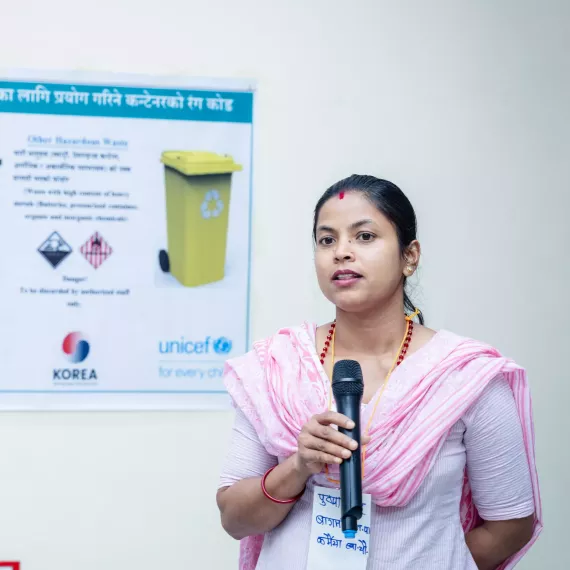
A senior auxiliary nurse midwife (ANM) at the Karmaiya Health Post in Bagmati Municipality in Sarlahi District in Nepal’s southern plains, Pushpa has 15 years of experience in the health sector. However, it is only recently that she has fully understood the critical role that implementing key WASH measures in health facilities can play in preventing the spread of infections and protecting the lives of patients as well as staff.
This understanding stemmed from a training that Pushpa participated in on Water and Sanitation for Health Facility Improvement Tool (WASH FIT) organized by UNICEF and partner organization Chay Ya Nepal in Bardibas, Mahottari District, in southern Nepal in April 2024. The training was made possible through generous funding contribution from the Government of Korea towards UNICEF’s Access to COVID-19 Tools Accelerator (ACT-A) work that focuses on supporting COVID-19-related recovery and restoring essential health services, as well as strengthening primary healthcare, including community health systems and infrastructures such as WASH, healthcare waste management and environmental cleanliness.
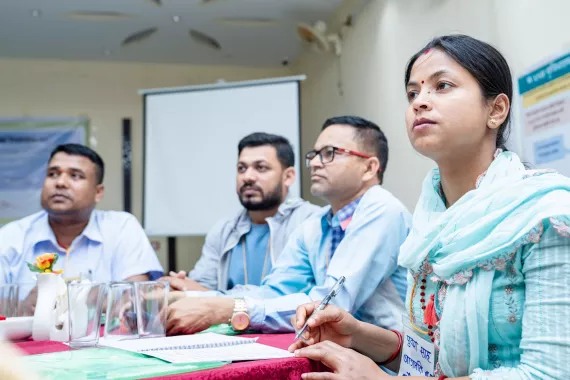
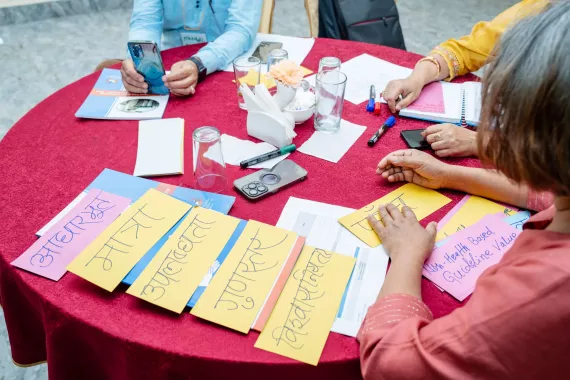
Pushpa was among 27 healthworkers from across Madhesh Province who took part in the three-day WASH FIT training. The training was primarily aimed at helping participants to better understand and implement standardized WASH services and procedures across their respective facilities, ensuring measurable improvements in practices related to WASH, waste management and infection prevention.


Throughout the three days, participants were guided through a range of sessions that included lectures, discussions and quizzes. Topics covered managing safe water supply and safely managed sanitation, which included discussing the impact and risks of inadequate water and sanitation. Hygiene practices were addressed with an emphasis on system change, monitoring and feedback. A key focus was placed on integrating considerations related to climate change, environmental sustainability, gender and disability into all WASH practices, whereby participants were encouraged to develop action plans for implementing these improvements in their own facilities.


The training also included field visits, such as one to the nearby Bardibas Hospital to observe ongoing practices on WASH, healthcare waste and environmental cleaning.
For Pushpa, it has been an eye-opening experience and a much-needed push to do better at her own workplace. The current situation at the Karmaiya Health Post leaves much to be desired, she admits, with poor toilet facilities, limited handwashing and waste management arrangements, among other issues. Addressing this is all the more important given that Karmaiya also functions as a birthing centre, drawing in patients from multiple wards across the municipality.
“I want to make sure we have washbasins near the main entrance, for example,” Pushpa says, listing some of the changes she wants to bring into effect soon. “We also need to urgently put in place separate toilets for men and women."

This sense of urgency and commitment to change is also shared by other participants in the training. “The training has made me realize that there is a lot of improvement needed at my health facility,” says Chandra Kala Kumari Ram, ANM from Laxmipur Patari Rural Municipality in Siraha District.
“I am determined to work to turn things around.”
Included in Chandra Kala’s action plan for her facility is organizing awareness events on sanitation and hygiene focused on female community health volunteers or FCHVs – who have deep connections and influence over families in their given working areas. Chandra Kala also hopes to explore the possibility of segregating and selling recyclable waste as an added income source for the health post, where currently the waste is either burned or dumped haphazardly.

Another healthworker, Hospital Management Officer at the Lahan Provincial Hospital, Dhanoj Kumar Gupta has also been inspired by the training to work towards improved waste disposal. The hospital currently disposes of waste on the banks of a nearby river, a practice that carries with it enormous risks to the environment and public health.
“We will immediately get started on a mechanism for the hospital, including things like installation of color-coded bins around the premises to help with better management of waste,” Dhanoj says. “We will also be looking into making our facility better accessible for persons with disabilities.”
Now equipped with a clearer understanding of the importance of WASH in preventing infection prevention and control in healthcare facilities following risk-based approach, and with action plans to guide their efforts, these healthworkers have taken the first step in the journey towards improving patient outcomes and promoting public health in their communities.