Communicating for change
In Mugu, where the uptake of maternal and child healthcare services is low, female community health volunteers are training to more effectively communicate with families

Mugu, Nepal - Early on a Sunday morning, in her home in Gamgadhi Gaunpalika in Mugu District in mid-western Nepal, Dev Laxmi Malla is getting ready for work. She puts on a little make-up and then drapes a light blue saree around herself.
This saree has become something of a symbol in Nepal, worn by around 52,000 women across the country. It’s the uniform of the Female Community Health Volunteers or FCHVs – women who work to link local families and communities to available health services and promote healthy behavior. Dev Laxmi herself has been an FCHV for over 13 years.
“It’s a busy day today,” she explains, packing her bag. “I have a meeting with the other volunteers at the health post and then I’ll be presenting at the Mothers’ Group gathering.”

Dev Laxmi isn’t the first in her family to take up this line of work. Her elder sister had been an FCHV until she got married and moved to another district. While following in her sister’s footsteps was certainly one of the reasons she wanted to become an FCHV, another key factor was the kind of conditions she had grown up seeing around her.
Indeed, Mugu’s natural beauty and rich biodiversity belies a harsh reality: the district is one of the least developed areas in Nepal.
Mugu performs particularly low on maternal and child health indicators in comparison to the national average. Less than 50 per cent of women here give birth in health facilities. Only 41 per cent complete the four ante-natal care visits while just about 10 per cent get to the third post-natal check-up. Deep-rooted gender norms that devalue women, and a longstanding tradition of home births, are just some of the underlying causes of such low health service utilization.

It was with the intent of helping to address these factors that Dev Laxmi had entered the profession.
“We want to change the behaviour of pregnant women, families and communities,” she says. “All babies should be delivered in health facilities and pregnant mothers should visit the health post to get the proper antenatal and postnatal check-ups.”
In order to render these efforts of FCHVs and health workers more effective, UNICEF with support from the Korean International Cooperation Agency (KOICA) has been working to improve maternal, newborn and child health (MNCH) in Mugu.
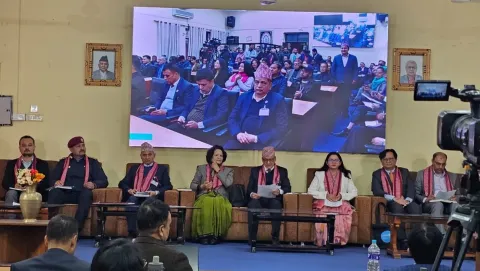
Recognizing how crucial successful communication is in raising awareness and access to MNCH services and behaviours, a training on interpersonal communication was recently held as part of the programme supported by UNICEF and KOICA. The session was geared at helping frontline health workers to communicate effectively with the communities they serve, by engaging groups and individuals in meaningful rapport and dialogue. Dev Laxmi had been among the community-level communicators who had participated in the two-day session.
“Although I’ve been doing this for so long, the training showed me how to better communicate necessary information to the right audiences,” Dev Laxmi says. “I learned ways that I could get the message across more strongly.”

Those reinforced skills are on clear display at the mothers’ group meeting in Ward 1, the first such presentation Dev Laxmi has had to make since receiving the training in March 2019. In a clear, confident voice, she proceeds to inform the 25 or so mothers gathered here about the various facilities available at the health post and the district hospital. Holding out her FCHV handbook, she underscores her points by displaying various messages and photos to the group, something she learned at the training.
When the meeting has concluded, Dev Laxmi reflects on the kind of response she got. “I think the methodology used in the training – like role-playing, for instance – has really helped me address big groups like this and keep their attention,” she says. “I had always had the handbook, but now I know how to really use it to its full potential.”
In addition to such trainings, the project has also supported the establishment of fathers’ groups in different parts of the district to promote fathers’ engagement in the health and wellbeing of their children. Likewise, phone numbers of mothers-to-be have also been compiled so as to disseminate needful information to them through SMS.