WHO and UNICEF welcome first delivery of essential childhood cancer medicines to Nepal under Global Platform Initiative
- English
- नेपाली
KATHMANDU, 16 February 2025 – The World Health Organization (WHO) and UNICEF celebrate a significant milestone in Nepal's fight against childhood cancer with the arrival of the first batch of essential cancer medicines under the Global Platform for Access to Childhood Cancer Medicines (GPACCM).
The GPACCM or the Global Platform, a partnership between WHO and St. Jude Children's Research Hospital, with UNICEF and PAHO as procurement partners, aims to provide a steady supply of quality-assured childhood cancer medicines to low- and middle-income countries.
Nepal became a focus country of the WHO Global Initiative of Childhood Cancer (GICC) in 2020. In 2022, Nepal was selected as one of the six countries (the only one from WHO South-East Asia Region) to participate in the Global Platform. In March 2024, the Ministry of Health and Population signed the letter of agreement to launch this initiative in Nepal. As part of the agreement, Nepal will receive an uninterrupted supply of 35 types of essential, quality-assured medicines for children with cancer at no cost for five years.
The medicines, delivered through UNICEF's procurement services, will support treatment for children at four hospitals: Bhaktapur Cancer Hospital, Kanti Children's Hospital, Patan Academy of Health Sciences, and BP Koirala Memorial Cancer Hospital. These facilities have met rigorous standards for safe handling and administration of cancer medicines, ensuring quality care for young patients.
This initiative addresses a critical need in Nepal, where approximately 900 new childhood cancer cases emerge annually, with previously only one-third receiving proper treatment due to various constraints including medicine availability.
The initial shipment includes more than 2300 packs of critically needed medicines that will be used to treat a variety of childhood cancers. The procurement of these medicines is based on forecasting and quantification conducted by the WHO Country Office for Nepal in coordination with participating hospitals.
Nepal has declared free treatment for cancer patients up to the age of 14 years through government-designated institutions effective from 16 November 2024, a decision influenced by the previous years of GICC activities and backed by the anticipation of medicines delivered through the Global Platform.
Hon. Health Minister Pradip Paudel said: "The Ministry of Health and Population is committed to cancer treatment and control. To control cancer, which is becoming a major health problem in the country, we are working to promote preventive methods along with treatment by adopting the National Cancer Control Strategy. We have also arranged for free treatment so that no child is deprived of cancer treatment due to a lack of finances. We thank our partners for their support in making child cancer treatment effective. In addition, cancer treatment has been expanded to all provinces and we plan to gradually improve it."
Dr Rajesh Sambhajirao Pandav, WHO Representative to Nepal, said: "What is special about the Global Platform is that along with supplying quality-assured medicines, the platform is helping to drive long-term improvements in childhood cancer care. By strengthening national supply chain management systems and pharmacy services, enhancing clinical management, and improving regulatory and monitoring systems, this partnership ensures effective distribution of medicines. These efforts will create lasting, sustainable advancements in the overall care of children with cancer in Nepal, shaping a future where every child has access to the treatment they need."
Carlos Rodriguez-Gallindo, MD, Director of St. Jude Global, said: “The challenges of increasing childhood cancer survival rates must be addressed from multiple angles. This partnership tackles these challenges through a number of avenues, including strengthening supply chains, addressing workforce gaps and increasing advocacy for children with cancer. More children will receive better care at an international level because of this intricate approach.”
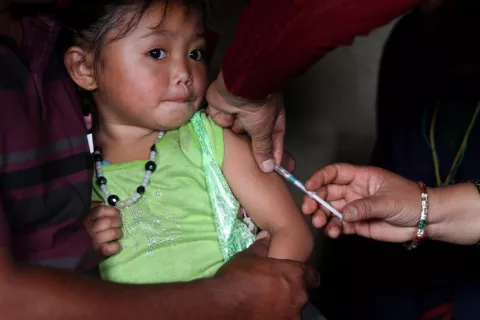
Dr Alice Akunga, UNICEF Representative to Nepal, said: “Nepal has demonstrated strong commitment to improving childhood cancer care through various initiatives, including the historic "Dhulikhel Declaration" on Childhood Cancer. The introduction of the human papillomavirus (HPV) vaccines to protect adolescent girls from cervical cancer early this month is another testament of the government’s commitment. UNICEF is proud to support the government and work with WHO and St Jude Research Hospital to expand access to childhood cancer medicines through the Global Platform, striving toward a world where every child is protected from cancer.”
Following the initial shipment, essential medicines to treat childhood cancer are expected to arrive in multiple shipments over the next few months.
Notes to Editors:
- The Global Platform for Access to Childhood Cancer Medicines, co-founded by St Jude Children's Research Hospital and WHO, was launched in 2021, to ensure children around the world have access to lifesaving treatments. It aims to provide quality-assured cancer medicines to approximately 120,000 children between 2023 and 2027.
- St. Jude Children's Research Hospital has committed US$200 million over six years to support this initiative.
- In Nepal, childhood cancer survival rates are currently below 30%, compared to over 80% in high-income countries.
- UNICEF is the procurement partner, responsible for procuring of medicines and delivery to countries.
Media contacts
About UNICEF
UNICEF promotes the rights and wellbeing of every child, in everything we do. Together with our partners, we work in 190 countries and territories to translate that commitment into practical action, focusing special effort on reaching the most vulnerable and excluded children, to the benefit of all children, everywhere.
For more information about UNICEF and its work for children, visit www.unicef.org