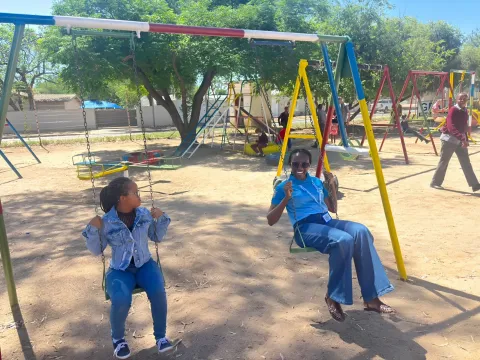
From the starting line, everyone belongs
Overcoming adversity through acceptance

The morning air was crisp, carrying a cool breeze across the sports field as the first rays of sunlight warmed the ground beneath it. Laughter drifted between participants, volunteers and workers alike. As final preparations were made; there was excitement in every corner as music and chatting filled the air.
For many, it was a day of friendly competition. For Miriam, it was something more.
Watching persons with disabilities laugh, run, compete and encourage one another, she saw more than a sporting event. She saw people experiencing something everyone deserves to feel; belonging.
"I never really felt different growing up," she says. It is a statement that surprises many people.
Born with scoliosis, a condition that affects the curvature of the spine, Miriam knew from a young age that her body was different. Yet her memories of childhood are not defined by exclusion. Instead, she remembers acceptance.
Raised between her mother's and father's families before eventually moving to Walvis Bay to continue her education, Miriam describes a childhood surrounded by people who saw her before they saw her disability.

"I felt like I belonged at school," she recalls. "Whether it was primary school or secondary school, I never felt excluded. It wasn't that I didn't know I was different," she explains. "I knew from a young age. But I was never made to feel less because of it."
Although frequent medical appointments became part of her life, her schools and family encouraged her to participate alongside everyone else. Discipline and respect shaped the communities she grew up in, and openly mocking or excluding another child was simply not tolerated.
That sense of belonging became one of the greatest gifts of her childhood.
Today, Miriam uses that experience to advocate for children and adults with disabilities across Namibia.
"As an advocate, I understand how people feel because I've lived it," she says. "I know the emotions they carry."
Over the years, she has witnessed meaningful progress.
She remembers a time when there were few organised disability movements and limited opportunities for persons with disabilities to have their voices heard. Today, disability organisations, stronger policies and growing public awareness are helping to create more inclusive communities.
But Miriam believes that one of the biggest challenges cannot be solved by policies alone. It is by changing mindsets.
"I want people to understand that disability is not who we are," she says.
"Disability is a limitation in part of my body," she explains. "It is not my whole identity."

Even the words society chooses matter. She hopes people will move away from language that defines individuals by their disability and instead recognise them first as people.
That message is exactly why the National Disability Council of Namibia hosts such events.
Beyond the medals and celebrations, they create spaces where people can build confidence, form friendships and be recognised for their abilities rather than their limitations.
As the cheers echo across the field and another game begins, she watches with quiet pride.
The excitement, determination and smiles surrounding her remind her of the childhood she was fortunate to have; one where acceptance came before assumptions.
Her hope is that every persons with a disability, young or old; no matter where they are born, grows up with that same certainty.
Not just simply knowing they are included; but never having to question whether they belong at all.