The bumpy road to education
3.3 per cent of Namibian children between 6 and 19 have a disability
ONGWEDIVA, Namibia, 6 August 2015
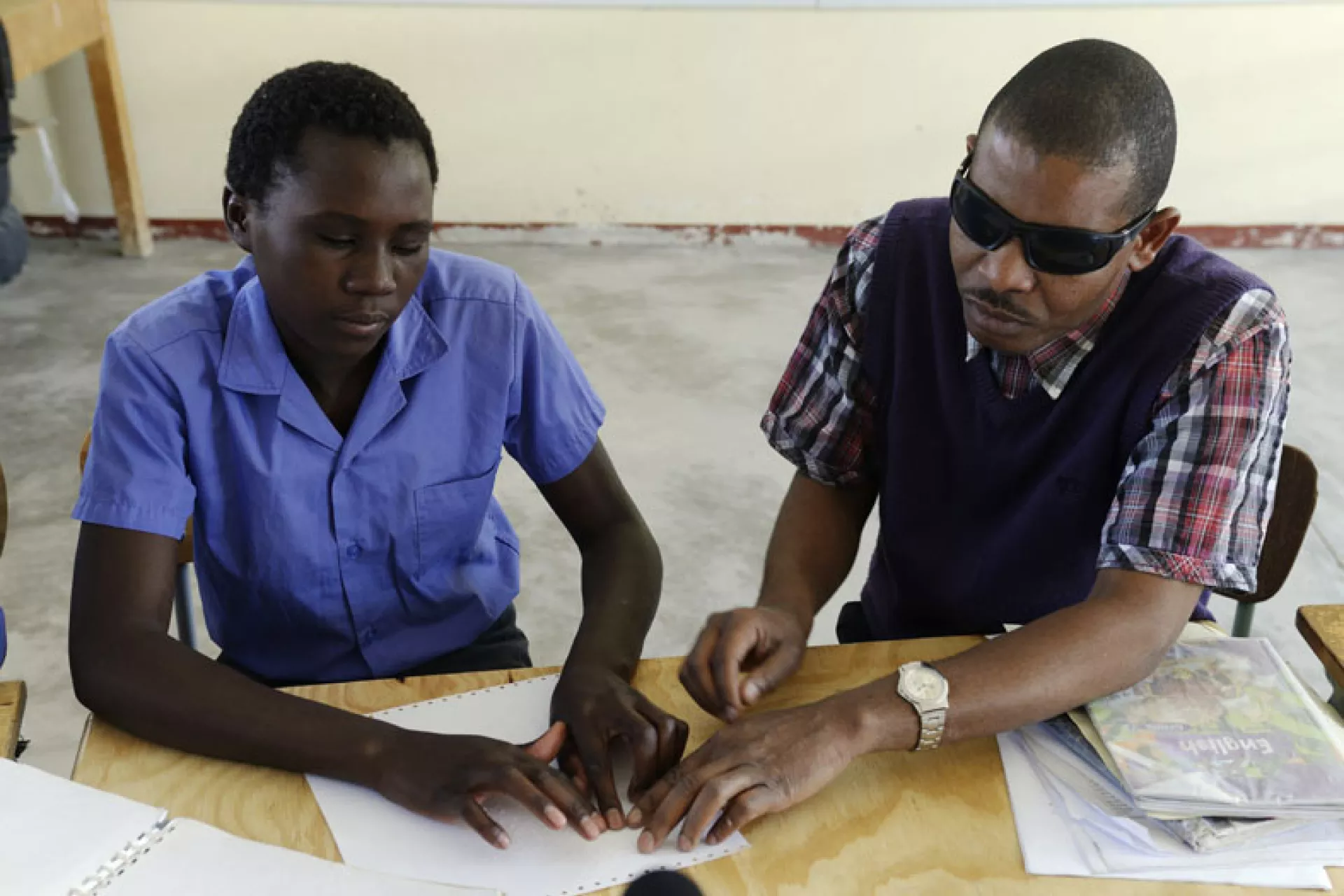
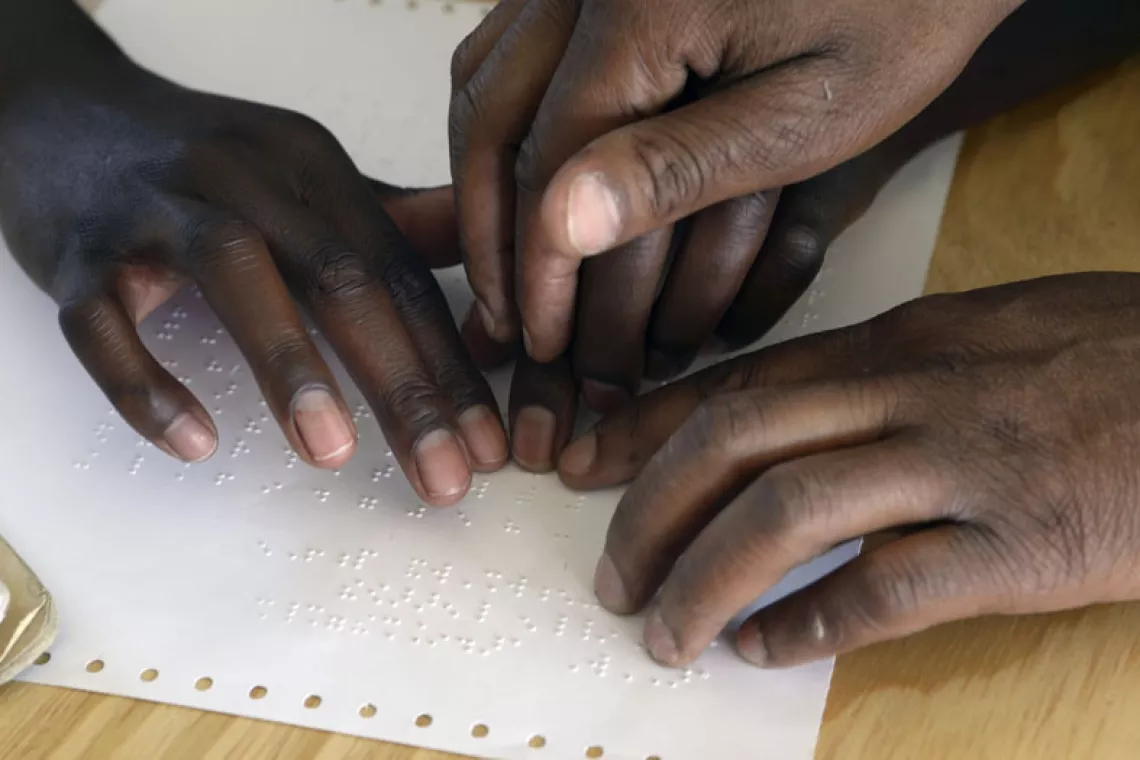
In the class for visually impaired students at Eluwa Special School, 14-year-old Lonia Shiningani stands out as shy and withdrawn. Unless probed, she remains quiet. But when asked to read, her face lights up. Stooping over her book, her nose almost touching the paper, she traces her fingers over the raised dots of the braille text and reads aloud as she moves from word to word.
Her teacher, Mr Tobias Mwaudikange, who is also blind, explains that Lonia is still relatively new to the school and is getting used to the unfortunate reality of losing her sight. The teacher is patient with her, helping her when she stumbles over a word and ensuring that she will gradually rebuild her confidence.
As far as Lonia can remember, she has always had problems with her eyes.
“I was born with eye problems. I only had one eye that could see very well,” says Lonia.
“In 2007, the eye that could see very well also started to have problems. In 2010, things got complicated and I could no longer see.”
Having one’s vision recede into near-nothingness can be a terrifying prospect. A person initially loses independence and must re-organise their life dramatically. In Lonia’s case, she could no longer attend the school near where her family lives because her failing eyesight affected her reading, writing and general school performance. She had to leave home and find a school that would allow her to further her education despite the impending disability. It was not an easy feat, as throughout Namibia special needs schools are few and far between.
Lonia was moved to Eluwa Special School in the northern town of Ongwediva, Oshana Region. Established in the early 1970s, Eluwa was the first government school in Namibia to offer schooling for children who are hard of hearing or visually impaired. It was a bumpy road …
She was scared, missed her family terribly and had to get used to her new surroundings. But Mr Mwaudikange, her teacher, was supportive from day one, orienting her to the braille lettering and also helping her through the trauma of the changed circumstances of her life. Determined to master her new ‘language’, Lonia was able to read braille fairly well, within three months.
“When I started classes, the teacher gave me a paper on which there are things like holes,” says Lonia. “I asked my fellow learners at the hostel about the paper I had been given. They told me that the letters A to Z from the alphabet were on the paper. I learned those letters the whole day. The next morning when I went to school, I knew every letter on that paper. And now, I know how to read and write using braille.
There are currently 93 learners with visual impairment at Eluwa. The school also accommodates 248 learners with varying degrees of hearing loss. Mr Mwaudikange explains that most of these learners struggle with learning because they experienced stigma and discrimination at home, and lacked the support to help them live with their disability.
Parents regard disability as a curse and often keep their children indoors or hidden from neighbours. Because of the stigma, some of the children with visual impairment are never exposed to any form of early childhood learning and cannot look after themselves.
“Unfortunately, not so many come to school having gone to pre-primary school. Most of them come here for the first time. They don’t have the basics that most of the children who have gone to preprimary have acquired. For those who have some schooling, we proceed with what they know,” says Mr Mwaudikange.
The teacher adds that some parents drop their children off at the school hostel and don’t make any contact or visit them throughout the term. Some are even left in the hostels during the school holidays when all the other learners have gone home for the break, causing a lot of distress and trauma.
The school, however, tries to address stigma by educating the parents on disability. “Most of the children feel that they are not accepted by their families. This causes emotional problems,” says Esperanca Antonio, Eluwa’s acting principal. “For most parents, it’s like a curse or witchcraft. But thanks to the meetings with the parents, we tell them this is not a curse and that they have to accept their children as they are.” What has also helped to change attitudes is the fact that some of the former students have become employed. Mr Mwaudikange, Lonia’s teacher, is a graduate from Eluwa. “Since we have produced some children who are now teachers or shop assistants, Eluwa is seen to be making good progress,” says acting principal Esperanca Antonio.
The Government of Namibia has put in place a legal framework for inclusive education and disabilities, but services are falling behind.
“The Government is doing a lot,” says Esperanca Antonio, Eluwa School’s acting principal. “But the problem is we don’t have facilities. We also have a number of other challenges when it comes to special schools. The lack of equipment, for example; the braille machine that is used now is outdated. I feel we need to get more resources for special schools because we have special needs compared to the normal schools. Teachers are also not well trained on learners with special needs.”
Back in the classroom, Mr Mwaudikange has taken Lonia up to the blackboard on which he’s tacked boards that have Coke, Fanta and other bottle tops arranged in braille dot positions that represent different letters of the alphabet. Eluwa Special School may not have the latest equipment but it has the resourcefulness that is needed to teach children. With such dedication and passion, a lot can be achieved in the face of adversity.
“The school has helped me a lot, especially in Mathematics and English. When I complete my studies, I would like to become a teacher because teaching is a career that I like.” ” says Lonia