Where hope takes root: Building hopeful futures for children across northern Myanmar
From classrooms to camps, support from the people of Japan is helping children in Kachin learn, heal and hope.

- English
- မြန်မာ
When children in her neighbourhood set off for school each morning, Christina, 8, used to watch quietly from her window. For a long time, those moments brought silent heartbreak. After a serious illness left her unable to sit, stand, or walk on her own, traveling to a school was simply not possible, and Christina watched the world move on outside while she stayed behind.
"I used to cry whenever I saw other children going to school," recalls Christina’s mother. "I kept hoping and praying for a way for my daughter to learn and feel like she belongs."
Across town, 17-year-old Jue Jue carried that same longing in her heart. Living with a physical disability since infancy, Jue Jue spent years wishing for a classroom where she could learn with friends and be recognised for her abilities, rather than what she cannot do.
Reaching every child, wherever they are
Life began to transform when both families connected with the Growing Seed Disability Centre in Myitkyina, Kachin State. Supported by UNICEF through generous funding from the Government of Japan, the centre provides an integrated lifeline, combining inclusive classroom education, both home and centre-based rehabilitation, assistive devices and bi-monthly cash assistance.

For Christina, whose mobility keeps her at home, support comes directly to her doorstep. Dedicated teachers and therapists visit her regularly, patiently guiding her through movement exercises, eating independently, and daily routines at her own pace. Step by step, Christina has rediscovered her strength and a reason to smile.
"She smiles so brightly now whenever her teachers arrive," Christina’s mother says proudly. "Seeing her practice standing and trying again every day gives our whole family strength."

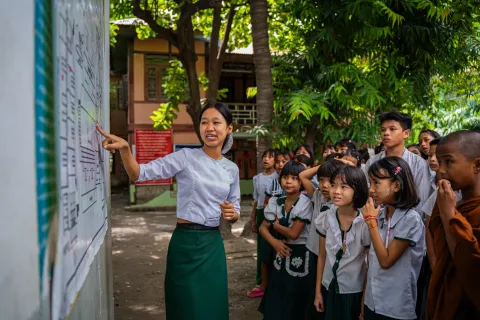
For Jue Jue, walking into the centre’s classrooms opened up a vibrant world of friendship and growth. Surrounded by encouraging educators and peers, she blossomed into a cheerful student and mentor who looks after younger classmates while learning basic digital skills.
"I want to become a teacher here one day," Jue Jue says with a radiant smile. "I want to help other children with disabilities realise that their dreams matter just as much."
Moments of connection across Kachin
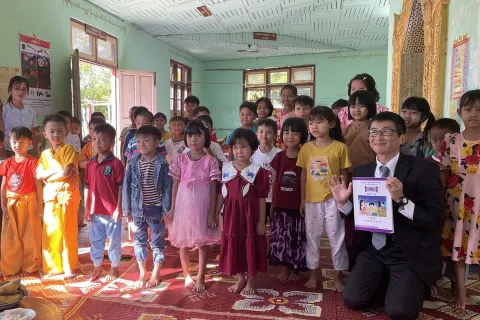
The meaningful progress in Christina’s and Jue Jue’s lives illustrates how tailored support meets children where they are. During a recent mission to Myitkyina, Shogo Yoshitake, Chargé d'Affaires of the Embassy of Japan, travelled alongside UN agencies to witness firsthand how collaborative support protects children in their classrooms, homes, and communities.

At the disability centre, Mr. Yoshitake met with students in their classrooms, and spoke with staff and caregivers about both the centre-based classes and the home-visit programmes that reach children like Christina.
Later, in a displacement camp near Myitkyina, 11-year-old Hkaw Mee proudly held up her new UNICEF school bag. After leaving her home because of conflict, she is building a new routine—one that includes learning, playing and spending time with other children. The bag is more than something to carry her books in. It is a small sign that, even in unfamiliar surroundings, she can continue learning and hold on to a sense of childhood.

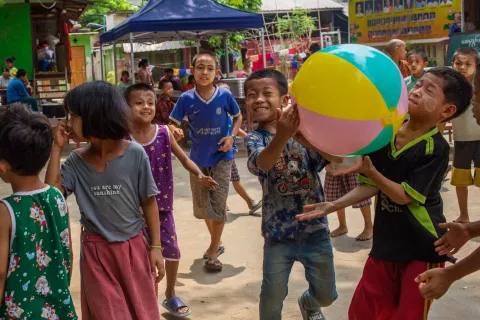
That sense of normalcy continued inside the camp’s child-friendly space, where Hkaw Mee and other children took part in UNICEF’s “I Support My Friend” session. Sitting together in groups, the children shared, listened and learned simple ways to support one another when they or their friends feel worried, sad or afraid. Mr. Yoshitake joined their conversation, listening as the children spoke about friendship, care and the small things that help them feel less alone.

For Hkaw Mee, a school bag, a safe space and the chance to learn alongside other children are small but important steps towards feeling secure again. Together with the support seen at the disability centre and in schools, they showed how practical assistance can help children hold on to learning, connection and hope, even when their lives have been disrupted.
Reflecting on the visit, Mr. Yoshitake said, “This visit showed me how vital support is reaching children and families across Kachin. Whether in a disability centre, a school or a displacement camp, children are being given opportunities to learn, feel safe and regain hope.”
Building resilience amid compounding crises
For children and families in Kachin, support can make the difference between facing another crisis alone and having someone there to help. UNICEF and the partners are helping children with disabilities access learning and rehabilitation, displaced children find safety and care, and families meet their most urgent needs.

The challenges facing Kachin are ongoing, from conflict and displacement to flooding during the monsoon season. But when support reaches children where they are, it can help restore a sense of stability and possibility. For children like Christina, Jue Jue and Hkaw Mee, that support is helping keep learning within reach, protect their well-being and nurture their hopes for the future.