The quake stopped, but he hasn’t slept since
Myanmar’s children struggle with trauma after devastating earthquake

- English
- မြန်မာ
“It was like something took control of him. He hit his own head over and over in the middle of the night. It broke my heart,” says Ma Nu[1], a mother in her forties, looking down at her hands as she speaks — her voice low, heavy with grief. Her 8-year-old son, Mg Pyae, was once a gentle, introverted child who found comfort in his own company. Now, he startles awake in fear, haunted by tremors that have long stopped – at least on the surface.
They were an ordinary working-class family, living peacefully in their modest home in peri-urban Mandalay. But that peace was shattered on 28 March when a 7.7 magnitude earthquake struck central Myanmar.
“I was in the kitchen and my husband in the living room when it happened,” Ma Nu says. “The floor moved beneath me like a wave. I couldn’t even stand straight. My son was upstairs, about to nap.” Her eyes tear up at the memory. “I screamed his name. I couldn’t think of anything else.”
She feared for her son, who was alone on the upper floor. But thankfully, he ran downstairs just in time. “Straight into his father’s arms. Everything around us was shaking – plates fell, furniture tipped over. A pipe must have burst too – water was everywhere. But we made it outside somehow.”
Mg Pyae, usually shy and reserved, speaks softly about that day. “I thought someone was shaking the bed,” he says, barely audible. “I didn’t know what was happening. I’ve never felt anything like that before. I heard my parents screaming so I just ran.”
What they saw outside took their breath away. “The houses next to ours - they were gone. Just rubble.”
They were still struggling to make sense of what had just happened when, only a few minutes later, an aftershock struck. This time, their home collapsed completely, turning to rubble in just seconds. Thankfully, the whole family was already outside. It felt like a miracle that they got away with only a few cuts and bruises.
All around them, homes had fallen. Their next-door neighbours, who were like family to them, didn’t make it.
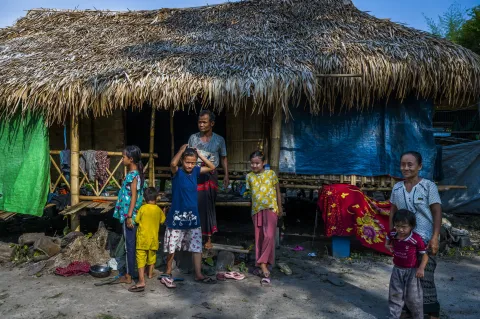
In the days that followed, Ma Nu and her family joined over 100 other displaced families in a temporary shelter site set up in a nearby schoolyard. They have been living there for almost one month now, under thin canvas sheets – barely enough to block the sun, offering little privacy and no real protection.

“At night, my son holds my hand tight, not letting me out of his sight. I sing prayers to him until he falls asleep,” Ma Nu says. “He dreams about earthquakes all the time. He’s still a child — how can he make sense of any of this?”
By day, Mg Pyae appears like any other child. He even smiles sometimes. But at night, the fear returns.
“He used to fall asleep as soon as his head touched the pillow. Now, even the wind makes him stir. One night, he hit his own head over and over,” she says, her voice breaking. “He says he’s scared it will happen again. Every creak in the shelter sounds haunting to him.”
Before the earthquake, they had a home – a place filled with laughter, with routine and with normalcy. Now, they must share a crowded space with strangers. For an introverted boy like Mg Pyae, the loss of privacy and familiarity is overwhelming.

“He’s always been a quiet child,” Ma Nu says, with a small smile. “He likes to draw. Always in his own little world. Not much of a talker, not many friends. But now, he’s forced into this sudden change. It’s hard for him. So, I try to help.”
Ma Nu does everything she can to help Mg Pyae adjust. Even with aching legs, Ma Nu makes the effort every day. “I take him whenever there is a food distribution or donation. I talk to him. I reassure him that he is safe. Nothing can hurt him now. And this is just temporary. I want him to feel like life can be normal again.”
Mg Pyae draws a lot these days. “It’s the only thing that calms him. Sometimes he draws our old house. Sometimes just trees, clouds and the sky. I think he misses the quiet,” says Ma Nu.

Despite the hardship, the resilient mother is holding onto gratitude to be alive, mustering resilience to face the daily challenges.
“We’re alive. That’s what matters. We’re still together,” she says. “But I see the worries in my son’s eyes. And that’s what hurts the most.”

“My only wish is that one day my son stops having nightmares - the ones that come in sleep; the ones this earthquake left behind.”
Mg Pyae is not alone. Across Myanmar, many children are grappling with invisible wounds from the devastating earthquake. In a recent poll of young people by U-Report, nearly 40 per cent identified mental health and psychosocial support as a top concern — a reflection of just how widespread the distress has become since the earthquake.
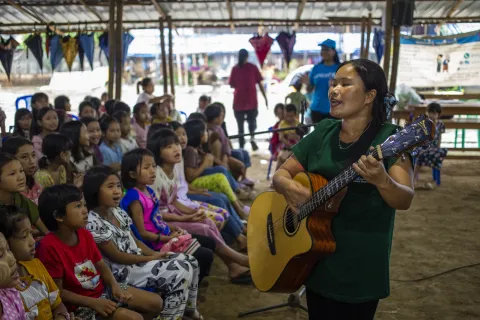
To help children like Mg Pyae begin to heal, UNICEF is providing psychosocial first aid and establishing child-friendly spaces across earthquake-affected areas — safe, nurturing environments where children can express themselves, play, and feel supported. Recreational kits with art, sport supplies and toys are being delivered to help restore moments of joy and normalcy in the hardest-hit communities.
But the need is immense and growing. Without sustained support, the emotional scars left by this disaster may deepen, affecting children’s well-being for years to come. For families like Ma Nu’s, the road to recovery begins not only with rebuilding homes — but also with restoring hope.
[1] Ma Nu* and Mg Pyae* are not real names – their identities have been changed for their confidentiality.