The Child Lawyer: Defending Children’s Rights in Myanmar
How a lawyer helped protect a teenager's rights—and gave one family hope during a time of uncertainty.

- English
- မြန်မာ
For two weeks, Daw San Aye1 did not know where her 15-year-old son was.
Every day, the mother-of-four searched for information. Every day, she returned home without answers. When she finally found him, he was being held in detention, facing serious charges.
“I felt completely helpless,” she recalls. “I didn’t have any knowledge about my son’s rights, and I didn’t know how to contact a lawyer.”
Living hand-to-mouth as a daily labourer, hiring legal representation was unimaginable. As the days turned into weeks, she feared her son would face the justice system alone. Then she heard about a lawyer in Bago Region whom people called “the child lawyer.”
His name is U Myint Hlaing.
The 46-year-old father of two has become known across the region for defending children and young people facing legal cases, often supporting families with limited resources and little understanding of their rights.
“I started seeing myself as a defender of child rights,” he says. “I’m proud and confident to stand and fight for them.”
A Changing Legal Landscape
Yet it was not always this way. Before taking on these sensitive cases, U Myint Hlaing had little experience working specifically on juvenile justice.
That changed when Myanmar’s political crisis reshaped the legal landscape. Since 2021, increasing numbers of children and young people have faced arrest, detention and legal proceedings linked to the country’s ongoing conflict. As these cases became more common, fewer lawyers remained willing or able to take them on.
“In my town, there were only a handful of us left working on these cases,” U Myint Hlaing recalls. “Many lawyers stopped taking them because of the risks and sensitivities involved.”
He explains how legal professionals faced growing pressures and uncertainty, meaning that families increasingly struggled to find lawyers willing or able to represent children in such cases. As word spread about his work defending children, families increasingly sought him out through referrals from former clients, community members and local networks.

To meet this critical need, he joined a network of legal professionals receiving specialised training on child rights, child-friendly justice and legal protections. The initiative was part of the Protection of Children through International and National Law programme, implemented by the International Legal Foundation (ILF) Myanmar and supported by UNICEF, with funding from the European Civil Protection and Humanitarian Aid Operations (ECHO).
The training transformed how he approached his courtroom work.
“We learned about child rights and the protections children should receive,” he says. “After knowing these laws, I had the courage and confidence to point them out when children’s rights were not being respected.”
A Holistic Approach to Justice
The programme also sought to strengthen the broader justice system.
“Together with UNICEF, we trained juvenile defence lawyers and other justice stakeholders on child-friendly justice and child rights law,” says the Deputy Country Director and Juvenile Justice Team Leader at ILF Myanmar.

“We advocate for greater awareness of children’s rights among police officers, prosecutors, judges and other actors within the justice system. Our goal is to ensure that children are treated according to child-rights principles and that decisions affecting them take into account their age, needs and best interests.”
She explains that another key part of the programme is connecting trained juvenile defence lawyers with social workers and civil society organisations.
“Lawyers cannot work alone,” she says. “Children often need legal assistance alongside psychosocial support, case management and other protection services. By linking lawyers with social workers and community-based organisations, we can provide more holistic support for children and their families.”
Waking from the Nightmare
For U Myint Hlaing, the vital importance of that support became clear when Daw San Aye contacted him about her son, Aye Chan.
At the time, Aye Chan was just 15 years old. The eldest of four siblings, he worked as a daily labourer to help support his family. By the time U Myint Hlaing met him, the teenager had already spent weeks in detention. His family had gone two weeks without hearing from him, and he had little understanding of the protections available to him as a child.
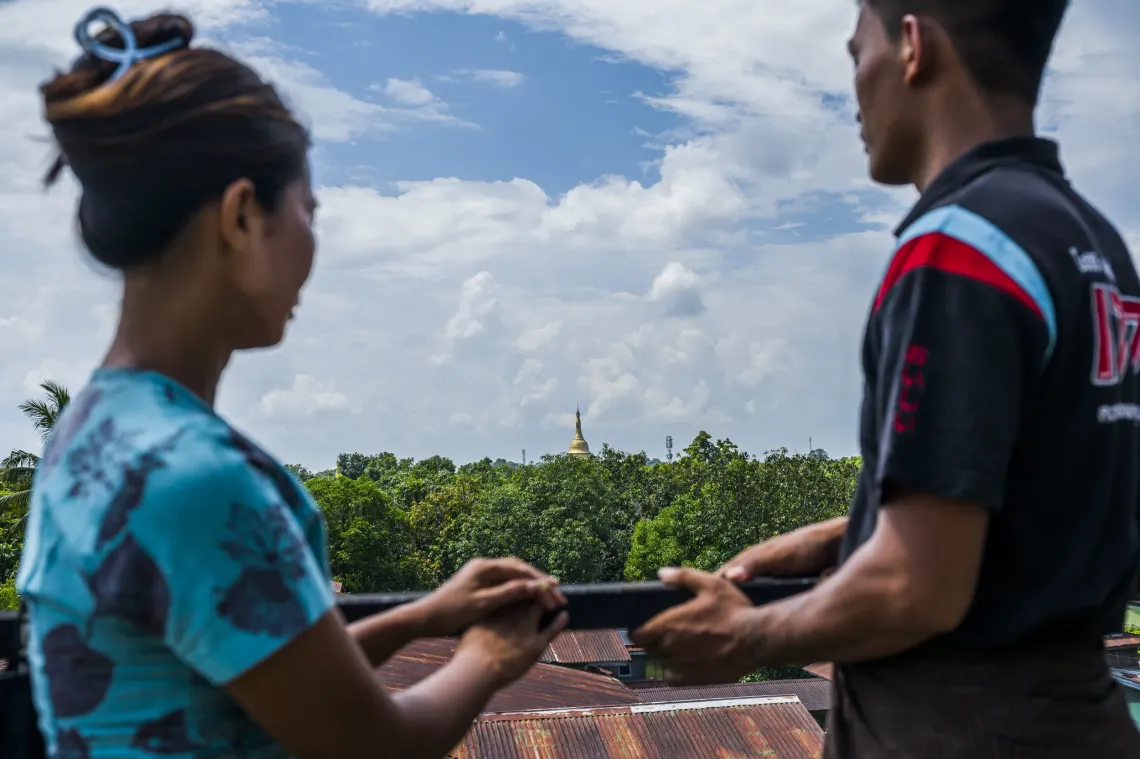
“When I first met him, he didn’t know anything about his rights as a child,” the lawyer recalls. “So, I explained them to him.”
For Aye Chan, that conversation brought reassurance during one of the darkest periods of his life.
“When I met the lawyer, he greeted me warmly, reassured me not to be scared, and explained what my rights were,” he says. “I never knew anything about child rights before.”
The challenges were considerable. Communication between lawyer and client was limited, and despite still being a child, Aye Chan was regularly brought before the court in handcuffs.
Drawing on his specialised training, U Myint Hlaing advocated for the teenager’s rights throughout the legal process. At a time when child-rights principles were not always widely understood, he repeatedly raised concerns about how the teenager was being treated and reminded justice actors of the protections afforded to children under the law.
“I had to explain the child’s rights and the laws protecting children,” he says. “I raised these concerns before the court and with other justice actors.”

Month after month, the lawyer continued advocating on the boy’s behalf while helping his family understand the legal process. For Daw San Aye, the support brought something she had nearly lost: hope.
“It really gave me courage and confidence amid the devastation to know that there was support for my son and other children facing this kind of trouble,” she says. “I realised there were still people willing to defend children’s rights.”
After four months in detention and months of legal advocacy on his behalf, Aye Chan’s case concluded and he was released.
“I was so happy that I cried,” he recalls. “I finally woke up from that nightmare.”
Looking to the Future
Today, Aye Chan is 19 years old and the father of a two-month-old baby boy.
Although years have passed since his release, uncertainty still shapes parts of his life. Like many young men his age, he worries about his safety amid reports of conscription and recruitment linked to Myanmar’s ongoing conflict. Some days, those fears are enough to keep him from leaving home to look for work.
Those experiences have only deepened his hopes for the next generation.
Looking at his infant son, he often thinks about the future.
“As a father now, I want to feel reassured that my son’s future will be safe and sound,” he says.

For U Myint Hlaing, stories like Aye Chan’s are why he continues his work. Since receiving his specialised training, he has supported more than 100 children’s cases. Beyond the courtroom, he regularly shares knowledge about child rights with parents, police officers, court officials and community members.
He believes the support provided through UNICEF, ILF Myanmar and the European Union (EU) has been vital in helping lawyers stand beside vulnerable children and their families at a time when access to specialised legal assistance remains limited.
“I am very grateful to UNICEF and the EU for this support,” he says. “Without it, children’s rights can be severely harmed. If a child is sent to prison, their future can be affected for years to come. They may carry psychological trauma, lose opportunities, and struggle to rebuild their lives. That is why this support is so important.”
His dream is simple: that every child understands their rights and that the responsibility for protecting them is shared across society.
“I hope child rights can be taught in schools so children understand their rights from an early age,” he says. “Parents, teachers, law enforcement officers, judges and everyone involved in children’s lives should know these rights too. Protecting children is a responsibility we all share.”
Until then, the people of Bago Region will likely continue calling him by the name he has earned through years of standing beside vulnerable families:
The Child Lawyer.
Names and locations in the story have been changed.