Periods with Dignity
Enhancing Learning Outcomes for Girls in Ta Greh Township through Menstrual Hygiene Management

- English
- မြန်မာ
Naw Marry Htoo (17) and Naw Moe Cherry (18) are, both Grade 12 students at Pitaka High School in Ta Greh Township, which falls under the administration of Karen Education and Culture Department (KECD), Kayin state, Southeastern Myanmar.
In their school, which has over 230 students, including 70 girls, managing menstrual periods used to be a challenge. While girls typically start menstruating between 10 to 15 years old, early education about menstruation and awareness on menstrual health is extremely limited, especially in elementary schools, which also lack designated facilities.
Menstrual hygiene management (MHM) is a crucial practice through which women and girls navigate their menstrual cycles. Unfortunately, throughout history, this aspect of women's health, particularly in schools, has been marginalized and even scorned. The natural occurrence of menstruation is frequently met with ignorance, resulting in improper practices and subsequent health issues due to inadequate hygiene. Despite the widespread use of menstrual pads, numerous secondary and high schools still lack dedicated facilities for proper menstrual hygiene management.

Looking back, Naw Moe Cherry remembered the struggles of having periods before the age of MHM rooms. “Our school did not have MHM rooms, neither did others. There were separate toilets, but nothing to help us manage menstruation. It was tough, and sometimes I wanted to skip school."
Things got better when MHM rooms were introduced to the school through ADRA Myanmar supported by Aeon 1% Club Foundation and the Japan National Committee for UNICEF. According to Naw Marry Htoo, after implementation of MHM rooms at her school, "It has been really convenient. We now have everything we need – pads, soap, water, and bins, all in one place. Dealing with my period is now safe and easy."
As part of the initiative, UNICEF teams rolled out awareness campaigns across schools, distributing information, education, and communication materials, and organizing sessions with education providers, community leaders and pupils on the importance of early education on MHM and the need to have dedicated MHM facilities across learning centers.
Both girls are inspired by this change.
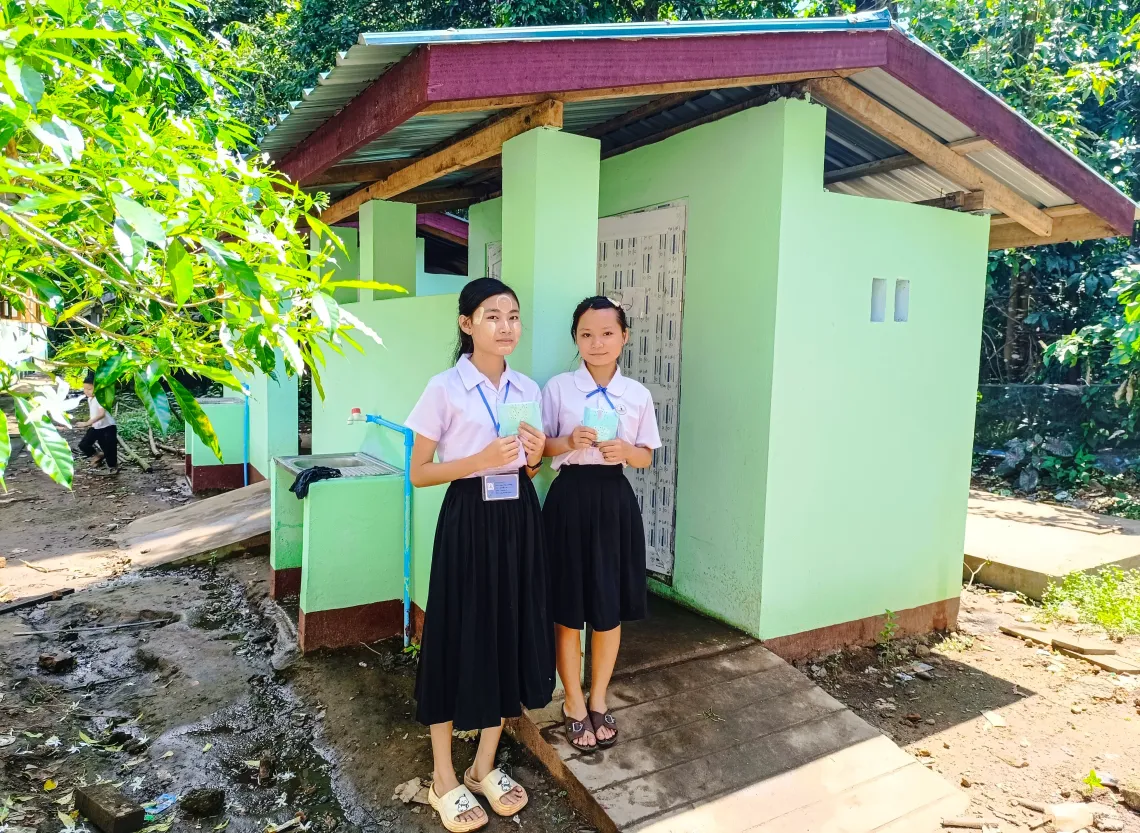
"Thanks to awareness sessions, posters, handbills, school lessons and awareness on menstruation, we now understand that menstruation is a natural part of becoming a woman, and there's no need to feel embarrassed about it," said Naw Moe Cherry.
Naw Marry Htoo also expressed her appreciation, "We are grateful for the MHM programme, UNICEF and our elders for thinking about us and making our school life better. With MHM rooms, not only has our school experience improved, but it also gives us the courage to ask for the same in other schools."
The shift from silent struggles to finding a voice represents a significant milestone for these students. The introduction of MHM rooms in schools serves as a symbolic marker of their journey towards living with dignity, fostering a positive, healthy, and secure school experience. This initiative not only promotes education but also lays the foundation for improved learning outcomes and a brighter future for all girls.