Everyone I know has been affected
Youth turn fear into action amid growing landmine threat in Myanmar

- English
- မြန်မာ
When Simon, 25, fled his home in Lashio, in Myanmar’s Shan State in late 2023, he thought he had lost everything. Conflict forced his family to leave behind their home, farmland, and everything familiar. Now displaced and staying with relatives, Simon carries not just the burden of survival, but the memories of friends who never made it out.
“I’ve seen how landmines have affected people returning to my hometown and heard firsthand accounts from displaced people across Myanmar who have been affected by landmines,” he said. And now, for the first time, I feel empowered to do something about it. I am homeless but not hopeless - I’ve never felt more useful in my entire life.”
Simon is one of more than 30 youth leaders who were trained by UNICEF in Explosive Ordnance Risk Education (EORE) in March 2025. The trainees, U-Reporters from the country’s most conflict-affected and contaminated regions, including Shan, Sagaing, Chin, Kayah, and Kachin, were equipped by UNICEF with tools to educate their communities on how to stay safe from landmines and explosive remnants of war (ERW).
The need couldn’t be more urgent. In 2025, Myanmar recorded 510 landmine and explosive ordnance incidents, killing or injuring 745 civilians, among them 155 children, both boys and girls. Shan State alone accounted for 33 per cent of all casualties. https://www.unicef.org/myanmar/reports/myanmar-landmine-and-explosive-ordnance-incidents-information-2025
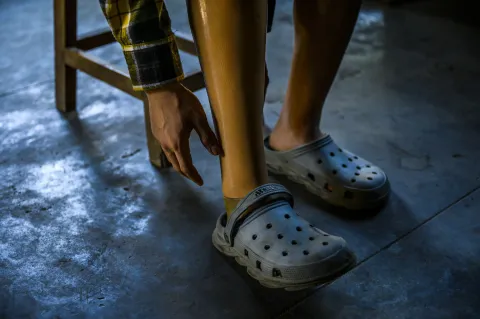
Landmines are no longer hidden in distant battlefields. They lie on paths to school, near water sources, homes, and farmlands—anywhere a child might take a step.
“Everyone I know has been affected—directly or indirectly,” said Simon. “This was my chance to help others avoid the same pain.”

Soon after the training, Simon and fellow UNICEF U-Reporters travelled to displacement camps and host communities in Shan State, Myanmar’s most heavily affected region. Armed with pamphlets, guidebooks, and determination, they began holding awareness sessions, some under makeshift roofs, others in church halls or open-air clearings.
“I met mothers who had lost their husbands. Teenagers who had seen friends die. Families who picked up explosives thinking they were scrap metal to sell,” Simon said. “They were desperate – and had no idea what they were handling.”

Mary, 18, from Kayah State, understands that desperation and impact of the conflict. She witnessed people in her village wounded by landmines or ERWs while on their community farm. Displaced for over a year and separated from her mother and younger brother, Mary now lives in Shan State, where she is leading the vital awareness sessions.
“Sometimes I feel sad and hopeless that I had to flee my home and community, away from family,” she said. “But now teaching families how to stay safe, I feel like I have a purpose. I hope that by preventing more deaths, I can begin to heal from my own losses.”

Mothers in the camps were quick to express their gratitude. Daw Thet Myar, a mother of two in a displacement camp near Nyaungshwe, said she had no idea what landmines looked like until the youth came to teach them. “Now I know what to watch for and what to tell my children,” she said. “I feel like I can protect them better. This knowledge will save lives.”
Another mother, Nan Htwe, whose husband was injured by a landmine while foraging for firewood, said the awareness sessions gave her a sense of control for the first time.
“We live in fear every day. But now, at least we know what not to touch, and what signs to look out for. I only wish this information had come earlier.”

Even among young people in the camps, peer-to-peer learning had a powerful impact. A 16-year-old boy in a host community near Taunggyi, who joined one of Simon’s sessions, said hearing from someone his own age made the message feel real.
“He wasn’t just giving a lecture. He’d been through it too. He knows what we are facing,” he said. “I told my little brothers and sisters everything he said when I got home. This will help us keep safe.”
The stories shared by families reveal how desperately needed this education is. Children unknowingly play with unexploded devices. Families scavenge for scrap metal, unaware of the risks. Some even mimic what they’ve seen in action films, thinking they can defuse explosives.
Seng Zaw, 23, from Kachin State, still remembers the moment his cousin was killed while playing near a stream. “It was supposed to be a safe place,” he said. “Now, I hear the same story over and over. Landmines in the fields. Landmines near homes. People stepping on them while fetching water or collecting firewood.”
With no demining operations in place, risk education is the only protection families have. UNICEF and its partners are working to expand efforts across conflict-affected areas, but the need far outpaces current resources.

“What we’re doing is helping people survive,” said Kyaw Win Oo, a UNICEF Child Protection Officer. “But we need to do more. We need funding to reach more communities, more children, more families who are still in the dark.”
For the youth leading the charge, this work has become deeply personal. “When I talk to displaced families, I see my own story reflected in theirs,” said Simon. “I don’t have much. But I have this purpose now. And I won’t stop.”
Mary added, “We’re doing everything we can. But we can’t do this alone.”
As the world marks International Day for Mine Awareness on 4 April, these young leaders are urging stakeholders and the international community to step up and invest resources in scaling up these life-saving efforts.
“This training saves lives,” Simon said. “But we’ve only just begun. There are thousands more families we haven’t reached – camps, villages, schools. If we had more support, we could do so much more.”