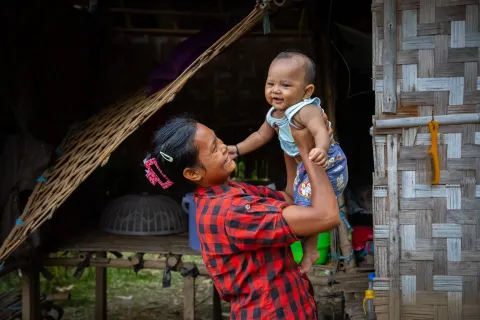
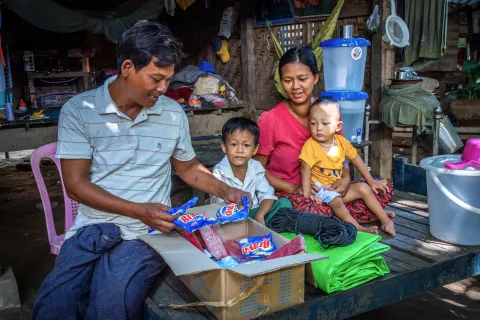
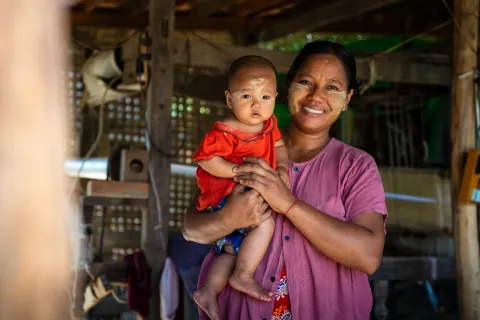
The day water came home
How solar power and community strength reshaped life in Kin Mon Chon, northwestern Myanmar

- English
- မြန်မာ
For years, 43-year-old Daw Pyae Yee lived her life around the sound of diesel.
Every morning before sunrise, she would shake her children awake and walk with them to the edge of Kin Mon Chon village, where the tall, ageing borehole stood. The long line always began early. As soon as the diesel engine sputtered to life, buckets, plastic jugs, and metal cans scraped against the concrete as families rushed to fill them before the sputtering engine overheated or the electricity cut out again.
“There were days when the engine refused to start,” she remembered. “If the grid failed, there was nothing we could do. No water for drinking, no water for cooking. You just waited… and hoped.”
Waiting became the story of the village. Kin Mon Chon sits in one of the driest parts of Chauk Township, where temperatures climb fiercely and groundwater lies deep under layers of hard rock. Even with two of the deepest boreholes in the area, the community lacked the power to draw enough water. Families spent precious income on diesel, only to wait 30 minutes or more each time for their turn. When electricity cut out—a common occurrence that sometimes lasted three days—the village was plunged into total water insecurity.
“We lost time, we lost money, and we lost strength,” said Daw Than Htway, 63, who has served on the Water User Committee for years. “We spent so many hours queuing that our fields were neglected, our children were late for school, and some evenings we returned home with barely enough to drink.”
Hope arrived when UNICEF, through critical funding from the Central Emergency Response Fund (CERF), proposed something that felt almost impossible: a fully solar-powered water system with a household metering network—bringing clean water directly into every household compound.
Most villagers had never imagined that sunlight, the same heat that dried their fields, could become the very force that delivered water.
“When UNICEF explained it to us, I thought, ‘Can the sun really do what diesel could not?’” Daw Pyae Yee said. “But it did. And it changed everything.”
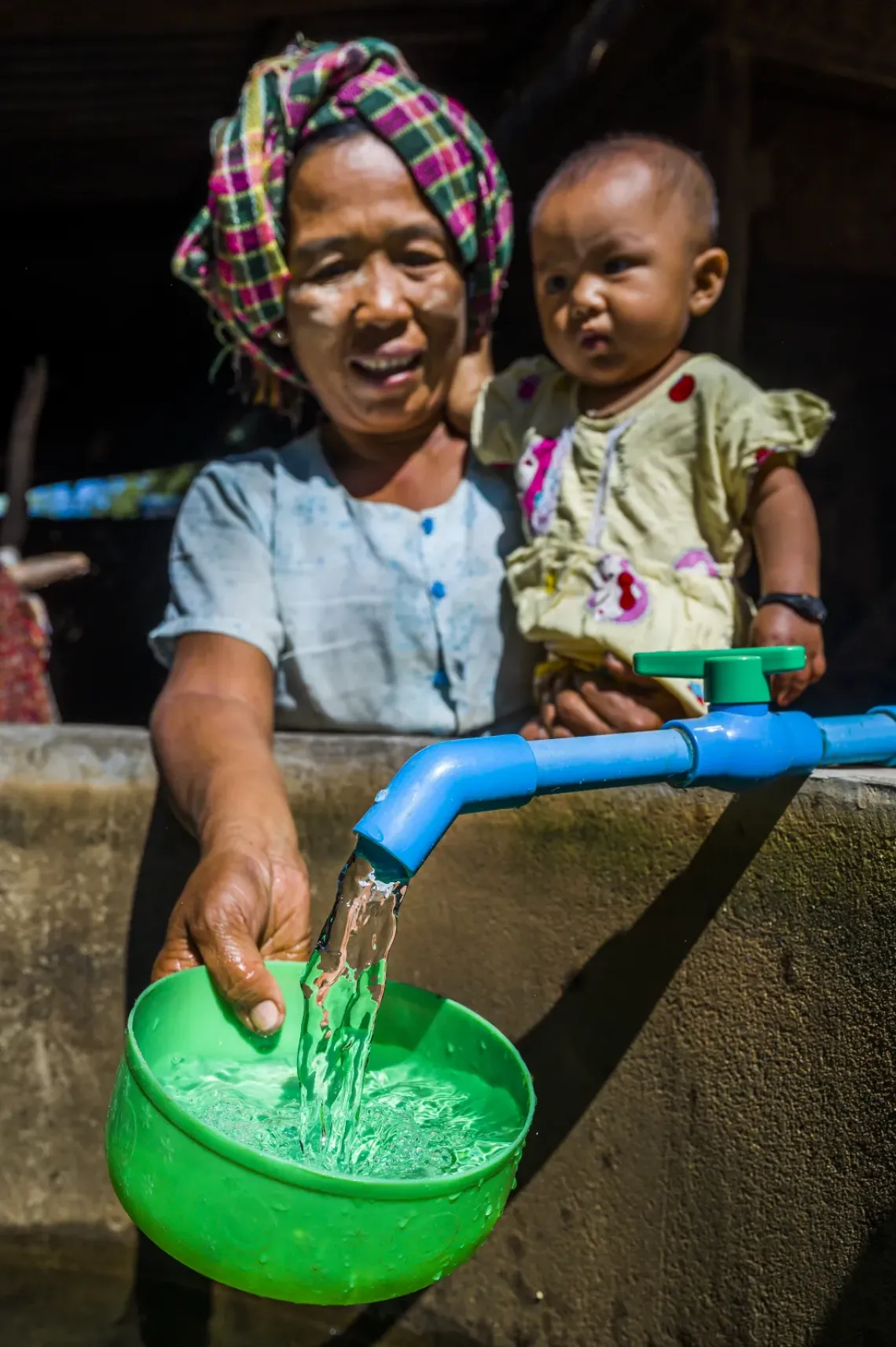
Working with its local partners, UNICEF installed a climate-resilient solar pump system, upgraded the boreholes, set up a new water tower, and laid a piped distribution network connecting every home. For the first time, families could open a tap and expect water—reliably, day and night.
“For us, this is dignity,” said Daw Than Htway, her voice catching slightly. “Now when I turn the tap, water comes. I still can’t believe it.”
At the centre of this transformation is U Tun Tun Win, the energetic Chairperson of the Water User Committee. Living with a leg disability since he was 16, he has nonetheless become the driver of the village’s most ambitious change in decades.
“We completely removed the diesel engine,” he said proudly. “Now the solar system covers the whole community. No noise, no smoke, no fear of the grid going dark.”
The financial impact was immediate.
“Before, we spent around 300,000 MMK every month on diesel,” he explained. “Now the cost is half. That money stays with the community.”
Kin Mon Chon families contributed their own funds to construct the water tower. They pooled money for pipes, fittings, and valves. And when installation began, the whole village turned out with shovels, basins, and bare hands.
“We dug every trench ourselves,” said 58-year-old Ma Yu Mon, who brought her two sons to help. “We wanted to feel that this system belongs to us—and it does.”
Elders helped direct pipe-laying routes. Young people carried sand and gravel. Women prepared meals for workers who spent long days in the sun. The community’s fingerprints are on every metre of the system.
“We built this together,” U Tun Tun Win said. “And because of that, we will maintain it together.”
CERF’s support ensured that hardware alone wasn’t the solution. UNICEF trained the entire Water User Committee and community volunteers in running the system and safeguarding it against the stresses of climate change.
Villagers learned how to maintain solar panels, manage water tariffs transparently, and implement Climate-Resilient Water Safety Plans—preparing them for extreme heat, unpredictable rainfall, or sudden breakdowns.
“I know how to fix basic problems now,” said U Tun Tun Win. “We are no longer afraid that one failure will shut down the whole village.”

Today, Kin Mon Chon feels different. Calmer. Stronger.
Families no longer queue in the heat. Children spend their mornings in school instead of carrying buckets. Farmers reach their fields earlier. The diesel engine, once a daily frustration, sits silent. And in the cluster of family compounds where Daw Pyae Yee lives, laughter echoes as children play under the shade of trees planted during the project.
“When my daughter asked for a glass of water the other night,” Daw Pyae Yee said, “I didn’t have to think. I just opened the tap. It felt like a dream.”
The change is more than water. It is time regained, health protected, dignity restored, and resilience built for a hotter, more uncertain future.
Thanks to CERF’s life-saving support, the people of Kin Mon Chon have turned a history of hardship into a story of leadership—proving that when communities have the tools, the power, and the knowledge, they can build their own climate-resilient future.
“This system didn’t only give us water,” said Daw Than Htway. “It gave us strength. It gave us hope. It gave us control over our tomorrow.”