Zinha can now afford medicine when her baby falls ill
"I am very happy to receive the money from this programme. It will help my son a lot."

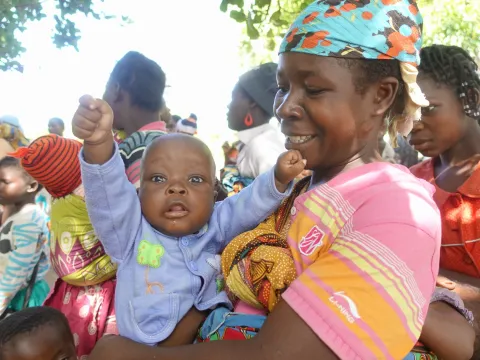
Ocua, Cabo Delgado - When eight-month-old Ajeu Flores fell ill with a fever, his mother, Zinha Dias, had to turn to her own mother for help buying medicine. But sometimes, there was no money to spare.
"When my baby was sick, I had to ask my mother for money to buy medicine," recalls Zinha, 31. "Sometimes she didn't have any money, so I couldn't buy the medicine for him."
Ajeu eventually recovered, but the experience was difficult for Zinha, who struggled to afford the medicine he needed.
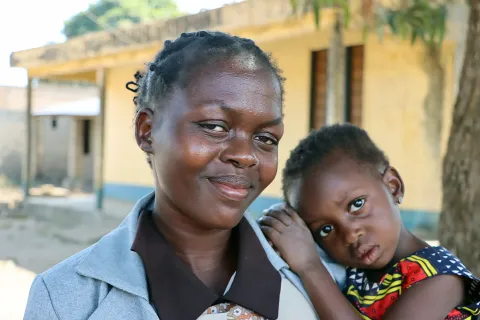
For Zinha, a mother of four living in Ocua, providing for her children is a daily struggle. Without a husband or a home of her own, she relies on working on her mother's land, where they grow cassava.
But what they produce is not always enough to feed the family.
"Some days we have no food, and there is nothing for us or the baby to eat," she says.
Good nutrition is particularly important during the first 1,000 days, from pregnancy to a child's second birthday, when the foundations for healthy growth and development are established. In Mozambique, 37 per cent of children under five are stunted, meaning they are too short for their age, a sign of chronic undernutrition.
Zinha hopes that a new source of financial support will help her provide a more varied diet for her son and meet his other basic needs.
The Government of Mozambique's Child Grant programme has just been introduced in Ocua, and Zinha is among the first to benefit. She has received 2,160 meticais, covering four months of support at 540 meticais per month.
"The money will make a big difference for our family," she says. "I will use it to buy maize and other foods besides cassava, as well as clothes for my baby."
The payment also means Zinha can buy medicine when her son falls ill, rather than relying entirely on her mother's help.
"Before, I had to ask my mother for money. Now I can buy the medicine myself," she explains.
The Child Grant programme supports vulnerable families with children aged 0 to 2 through a "Cash and Care" approach, combining financial assistance with information on nutrition, hygiene and childcare, alongside additional support for particularly vulnerable families.
An impact evaluation of the Child Grant in Nampula found that the proportion of children meeting minimum dietary diversity requirements doubled, while household poverty fell by 10 per cent compared with a control group.
In Ocua, approximately 2,000 beneficiaries are receiving support through the programme, implemented by the Government's National Institute of Social Action (INAS) with UNICEF support.
For Zinha, the grant offers some relief from the daily struggle to meet her children's needs, helping her buy more varied foods, clothing and medicine for Ajeu.
"I am very happy to receive the money from this programme," she says. "It will help my son a lot."
UNICEF supports the Government of Mozambique's Child Grant programme in Ocua through the UN Joint Programme on Social Protection (UNJP-SP), with generous funding from the Governments of Sweden, Ireland, Canada, Finland, Germany and the United Kingdom.