A Child Grant supports a father's hopes for his daughter
"We can buy food, nappies and clothes for our daughter. If she gets sick with fever again, like she did before, we can use the money to buy medicine."

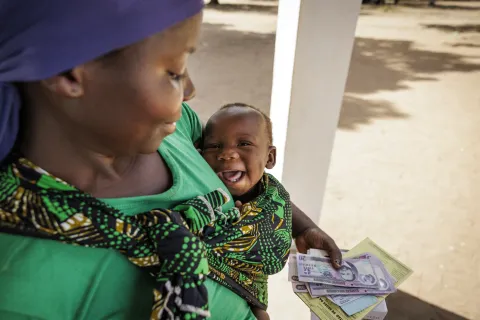
Ocua, Cabo Delgado - On a dusty patch of land at the edge of Ocua village, around 30 mothers and their babies sit on wooden benches and plastic chairs in the shade, waiting to receive Child Grant payments. Among them is just one father, 31-year-old Juanito Joaquim, who has accompanied his wife, Mathilde Castello, 20, and their 11-month-old daughter, Tina.
For Juanito, being involved in his daughter's upbringing is important, and he believes more fathers should take an active role in caring for their children.
"I would tell other fathers that they should participate in these activities for their children," he says. "They should be involved in looking after their children's health and wellbeing. There is nothing more important than our children."
Juanito and Mathilde live in Ocua, where they grow maize, beans and sorghum on their farm.
Tina was born healthy but later fell ill with malaria, an experience that highlighted the importance of having money available when a child becomes sick.
"Our daughter was born healthy, but later she became sick with fever and malaria," Juanito recalls.
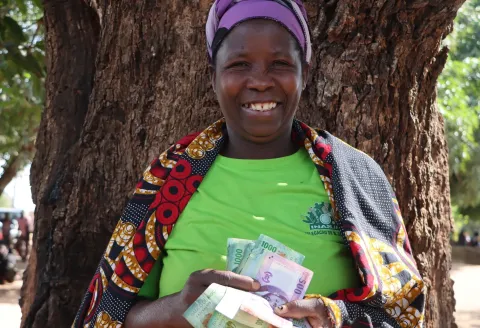
The Child Grant has just been introduced in Ocua, and Mathilde is among the first mothers to benefit. She has received 2,160 meticais, covering four months at 540 meticais per month. The money will help the family provide food, clothing and other essentials for Tina.
"This money will help our family a lot," Juanito explains. "We can buy food, nappies and clothes for our daughter. If she gets sick with fever again, like she did before, we can use the money to buy medicine."
The Child Grant provides financial support to vulnerable families with children aged 0 to 2, helping them meet essential needs during the critical first 1,000 days, from pregnancy to a child's second birthday. It follows a "Cash and Care" approach, combining payments with information on nutrition, hygiene, positive parenting and childcare, alongside dedicated support by social workers for particularly vulnerable families.
An impact evaluation of the Child Grant in that the proportion of children meeting minimum dietary diversity requirements doubled, while household poverty fell by 10 per cent compared with a control group.
In Ocua, around 2,000 beneficiaries are receiving support through the Child Grant, which is implemented by the Government's National Institute of Social Action (INAS).
"Many families do not have money, so they eat what they grow," explains Gedeão Focas, 39, an INAS technician in Ocua. He says the Child Grant helps families afford essentials such as food, soap and medicine for their children.
For Juanito, the support is about giving Tina a good start in life. He is already looking forward to the day when she begins school.
"When Tina is old enough, I look forward to walking her to school and collecting her afterwards," he says. "Education is very important."
And he has a particular ambition for his daughter.
"I want her to grow up to become a nurse."
UNICEF supports the Government of Mozambique's Child Grant programme in Ocua through the UN Joint Programme on Social Protection (UNJP-SP), with generous funding from the Governments of Sweden, Ireland, Canada, Finland, Germany and the United Kingdom.