Minalda’s Voice for Children in Nampula
Supported by UNICEF with funding from the European Union, Voice of the Children demonstrates how youth-led communication can drive social and behaviour change.

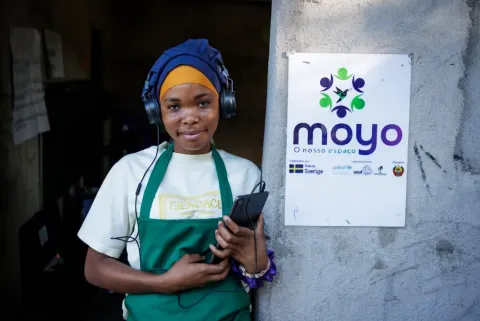
Namialo, Nampula - Every Saturday morning at 11 o'clock, thousands of children, parents and community members across Nampula tune in to hear a familiar voice. Calm, confident and full of energy, 18-year-old Minalda Mussa Sipia welcomes listeners to Voice of the Children, a radio programme created by young people for young people.
For the past four years, since she was 14, Minalda has been one of the programme’s young presenters, helping children and adolescents discuss the issues affecting their lives.
Every Saturday, the programme broadcasts for one hour in a mix of Makua, the local language, and Portuguese. Topics include children’s rights, child marriage, child labour, road safety, health and emergency preparedness.
“The majority of the community listens to the radio every day, and that includes children,” says Minalda. “Radio is very important for information and entertainment here in Nampula.”
For Minalda, radio is also a place where young people can ask questions, learn about their rights and hear from others their own age.
“I love my work on the radio because we can help children by sharing important information and starting discussions about issues in their lives,” she says. “We can help prevent children from getting diseases or making decisions that could affect their future.”
The conversations do not stop at the studio door. Voice of the Children regularly broadcasts from schools and community events, taking the programme directly to children and families.
During school visits, theatre groups perform interactive plays addressing children’s rights, health, protection and other social issues. Afterwards, Minalda and her fellow presenters interview students, capturing their reflections and questions for future broadcasts.
“The students know me because they have been listening to me for four years,” says Minalda.
The programme also connects young listeners with experts who can answer their questions. Minalda says doctors have discussed malaria and cholera prevention, while government workers have explained the child marriage law.
During cyclone season, the programme shared advice on how families could stay safe during storms, reduce the risk of cholera and protect children.
“We also had a special episode for parents on how to protect their children,” says Minalda.
For Minalda, some of the most meaningful discussions focus on protecting girls’ rights and helping them build brighter futures. She says the programme has encouraged girls who became pregnant to return to school and continue their education.
“Many girls who have babies at my age drop out of school and never return,” she says. “But on our programme, we have been telling them that it is not the end of their education and that there is help for them to return to school. I know a number of girls who listened to our show and returned to school.”
Another story has stayed with her. A girl told Minalda that her father wanted her to marry an older man with money. After listening to Voice of the Children, she learned that child marriage is illegal and that she had rights.
“She told her father this and said she would not marry so young. The early union did not go ahead,” says Minalda.
Stories like these remind Minalda that young voices can influence not only children, but also parents, families and communities.
Supported by UNICEF with funding from the European Union, Voice of the Children demonstrates how youth-led communication can drive social and behaviour change. By creating safe spaces where children can access reliable information, ask questions and express their views, the programme helps communities address harmful social norms, promotes children's participation and strengthens resilience in the face of everyday challenges and emergencies alike.
For Minalda, the experience has shaped her own future too. She has now finished school and hopes to study journalism.
As she turns 18, Minalda’s time on Voice of the Children is coming to an end. But she hopes the next generation of young radio hosts will build on what the programme has achieved.
“I would like the next young people to make the show even more impactful,” she says, “because this platform can really change the lives of people in our community.”
As one young voice prepares to hand over the microphone, others are ready to take its place, helping children across Nampula continue to be heard, informed and empowered.