The mango tree that sheltered five lives
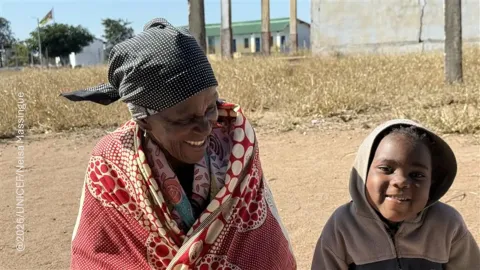
After floods destroyed her home in Guijá, Gaza Province, 81-year-old Delfina Mabunda is taking the first steps towards rebuilding her family’s life.

When floodwaters reached her home in Guijá, Delfina Mabunda had little time to react.
With nowhere else safe to go, the 81-year-old climbed into a mango tree in the family’s yard with her daughter and three grandchildren. There, the five of them waited for the waters to recede and for it to become safe to return to the ground.
When they finally came down, their home, built from fragile materials, had been destroyed.
Unable to rebuild immediately, Delfina improvised a shelter using plastic sheeting to provide some protection for her grandchildren. The family was left struggling to meet basic needs, including food, safe shelter and a source of income.
Delfina supports the household through small-scale agricultural work, but the floods made an already difficult situation even more precarious.
In June, Delfina was registered by the National Institute for Social Action (INAS) to receive post-emergency direct social assistance for households affected by the floods in Guijá. The assistance, delivered through M-Pesa, provided some immediate relief to a family that had lost almost everything.
UNICEF provided technical support to INAS throughout the response, working closely with district and provincial social action authorities to strengthen the identification of beneficiaries and follow-up with families receiving assistance.
The support also went beyond immediate financial assistance. UNICEF helped identify vulnerable children within beneficiary households and connect them with additional social services where needed. This included support to return to school, recover civil documentation such as birth certificates and identity documents, and access child protection services.
For Delfina, the financial assistance means being able to buy food, purchase seeds and begin repairing the family home. While it cannot replace everything the family lost, it is helping the family take important steps towards greater security and stability.
“The little I have, I share with my grandchildren,” Delfina says.
She now hopes to begin planting again and provide better conditions for her grandchildren as the family continues to recover.
Delfina’s experience reflects that of many families in Guijá who are rebuilding their lives after the floods.
UNICEF supported INAS to provide post-emergency direct social assistance to flood-affected households in Guijá, with generous support from the Eastern and Southern Africa Humanitarian Fund (ESA-HF), while helping vulnerable children access additional services to support their recovery and well-being.