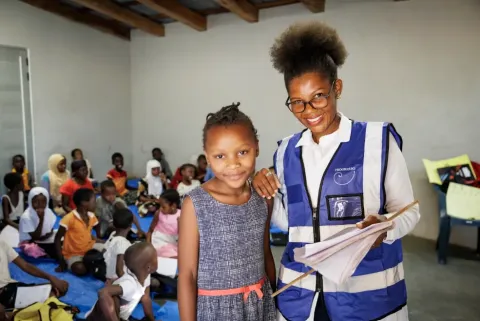
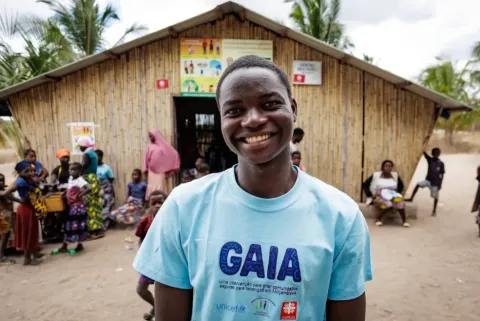
Knowing her rights: Elisite learns where to turn for help in Cabo Delgado
UNICEF supports the GAIA programme in Cabo Delgado with the generous support of the Government of Norway, helping adolescents affected by conflict understand their rights and know where to seek protection and support when they need it.

Mariangone, Cabo Delgado - For 17-year-old Elisite Antonio, learning about her rights has also meant learning what to do when someone is at risk.
Elisite, a Grade 7 student, has experienced insecurity herself.
“We had to run away from the community twice because men with guns came here,” she says.
Violence by non-state armed groups has repeatedly displaced families across Cabo Delgado, disrupting children’s education and daily lives.
After returning to Mariangone, Elisite began attending Girls Are In Action (GAIA) activities at the community’s multipurpose centre.
“I have been coming to GAIA for one year,” she says. “I have learned many things here.”
Girls Are In Action combines life skills education with psychosocial support to help adolescents affected by conflict understand their rights, build confidence and know where to seek help when they face violence or other protection risks.
At GAIA, girls and boys discuss issues including gender-based violence, child marriage and children’s rights. They also learn about the people and services they can turn to for support.
“GAIA has helped me understand gender-based violence and what to do about it,” Elisite says.
Adolescents are taught about Linha Verde 1458, a toll-free hotline that provides information and referrals on protection concerns, including gender-based violence, and Linha Fala Criança 116, a free child helpline where children can report abuse and seek support.
Elisite also knows that help can begin within the community.
“If someone here suffers from these situations, we must contact the police or the community leader,” she says.
She believes young people can also help friends who may be at risk.
“If a friend of mine is going to be married, I have the responsibility to approach them and say this is the wrong thing to do, to stop, and to get help,” she says.
Pedro Joao Augusto, 27, from Caritas, helps run GAIA activities in Mariangone. He says facilitators work with community leaders and formal services when an adolescent needs protection.
“If a girl comes to me about child marriage, the first thing I do is sit down with the community leader, then arrange a meeting with the family,” he says. “If it is not resolved, then we go to social services and the police.”
For Elisite, knowing her rights now also means knowing that she does not have to face a problem alone. She can speak to someone she trusts, contact a helpline or seek help from local authorities.
She hopes to stay in school and become a nurse one day.
UNICEF supports the GAIA programme in Cabo Delgado with the generous support of the Government of Norway, helping adolescents affected by conflict understand their rights and know where to seek protection and support when they need it.