A place where the future doesn’t give up
Far from home and facing uncertainty, displaced children in Goundam — like Boubacar — are finding a safe space to learn, heal, and dream again.

- Français
- English
Goundam, a few kilometers away from Timbuktu, hosts part of the 45,738 internally displaced persons, more than half of them are children, recorded in the Timbuktu region in September 2025, a sharp increase from the 24,867 displaced people registered in December 2024. Here, far from the homes they once knew, displaced families strive every day to rebuild a sense of normalcy. Amid the patchwork of makeshift shelters, a few bright, clean tents stand out — almost glowing with possibility. For children, these are more than just tents. They are their new school, a place where routines slowly return, and where hope begins to take shape again.
It is inside one of these tents that 12‑year‑old Boubacar started to feel like a student once more. “When our school stayed closed non-functional- for a whole week, I understood something was lost” — his words capture both the hardship of displacement and the relief of finding a safe, welcoming place to learn.
Just a few months earlier, his school in the village of Fatakara was forced to cease functioning. Gunfire, threats, and blocked roads emptied classrooms and forced teachers to flee. Like Boubacar’s former school, more than 2,300 schools in Mali are non‑functional, leaving more than 690,000 children without access to learning opportunities.

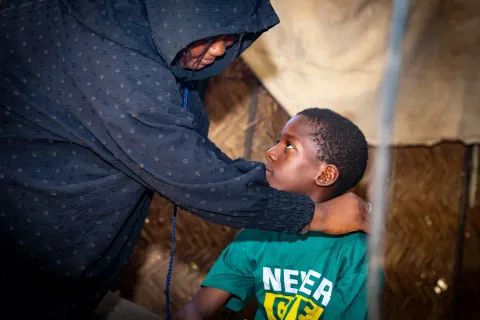
Hawa Cissé, a community volunteer teacher, trained in psychosocial support, gently placed a reassuring hand on his shoulder: “Here, Boubacar… this is also a school. You can learn again.” At first, Boubacar hesitated. The sounds of gunfire, sleepless nights, and tired faces kept coming back to him. “I had forgotten how to raise my hand,” Boubacar admits. But inside the tent, something shifted.
Little by little, Boubacar regained confidence. One morning, he picked up a pen. The next day, he read a sentence aloud. A week later, he stood at the board, reading a text in front of his classmates. “When I heard my own voice again, I knew I was getting better,” he says with a shy smile.
Teachers trained to support crisis-affected children know how to recognize fear in silence and discouragement at a glance. They teach — but they also listen. “In this space, we don’t just teach lessons. We help children rebuild themselves,” explains Hawa Cissé.

For parents, these tents have become an essential landmark. “Without these tents, our children would wander around the site. Here, they are protected, engaged, and they begin to dream again,” says Alassane Boureima, Boubacar’s father. Across the Timbuktu region, Boubacar is not alone. Like him, more than 3703 children including 1789 girls have resumed learning — or accessed education for the first time — thanks to the multi‑year resilience programme (MYRP).
“These tents are Temporary Learning Spaces that we set up with the Timbuktu Education Academy on displacement sites, while permanent classrooms are being built or rehabilitated,” explains Fatoumata Hamadoun, Education Officer in the UNICEF Timbuktu office. “They protect children from risks of violence, exploitation, or recruitment by armed groups. They offer a safe environment where childhood can breathe — even in emergencies.”
“Thanks to the support provided — from temporary learning spaces to teacher capacity building and the distribution of learning kits — the school attendance rate has risen above 50 per cent this year, a remarkable improvement compared to previous years,” proudly shares Mahamane Ibrahim Maiga, Director of the Pedagogical Animation Center of Timbuktu.

For Boubacar and his family, the support did not stop at only education. They also benefited from cash transfers, assistance that deeply changed their daily life. “Life here is difficult, but with this support, we were able to get back on our feet a little and start thinking about tomorrow,” says Alassane Boureima.
This social protection safety net allowed Boubacar to learn with peace of mind, free from the economic pressure weighing on so many displaced children. “Here, I understood that the crisis cannot steal all my dreams. As long as I learn, my future stays open,” he concludes, smiling with hope.
More than an emergency response, the multi‑year resilience programme (MYRP) is a strategic lever for peace, stability, and sustainable development — enabling every child to learn, be protected, and keep dreaming, even in times of crisis.

The second phase of the programme (MYRP2), launched by the Ministry of National Education in partnership with UNICEF and funded with $22 million from Education Cannot Wait (ECW), aims to ensure safe, inclusive, and quality education for 204,500 children and adolescents like Boubacar in Mali’s crisis‑affected regions. The programme responds to the impacts of conflict, insecurity, and natural disasters through three priorities: ensuring equitable access to education, improving teaching quality, and strengthening governance and resilience of the education system. It supports classroom construction and rehabilitation, teacher training, distribution of learning materials, and menstrual hygiene kits as well as financial support for vulnerable households. MYRP2 also promotes school inclusion, girls’ education, and alternative learning pathways, including vocational training.