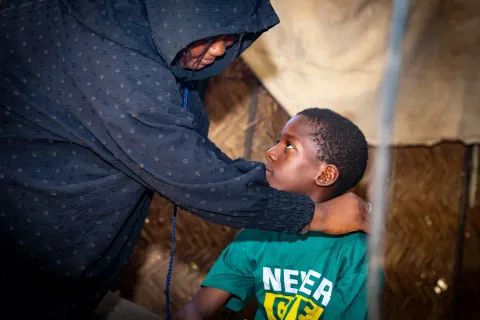
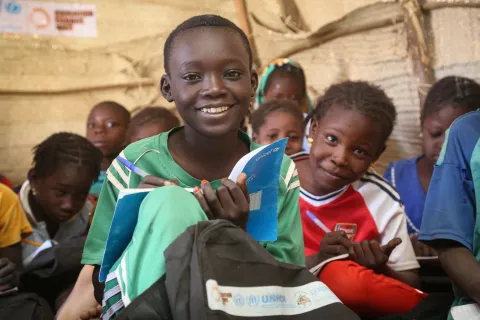
Running to reach the one canoe in the village to get to school on time.
With floods and desertification, the pupils of Ibrahim Touré School demonstrate resilience in the face of climate change relying on one canoe that serves a whole village to cross the canal to school.
- Français
- English
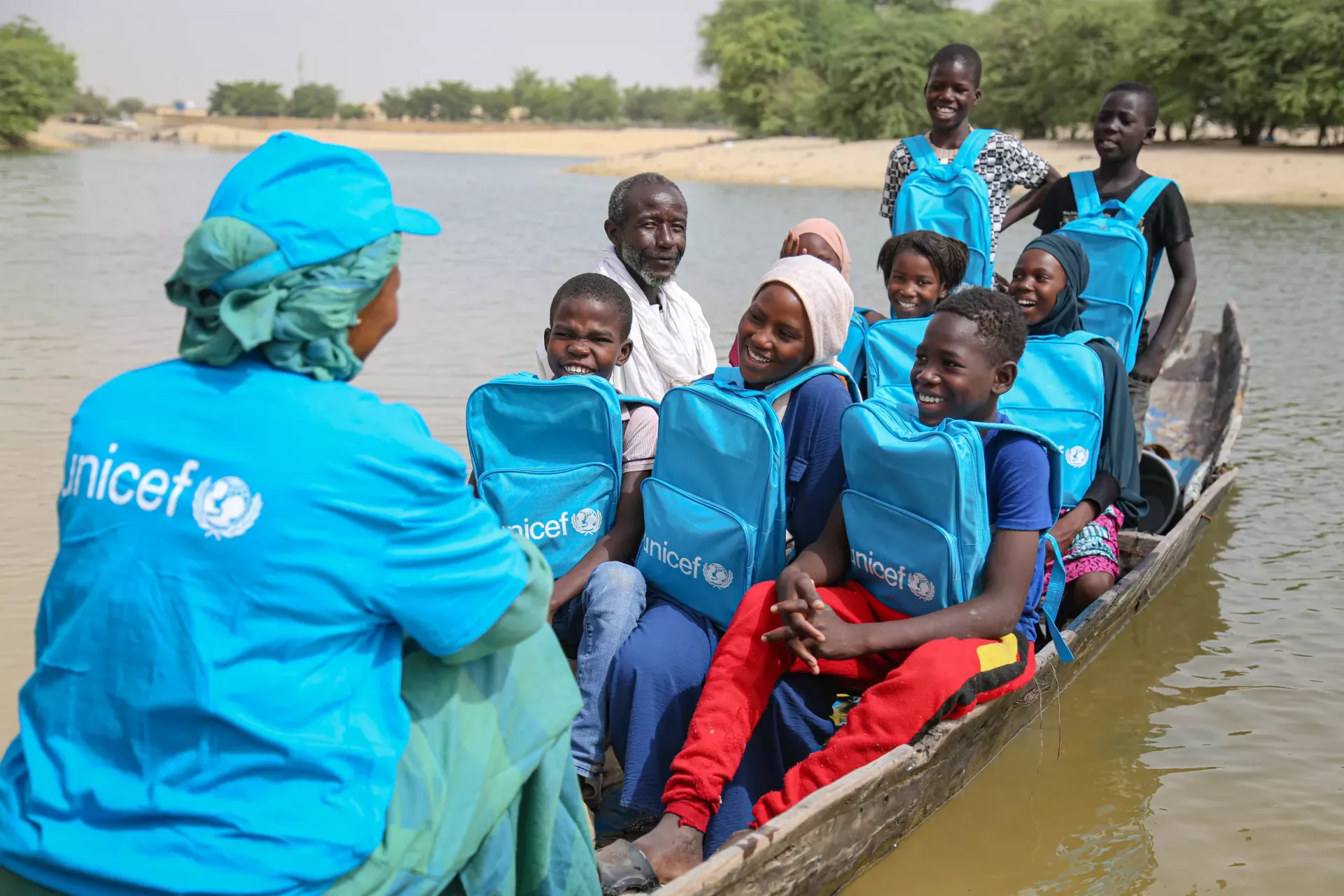
Every morning, dozens of children from the neighborhoods of Djingareyber, Sans Fil, Sankore, and Badjinde cross the canal in a canoe to reach the Ibrahim Touré School which squeezed between the canal that connects the Niger River to the city of the 333 Saints and the sand dunes that are gradually approaching the school's perimeter. This daily endeavor is undertaken by over a quarter of the school's population (96 out of 378 students).
Early in the morning, parents and students rush to the canal, creating an atmosphere similar to that of a bus station. The children board an old canoe that accommodates 15 to 20 passengers in the order of their arrival.
"During the flood season, we provide a canoe for the children's passage. The parents, through the School Management Committee, organize this boat crossing. ," explains Oumar Ismaguel, a notable figure in the Kolo Sector and representative of the Djingareyber neighborhood.


At the age of 10, Hamadoun Alhousseini, one of the children preparing for the crossing, describes what a typical day looks like for him as a primary school student. Each morning, Hamadoun must hurry to be among the first to board the canoe to get to the other side to avoid the crowd, considering that this is the only means used by the entire. village. "Every morning when I wake up, I take a shower, do my prayers, and pack my school bag. I then ask my mother for the money for the boat fare to get to school. It is my mother who provides me with the money for the crossing," he shares.
After the crossing, Hamadoun Alhousseini walks with his classmates for nearly half a kilometer, facing the hot, dry winds and the sand of the dunes beneath their feet. "The journey to the school can take us one hour. As you can see, walking in the sand is not easy. Sometimes we lose our balance and fall."
Due to the challenges of the crossing, the administration must adjust the school’s schedule to align with the realities on the ground. "We have shorter school days compared to the conventional programme, which can sometimes extend until five o'clock. We conclude classes by 2:30 PM to allow the children to return home on time, especially those who need to take the boat again. When there is determination, nothing can deter a seeker of knowledge," Mohamed, the school director, explains.


Communities seek effective and sustainable actions

The Ibrahim Touré School in Djingareyber faces numerous risks associated with climate change. The presence of the canal and sand dunes poses significant obstacles, while extreme temperatures, reaching over 45°C during the academic year, further hinder children's enrollment. According to the school management committee, these elements present substantial challenges that must be addressed to ensure the effective operation of the school. They believe that the children’s journey across the canal by canoe carries inherent risks, despite the absence of any reported incidents thus far. Parents are required to pay 50 XOF (7.5 cents $US) per child for the canoe crossing to school, which adds a financial burden on families.
The urgent appeal from the parents, the school administration, and the entire community is clear. "I urge all partners to engage in finding a solution to this issue. We need a bridge at this location to facilitate access to education for the children," states Mr. Saïd, the school director.
Ensuring that every child enjoys their right to education

In Timbuktu, following the floods, 14,288 children like Hamadoun Alhousseini and his fellow students at Ibrahim Touré School received individual school kits to help ensure they attend school. Furthermore, 17,338 children, including 6,840 girls, were reintegrated into the educational system through improvements of 56 facilities, including the renovation of 23 classrooms and the construction of 33 semi-durable learning spaces. The provision of 69 tents and 985 benches also played a significant role in establishing Temporary Learning Spaces. These responses to the floods were possible thanks to funding from the United Nations Central Emergency Response Fund (CERF) and from the Federal Republic of Germany for resilience initiatives (BRS),
"The school kits provided by UNICEF alleviate the burden on parents regarding the purchase of school supplies and also foster a sense among these children, who demonstrate remarkable determination to excel, that their ambitious goals are within reach" stated Mahamadou Moufliha, Director of the Pedagogical Learning Center in Timbuktu.
Hamadoun Alhousseini actively encourages his peers to attend school. "Children who do not attend school should not be loitering in the streets, as education is far more important than wandering around", he asserts. Hamadoun expresses his desire to pursue studies in order to earn money and build a school near his home, so that children will no longer have to endure the fatigue of traveling long distances to receive an education.