Early Childhood Education helps Awa to colour her dreams!
In Mali, Early Childhood Development Centres (referred to elsewhere as kindergartens or nursery schools) prepare children for primary school, enhance enrollment rates, and pave the way to future academic success.

- Français
- English
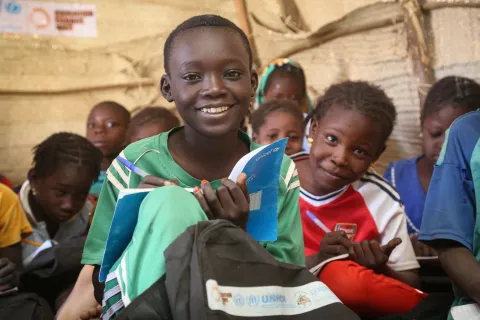
It is 7 a.m. in the village of Ambidedi-Poste, located about forty kilometers from the city of Kayes in western Mali. In front of the village’s school, Niangalen Cissé is holding the hand of her five-year-old daughter, Awa. She is taking her to the Early Childhood Development Centre (ECDC) situated within the village's primary school. Several other parents are doing the same, accompanying their children, five years old or younger, to the ECDC or preschool. Awa joins the other children in the Centre and her mother Niangalen says that she has seen some noticeable development in her daughter Awa since she began interacting with other children her age. The time that Awa is in the ECDC also gives her mother more time to manage the household.
"Since my child started attending the centre, I have been able to manage my schedule more effectively. I can complete many household tasks before she returns from school," she says.

The programme "Early Childhood Education in Two Vulnerable Regions – Mali," implemented by National Ministry of Education and national NGO with UNICEF support thanks to UNICEF Spain funds, has successfully established 135 ECDCs in Kayes and Koulikoro regions, achieving its set objective. A total of 7,697 children, including 3,882 girls, have been enrolled in these 135 ECDCs, surpassing the initial target of 4,500 children. In the Kayes region, particularly in the Ambidedi-Poste municipality, the programme facilitated the creation of over fifteen ECDCs, thanks to the active collaboration and involvement of local communities, supported by the Pedagogical Animation Centers (PACs), the Education Academies (EAs), and UNICEF.
In Ambidedi-Poste and several other municipalities in the Kayes region, UNICEF has assisted in the opening or reopening of Early Childhood Development Centres, such as the one Awa attends, through construction or renovation of classrooms and storage facilities, providing play kits, educational materials, and outdoor games, ensuring access to clean water, constructing latrines, and enhancing the skills of mothers as educators and the capacities of the center management committees.

According to Nènè Keita, a general pedagogical advisor at the Pedagogical Animation Center in Ambidedi-Poste, the role of the ECDCs is to prepare children for primary school. Her Pedagogical Animation Centre alone has fifteen ECDCs, with some demonstrating success and others needing further support.
"UNICEF has trained mother educators on topics such as discipline management, water, hygiene and sanitation, the use of the mother educator's notebook, and monitoring children's nutritional status," states Nènè Keita. UNICEF has also equipped the ECDC with recreational kits and outdoor play equipment such as swings, merry-go-rounds, and slides, in addition to constructing modern toilets.
The state of preschool education in Mali

ECDCs in Mali are primarily located in urban areas, with only 17 per cent of children enrolled in public institutions, 26 per cent in community-based programmes, and 56 per cent in private schools (Source: Education System Indicators Monitoring Report 2019 - 2023). However, access to preschool education has more than doubled from 3.4 per cent in 2012 to 7.53 per cent in 2023 (Ministry of National Education, 2023). Despite these improvements, preschool enrollment remains below the regional average of 27 per cent gross enrollment rate (Multiple Indicator Cluster Survey, 2015, UNICEF covering several countries).
Access to quality early childhood education in Mali is not mandatory and continues to be limited due to the restricted availability of preschool services, a shortage of qualified educators, and the lack of adequate infrastructure, such as water, sanitation, and hygiene facilities in schools.
These ECDCs positively influence outcomes in traditional schools. "The top students often come from these ECDCs. From the first year to the ninth grade, these children positively impact their peers. Generally, they are consistently among the top five in their class, sometimes even ranking consecutively," explains Adama Diallo, a teacher at the Ambidedi-Poste fundamental school. Mr. Diallo hopes that every child, like Awa, can benefit from the Early Childhood Development Centres.
Areas of strength to enhance

In 2023, the ECDC of Ambidedi had 70 learners, comprising 35 girls and 35 boys. Twenty-five of these children were successfully transitioned to primary school, providing them with a strong foundation for their primary education. This is not a common occurrence throughout the Malian educational system, where children typically begin primary school at the age of 6 to 7.
According to Madame Coulibaly Mâ Wague, head of the girls' education section at the Kayes Academy, the ECDCs serves as the cornerstone of education. At these centres, children are encouraged to become aware of themselves and their surroundings, preparing them for entry into primary education. However, managing Early Childhood Development Centres presents challenges for communities, despite their best efforts. The most significant challenge, as noted by Madame Coulibaly, is the lack of financial and human resources, with deficiencies in one leading to shortcomings in the other.
"Here, we have only one room that accommodates children aged 3 to 4, 4 to 5, and 5 to 6 years. This creates a mixed-age environment, which poses a problem. Due to limited resources, communities are compelled to place all children in the same class, albeit with differentiated support for those who are of school age."
Support from the instructors

Aichata Diawara, a dedicated volunteer instructor, expresses her pride in contributing to early childhood development in her village. "Seeing the children every morning brings me genuine joy. I understand that this is beneficial not only for the children's education, as they learn a lot of things here with their peers, but also for the parents, especially mothers, who can get more time for themselves."
In Mali, the community-based ECDCs receive support from UNICEF. Currently, there are 2,686 ECDCs operating throughout the country. In Kayes, the programme has reached 50 ECDCs, significantly impacting the children in these centres. Through monitoring missions by the EAs and PACs, the training received by mother educators in teaching methodologies, nutritional monitoring, and hygiene and sanitation have been effectively implemented. As a result, these educators maintain a close watch on the nutritional status of the children, ensuring that those with deficiencies are referred to appropriate health centres, thereby safeguarding their well-being. The Early Childhood Development kits, local toys, outdoor games, and sports equipment provided by UNICEF have greatly enhanced the children's learning environment.
One day, while walking home hand in hand with her mother, Awa looked up with sparkling eyes and said, "Mum, when I grow up, I want to be like Aichata and help children learn!" Niangalen, touched by her daughter's ambition, smiled. She knew that thanks to this programme, Awa and many others now had tangible dreams rooted in education.