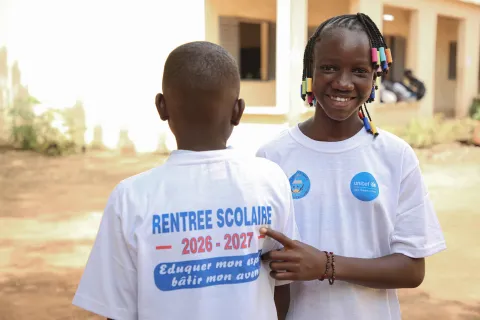
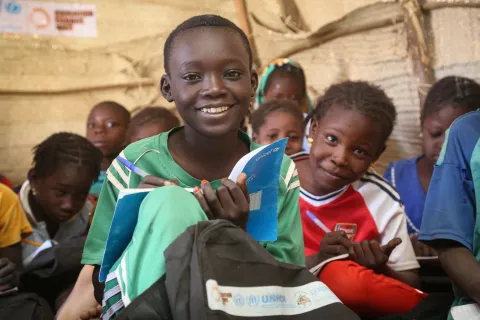
In Mali, students will return to school for the new 2024-2025 school year, this November 4th, 2024.
This year, more than 4 million students, including 1.8 million girls, will return to school for the 2024-2025 school year in Mali.

- Français
- English
Bamako, Mali, 04 November 2024 – This start of the school year takes place in a context of prolonged crisis marked by displacement of populations, attacks against education, as well as an increase in the closure of schools because of insecurity. In addition, heavy rains have caused floods and damage to several educational facilities nationwide, often transforming them into shelters for disaster affected populations. This situation resulted in the postponement of the start of the school year from October 1 to November 4, 2024. The schooling of boys and girls in Mali is hampered by social norms, household poverty, lack of infrastructure and teachers, and to this is added the impact of climate change such as high heat periods or floods during the rainy season.
This situation is well illustrated by the case of Fatoumata, 11, a student in the fourth grade in the Ségou region: "My school was flooded by the rains. I want it to be cleaned, weeded so that the classes can start as quickly as possible, thus enabling us to return to school. " - Quote shared before the start of the school year.
Despite these challenges, the Government of Mali and its partners remain committed to guaranteeing the right to inclusive and quality education, by putting particular emphasis on the resilience of systems, communities and individuals.
To reintegrate more than two million children outside the school system and keep more than four million registered children in the school circuit, the Government of Mali, with the support of Technical and Financial Partners (TFPs), continues to set up measures to ensure the continuity of education, in particular through the return to learning campaign. The campaign "For each child, an opportunity to learn" which targets the children of preschool and fundamental (first and second cycle) was launched on September 20, 2024, to boost the start of the 2024-2025 school year in Mali.
During his speech for the launch of the campaign, the Minister of National Education of Mali Dr. Amadou Sy SAVANE launched a vibrant appeal to all actors in the education sector: “I appeal to parents, students, teachers to put their heart to work. I therefore launch a solemn call for quality education. I invite the actors and the social partners of our education system to be in the right place at the right time. I invite teachers to be present in their posts and to accomplish, as expected, their professional obligations as educators and trainers."
As part of this campaign, approximately 50,000 students will receive school supplies, including teaching and learning materials. Emphasis is placed on the massive mobilization of communities, parents and guardians of preschool and school-age children, in favor of the enrollment and retention of children, and more specifically girls. Approximately 1.5 million people have already been mobilized thanks to the commitment of 2,500 young people and influential actors, through community awareness sessions, door-to-door visits, and radio broadcasts, including in conflict-affected areas. UNICEF encourages all education stakeholders to participate in these awareness campaigns for a return to learning.
On the sidelines of the campaign for the 2024-2025 school year, heavy flooding continued to rage, and the damage caused reminds us of the need to support governments in adapting to climate change and, more broadly, in strengthening resilience. The education sector fits well the resilience agenda as it is both a victim of shocks and a formidable tool for recovery and adaptation.
UNICEF has been involved in strengthening resilience for several years in Mali. Thanks to its anticipatory capacities and the flexibility of some of the contributions it has received, UNICEF has been able to support, to date, 62 schools affected by the floods for this school year through the provision of tents and school kits among other items, and support is continuing to cover additional schools.
The financial resources provided by our partners have also made it possible to achieve significant results in terms of access to education. Thanks to the Central Emergency Response Funds (CERF), Education Cannot Wait (ECW), European Union, and Germany, 50,458 children out of school (including 24,160 girls) were able to be integrated or reintegrated in 2024, thus facilitating their access to an environment conducive to learning. These efforts have also enabled the reopening and/or rehabilitation of dozens of schools for the 2024-2025 school year, while 1,792 schools were reported non-functional at the end of the previous school year, affecting more than 537,000 school-age children.
At the same time, the Government of Mali has retained several major strategic actions from the 2024 Education Convention when it was recommended to go beyond the constraints related to access to address the quality of learning, which is a key priority of the reforms of the Ministry of National Education. All TFPs were asked to support the Government of Mali in the development and implementation of a partnership pact for the transformation of the education system. This partnership framework aims to improve the quality of teachers for an efficient, fair and resilient education system. The Global Partnership for Education (GPE) is supporting this partnership, with technical support from UNICEF and UNESCO.
Similarly, phase II (2024-2027) of the Mali Resilience Programme (PPR-II) of ECW aims to support 204,500 children in the regions most affected by the crisis (Gao, Ménaka, Kidal, Timbuktu and Mopti).
UNICEF thanks the TPFs for their unwavering support so that each child has access to quality education in a safe and protective environment.
On the launch of the Back to Learning campaign, the UNICEF Representative, Dr. Pierre Ngom, reminded us that: "Education is a fundamental right that promotes a better future. By enrolling their children in school, parents contribute to the development of girls and boys as agencies for the transformation of society. Quality education is essential to reduce gender inequalities and promote the development of the country.”
Media contacts
About UNICEF
UNICEF promotes the rights and wellbeing of every child, in everything we do. Together with our partners, we work in 190 countries and territories to translate that commitment into practical action, focusing special effort on reaching the most vulnerable and excluded children, to the benefit of all children, everywhere.
For more information about UNICEF and its work for children, visit www.unicef.org.