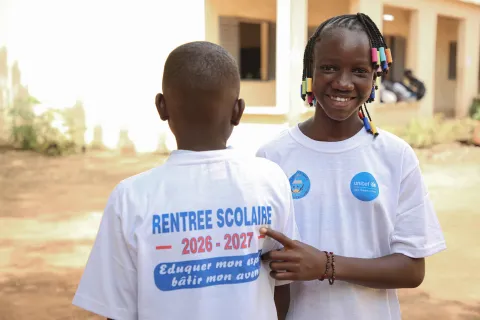
Hawa and Koumba, the hope of Gourel
Hawa and Koumba: The First girls to obtain the Certificate of Completion of Fundamental Studies (DEF) in Gourel-Ceno-Dedji

- Français
- English
In the village of Gourel-Ceno-Dedji, located in the Kayes region, a significant milestone has been achieved: for the first time, two children have successfully earned the Diploma of Completion of Fundamental Education (DEF). This village faces a troublingly high rate of school dropouts, with three out of four children failing to complete the second cycle of fundamental education. Contributing factors include the long distance to Gadiaba-Kadiel, the commune's capital, where the fundamental school is located, as well as economic hardships, social issues such as agricultural labor, and early marriage—all of which unfortunately lead to children dropping out of school prematurely.
In 2024, for the first time, two young girls, Hawa and Koumba, defied the odds with the support of their parents, teachers, local authorities, and UNICEF through the NORAD program. This initiative not only improved the quality of education by training teachers and strengthening pedagogical monitoring through Educational Academies and Pedagogical Animation Centers, but also provided bicycles to children—including Hawa and Koumba—to ease their daily commute to school.
Hawa: A Symbol of Hope for Gourel-Ceno-Dedji
Fifteen-year-old Hawa lives with her parents in Gourel-Ceno-Dedji, a village situated between Nioro du Sahel and Gadiaba -Kadiel, the administrative center of the commune. the local community primarily depends on agriculture and livestock farming. However, the village has an alarmingly low school enrollment rate, with many children dropping out before adolescence.Hawa is fortunate to have supportive parents who encourage her education. As an orphan, she relies heavily on her mother, Fatimata Bah, and her uncle, Amadou Dicko.

Fifteen-year-old Hawa lives with her parents in Gourel-Ceno-Dedji, a village situated between Nioro du Sahel and Gadiaba -Kadiel, the administrative center of the commune. the local community primarily depends on agriculture and livestock farming. However, the village has an alarmingly low school enrollment rate, with many children dropping out before adolescence.Hawa is fortunate to have supportive parents who encourage her education. As an orphan, she relies heavily on her mother, Fatimata Bah, and her uncle, Amadou Dicko.
Amadou Dicko, expressing his commitment to Hawa’s education, stated, "I want her to study. I already see the benefits of her education. Whenever we need help with our phones—saving contacts or retrieving numbers—she is the one who assists us."
Hawa's mother, Fatimata Bah, emphasized the struggles faced by children who lose a parent, noting that survival becomes even more challenging without a supportive family. "It is truly my husband’s brother who is taking care of everything for us today," she said.
After obtaining her primary education certificate, Hawa continued her studies in Gadiaba-Kadiel, located three kilometers from her village. Like many other students, she walked approximately six kilometers daily. "Walking to school was exhausting and painful," she recalled.

"Since I received the bicycle, going to school has been a relief, a genuine pleasure"
Many students in similar circumstances have been forced to drop out due to such challenges. TO address this issue and ensure every child has access to education, UNICEF, with support from Norway (NORAD), launched a project aimed at empowering adolescent girls through education in Mali. As part of this initiative, 294 bicycles were distributed to girls, including 36 students in the Gadiaba-Kadiel commune. These bicycles have significantly reduced dropout rates and improved school retention, particularly for girls in rural areas. The program has successfully reintegrated 13,000 girls into lower secondary schools, surpassing the initial target of 11,000.
Four students from Gourel-Ceno-Dedji, including Hawa and Koumba, received bicycles, making it easier for them to attend school. "Since I received the bicycle, going to school has been a relief, a genuine pleasure," Hawa said. "This year, I obtained my Fundamental Education Diploma. I am happy to have made my teachers proud. Without them, I wouldn’t have achieved this success. that is my greatest source of joy and motivation."
In many cases like Hawa’s and Koumba’s, parents might have chosen to marry off their daughters instead of allowing them to continue their education. However, Hawa’s uncle is determined to support her academic journey. "I want her to continue studying because we already see the benefits of her education. Now that she is going to high school, I will do everything I can to find her a host family in Nioro so she can continue her education," Amadou Dicko promised.
A call for the future of thousands of children

having successfully earned her Fundamental Education Diploma, Hawa now looks to the future with optimism. With the continued support of her family, she is empowered to shape her own path. She aspires to study health sciences, hoping to one day assist her community.
While envisioning her future, she reflects on the circumstances of her peers who were not as fortunate. "Achieving my Fundamental Education Diploma fills me with pride. Many of my classmates did not have the same opportunity, and I feel incredibly grateful," she said. "However, when I ask some parents why their daughters do not attend school, I hear different answers: some say the school is too far, others believe a girl’s place is in marriage, and some think educating girls is unnecessary."
Hawa strongly believes that every child should receive support not only from their parents but also from authorities and community partners. "Some of my classmates live far away and do not have bicycles. I hope they, too, will receive this support because it would encourage them to continue their studies. Sometimes, I leave my bicycle at home and walk with them in solidarity, so they don’t feel alone. I don’t want them to give up on their education," she said passionately.


“I want to encourage my fellow classmates to stay committed to their studies. We have the potential to become doctors and contribute to the health of our families. This will benefit us all. I urge students to focus on their education, respect their teachers, and, most importantly, practice patience. To achieve our goals, we must endure challenges—just as one must endure smoke to obtain coal.”