Drinking water supply revitalizes communities in Southern Madagascar
Since the implementation of the system called “Multiple Use of Water” in 2020 by UNICEF and its partners, 500 inhabitants of the village of Ehavo have seen the flourishing of economic activities within their community.

Under the blazing midday sun, we meet some women in the middle of the vegetable garden of Ehavo village – Androy Region, in the South of Madagascar. On this unusual day in November, the ground is still wet, watered by the scarce rain, which fell the day before. Among these women, Mamy stands out with her advanced age but with her radiant smile. At 56, she has seven children and twelve grandchildren. However, she is still hard-working even if her face has wrinkles left by the years of harsh survival, in the face of the drought that has been raging in the region. All these women are members of the village association that cultivate the vegetable garden. 25 households are beneficiaries and take care of it daily. “We grow cucumbers, zucchini and other vegetables with the installation of this drip irrigation system. During the harvest season, we can earn money through the local sale of the products. The rest is for our own consumption,” says Mamy.
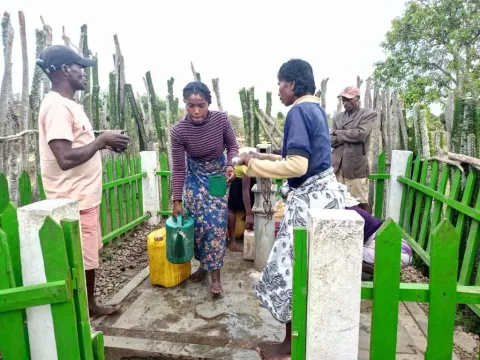
UNICEF and its partners have set up this drinking water supply system which serves 500 inhabitants of the village. Funded by KIWI, through UNICEF National Committee in Norway, this programme is part of the establishment of sustainable services, in order to enable the population to cope with the effects of climate change. Solar energy is used to power the water-pumping equipment for the 7m3 tank. The infrastructure also includes a standpipe, a plantation irrigation system and a handwashing device for pupils at the public primary school. 160 villages including 80,000 people in the three regions of the Deep South of Madagascar have benefited from this programme called "Multiple use of water".

Resilience to climate change
At the standpipe next to the school, we meet Vitasoa, Mamy's husband. He is responsible for managing the standpipe as well as distributing water to the villagers who come there to get their supplies. “Previously, we had to walk for five hours to find water, which we carried on our heads, using a pumpkin converted into a container. Today, people are more dynamic because drinking water is close to their homes, and they pay for it at a lower cost,” he says. Vitasoa is also president of the association of parents of public primary school children. Three of his grandchildren, Fanampime (12 years old), Manompiaze (10 years old) and Sambotodisoa (7 years old), are enrolled there. “I stay focused on my studies because later, I would like to become a midwife and help my community to develop,” says Fanampime, the eldest of the three children.
The population's access to sustainable water services is proving to be an essential point for UNICEF and its partners. As part of its 2021 – 2023 cooperation programme, UNICEF is targeting approximately 1,500,000 people in Southern Madagascar, who will receive the full package of water, sanitation and hygiene (WASH) interventions. The sustainability of these interventions will ensure relief among the population who will live in a climate-resilient environment. Some residents of neighbouring villages have begun to settle in Ehavo. According to Gege Jean Chrisostome, director of the school, "the number of pupils has continued to increase since the water arrived in the village".

Additional note: in the area of WASH, UNICEF is supported by several donors including the World Bank, USAID, CERF, ECHO, FCDO, KFW, the Governments of Japan – Norway – Korea and Italy, and the national Committees for UNICEF (Great Britain, United States, Denmark, Germany, Norway, France, Spain, Japan, Norway, Denmark, and the Netherlands).