Women in Action: Where Change Begins
In south-eastern Madagascar, a group of women has taken charge of their own destiny and has become a true model of leadership within their community.

In Ambila, a small rural village in the district of Manakara, the day begins early. Between household chores, getting the children ready and everyday challenges, women have long faced a difficult reality: making ends meet, accessing basic necessities and keeping their families healthy.
Since May 2025, a new dynamic has emerged. On that day, 23 people – the vast majority of whom were vulnerable women – decided to come together to form a community savings group called Voamani Mendrika. Among them were 19 single mothers, one teenager and just three married women, all driven by a common goal: to improve their living conditions and those of their families.
Initially, their initiative was focused solely on this community savings system. But very quickly, their ambition went beyond the scope of community savings.
“In the past, it was difficult for us to buy basic items such as sugar, a small solar lamp to use at night, or even to prepare a snack for our children. Hygiene products were often considered a luxury.”
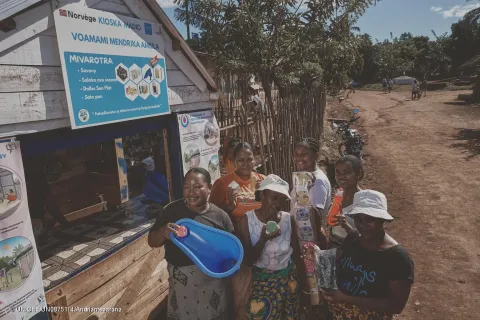
They then launched an income-generating activity (IGA) that directly addresses the basic needs of their community: the production and sale of hygiene and sanitation products. Solid and liquid soaps, handwashing stations, SanPlat slabs, washable sanitary pads… all tangible solutions to improve the daily lives of their fellow residents.
All members of the group are actively involved in this activity, which also includes the purchase and resale of essential goods as well as the running of a small food stall.
With the support of the DIO TAFA project, implemented by the NGO SAF/FJKM in partnership with UNICEF, their initiative has taken on a new dimension with the creation of the Madio Kiosk. This space has become a central hub for supplying the community.
Every week, around 250 bars of soap are produced (that is, nearly 1,000 per month), as well as 25 litres of liquid soap (around 100 litres per month).
The products are sold consistently and are even beginning to be stocked in local grocery shops, thereby expanding their impact. For local residents, this means easier, closer and more affordable access to water, sanitation and hygiene products. For the group’s members, it is much more than just an income.
The team members are driven by a desire to increase income, strengthen women’s leadership, foster community cohesion, ensure local access to WASH products and develop partnerships.

“Today, we are able to meet our needs without difficulty: our diet has improved, we take better care of our health and we have regained self-confidence."
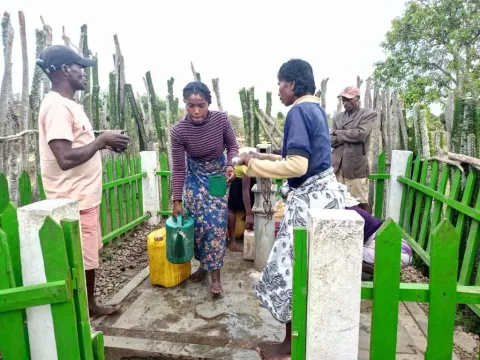
The impact extends beyond the group. By making hygiene products accessible, Voamami Mendrika is actively helping to ensure that open defecation remains a thing of the past in the community. Hygiene is gradually becoming a sustainable norm rather than a privilege.
Buoyed by this success, the group is now looking to the future. Their vision is clear: to evolve into a formal cooperative, increase their production and expand the number of their points of sale to become a key local reference in the field of WASH and nutrition.
Today, these women are no longer merely beneficiaries. They have become agents of change. Their story demonstrates that by combining community savings, entrepreneurship and the development of the sanitation market, it is possible to generate a lasting impact in economic, health and social terms, whilst empowering women.
Note: the DIO TAFA project is made possible thanks to funding from the Kingdom of Norway.