Communities welcome new types of improved latrines
In the Great South of Madagascar, new improved sanitation solutions are gradually transforming the daily lives of communities. Thanks to awareness-raising campaigns and tailored payment options, more and more families are adopting improved latrines.

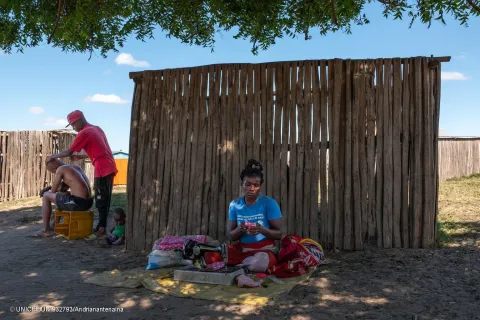
“I’m encouraging my community to use these new types of improved latrines, as they help keep everyone healthy,” explains Martine, a 67-year-old grandmother. In a small community on the outskirts of Tuléar, in south-western Madagascar, Martine is a respected figure in her neighbourhood. The woman, in her sixties, makes soap to support her family. This year, she decided to invest in an improved latrine, knowing how important better sanitation is for her family and her neighbours.
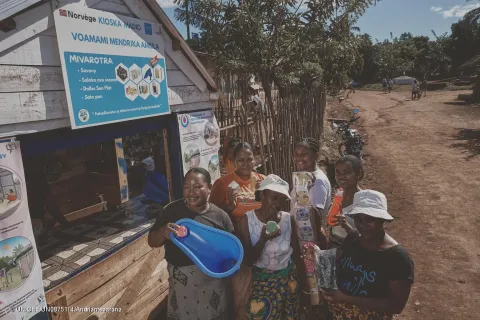
“We used to worry about our health when we didn’t have an improved latrine. Flies can carry disease,” she explains. Martine made this decision after discussing the matter with Justine, a sales representative recruited by the NGO International Development Enterprises (iDE), a UNICEF partner, which works in a consortium with the NGO Practica and Runway Consulting.
This 29-year-old young professional tours the neighbourhoods, going door-to-door to find new clients. According to her, listening is essential: “It is by talking with families that we understand their difficulties and we can offer them suitable solutions.”
For Martine, the price of 290,000 ariary – around 70 US dollars – was too high. Justine offered her a solution tailored to her situation.
“Thanks to the instalment plan, I was able to fund the structural work for the latrine. I’m going to do the same for the superstructure.”


A wide network of stakeholders
To build these latrines, Justine works with Ramarosandratana Sébastien, a bricklayer and owner of a small business specialising in the construction of water, sanitation and hygiene (WASH) infrastructure. In the town of Tuléar, there are only two companies offering this type of service. They have received comprehensive training and technical support, as well as capacity-building sessions on business management from the consortium.
Together, Justine and Sébastien are also promoting the use of the SATO pan with a self-closing flap, a practical sanitation device suited to this type of latrine. According to Sébastien, this system has several advantages: “It keeps flies out, reduces unpleasant odours and is easy to clean.”
Currently, they are also encouraging the adoption of a new type of latrine with a circular superstructure based on the Arborloo concept, a model that appears to work particularly well in rural areas. This model, designed by UNICEF, aims to improve communities’ access to safe sanitation services. The pits are easy to empty or allow for on-site waste treatment. The space provided also allows for dual use — as a latrine and a family shower — making it easier, in particular, for teenage girls to manage their menstrual hygiene.
“We build high-quality, sustainable and cost-effective infrastructure. With the right public awareness, the hygiene and sanitation market offers significant potential.”
In Madagascar, access to sanitation services remains a major challenge: more than 17,700,000 people did not have access to improved latrines in 2020. This increases the risk of water contamination and the spread of waterborne diseases such as diarrhoea, one of the leading causes of child mortality.
Against this backdrop, UNICEF has introduced this market-based sanitation approach. The overall objective is to reduce the pollution of drinking water caused by insufficient sanitation, benefiting at least 40,000 people in four target regions - Atsimo Atsinanana, Anosy, Androy and Atsimo Andrefana.
This programme highlights a strategic partnership with the private sector, fully aligned with UNICEF’s priorities. It demonstrates the growing commitment of businesses across various sectors to making a sustainable contribution to the sanitation sector.
By the end of the programme in 2026, Justine and the other agents involved have set an ambitious goal for themselves: to promote 8,000 latrines equipped with the SATO pan in communities across the Greater South. Martine, for her part, continues to sell her soap while looking after her grandchildren — and encouraging her neighbours to adopt better sanitation and hygiene practices.


Note : This market-based sanitation programme is supported financially by the Japanese government.