Building resilience to strengthen the economy and well-being of communities
Through a series of portraits, this story highlights life in the ecovillages of southern Madagascar and the impact of capacity building on the living conditions of the inhabitants.

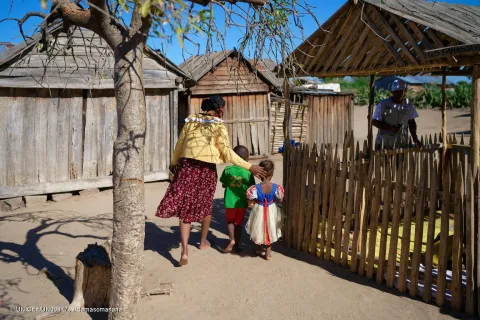
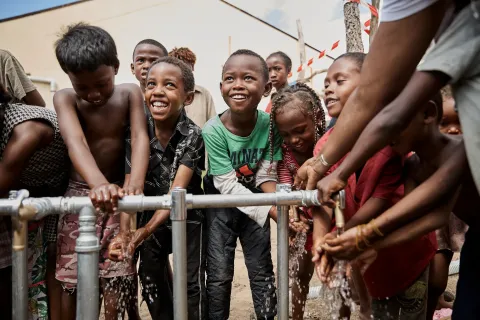
Like every morning, in the heart of the Terabovo ecovillage in southern Madagascar, Metrine goes to the water tap. The water point is located just two houses away from her home, in the same neighborhood. A single mother of a five-year-old child, she is responsible for one of the water points installed in the village by UNICEF and its partners. “Doing this daily task is important to me because I am contributing to village life,” she explains.
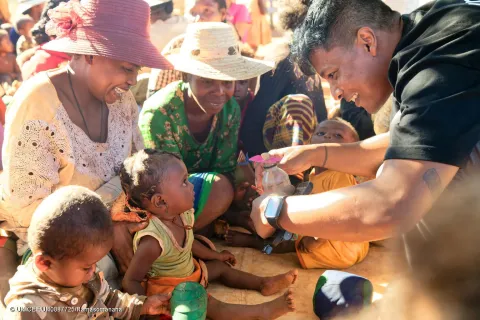
Metrine is also a member of a village savings and credit association, a community group where members make regular contributions, access small loans, and share the profits at the end of each cycle. Thanks to her loan, she was able to start a small pasta business, especially on market days. “This group has enabled many households, like mine, to strengthen their economic activities and look forward to a better future,” she continues.
Like her, Maho Rasoamampionona, known as Nitaka, is a member of this association. Thanks to this, her business selling reusable sanitary pads is thriving. “I am growing my business while supporting an important initiative for young girls in my community,” she emphasizes.


“I am growing my business while supporting an important initiative for young girls in my community."
Empowerment of girls and women
The lives of these women and girls have improved, and they have become more independent in dealing with the realities of daily life in these regions. Sambevave, 15, emphasizes the importance of empowering women and girls, a principle she finds in her former middle school club, located in the same village.
“I learned not only about my rights as a child, but also practical ways to protect myself from violence,” she says.
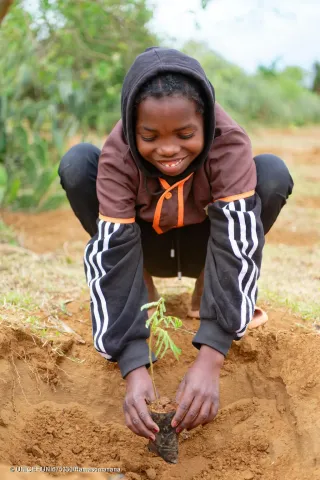
The village of Terabovo is one of 21 eco-villages created by UNICEF and its partners in southern Madagascar to strengthen communities' resilience to climate change. These model villages receive multisectoral support aimed at ensuring access to social services and sustainable infrastructure, promoting environmentally friendly practices, stimulating green and blue entrepreneurship, and encouraging inclusive local governance.
Thanks to funding from the Dutch National Committee for UNICEF, which focuses on community empowerment, several initiatives have enabled these populations to strengthen their resilience to their environment and, above all, to boost their economic activity, thereby tangibly improving their living conditions.
“Now that the whole community is using improved toilets, I think my business is thriving,” says Mbola, who is both a farmer and a manufacturer of circular slabs for Arborloo-type latrines.

Note: This ecovillage concept is funded by the National Committees for UNICEF in Belgium, the Netherlands, the United Kingdom (Moondance and Eleva foundations), France, Andorra, Korea, Germany and Norway (Kiwi).
“I learned not only about my rights as a child, but also practical ways to protect myself from violence.”