More children survive and attend preschool in Kosovo, but deep inequalities persist for Roma, Ashkali and Egyptian children, new MICS survey confirms

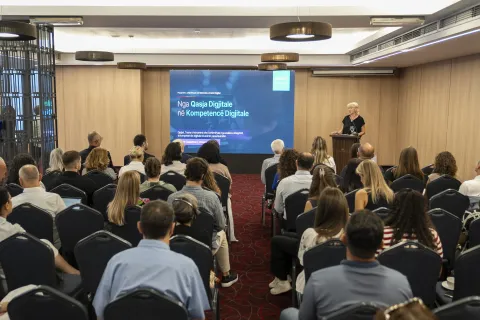
15th of September 2026, Prishtina – The Kosovo Agency of Statistics and UNICEF Kosovo today launched the findings of the 2025 Multiple Indicator Cluster Survey (MICS), the most comprehensive household survey on the situation of children, women, men and families in Kosovo. The findings indicate meaningful progress for children while also revealing persistent and, in some areas, stark inequalities affecting Roma, Ashkali and Egyptian children.
Director of the Kosovo Agency of Statistics, Avni Kastrati pointed out: “At the Kosovo Agency of Statistics, we are committed to producing high-quality, internationally comparable data that serves the public interest. The 2025 MICS findings provide essential evidence for monitoring progress, identifying inequalities and supporting policies to improve the lives of children and households across Kosovo.”
“Around the world, MICS is one of the most important tools that the UN supports. Wherever I have worked, it has been a core reference for government, for partners and for the UN’s programming. It produces data that is unavailable anywhere else, and it helps us to focus our attention on the most vulnerable people in our societies,” stated Stephen O'Malley, UN Development Coordinator to Kosovo.
As the third MICS round in Kosovo, following rounds in 2014 and 2020, this survey enables the assessment of progress over the years: child survival has improved, share in early childhood education has more than doubled, school readiness has continued to rise, and non-violent discipline has increased. Yet major disparities remain, with Roma, Ashkali and Egyptian children facing substantially higher risks in survival, nutrition, education and protection.
“The progress for children in Kosovo is real, but it is not yet equal. Data shows where investments are bringing results and where children are still being left behind. The common task is clear: use this evidence to target resources and services so that every child can survive, learn, be protected and thrive,” said Veronika Vashchenko, Head of the UNICEF Kosovo Office.
Key findings indicate that neonatal mortality declined from 11 to 8 deaths per 1,000 live births in Kosovo, a decrease of 27% from 2020, while among Roma, Ashkali and Egyptian communities from 21 to 15 a decrease of 29% since 2020.
Full immunisation among children aged 24–35 months stands at 76% in the general population and 44% among Roma, Ashkali and Egyptian children. Participation in early childhood education among children aged 3–4 more than doubled from 15% in 2020 to 36% in 2025, but remains around 7% among Roma, Ashkali and Egyptian children.
Education and protection gaps also remain pronounced. School attendance in the general population is 96% in primary, 95% in lower-secondary and 89% in upper-secondary education, while among Roma, Ashkali and Egyptian children it falls from 83% in primary to 27% in upper-secondary. Violent discipline declined from 72% to 64% and severe violence from 6% to 2%, but violence against children remains widespread.
Nutrition presents an emerging challenge in Kosovo. 24% of 5-9 years old children and 32% of children among Roma, Ashkali and Egyptian communities are estimated to be overweight.: 57% of children aged 6–23 months and 80% among Roma, Ashkali and Egyptian children eat unhealthy food.
Social transfers reach 94% of children under 18 years old and 80% of the population live in households that receive any type of social transfer, offering an important platform for more child-sensitive social protection.
MICS 2025 is based on nearly 14,000 interviews completed in 6,928 households through two separate surveys. The data can be disaggregated by residence, sex, age, education, wealth, ethnicity and disability status, helping institutions look beyond averages and identify where inequalities persist. MICS data can support policy and budget decisions, strengthen accountability and monitor progress against national and international commitments, including the Sustainable Development Goals.
The findings provide Kosovo institutions, development partners, civil society, academia and communities with a common evidence base to protect gains and accelerate progress for children, especially those furthest left behind.
MICS is a global household survey programme developed and supported by UNICEF, producing statistically sound, internationally comparable data on children, women and households. Led by the Kosovo Agency of Statistics, . MICS 2025 in Kosovo was funded by the government, UNICEF, the Swiss Cooperation Office – Embassy of Switzerland in Kosovo, the United Nations Development Coordinator Office in Kosovo, and UNFPA.
Media contacts
About UNICEF
UNICEF promotes the rights and wellbeing of every child, in everything we do. Together with our partners, we work in 190 countries and territories to translate that commitment into practical action, focusing special effort on reaching the most vulnerable and excluded children, to the benefit of all children, everywhere.
For more information about UNICEF and its work for children, visit www.unicef.org.