YuWaah Leaders Council
Bringing together multi-sectoral decision makers to co-create a better future

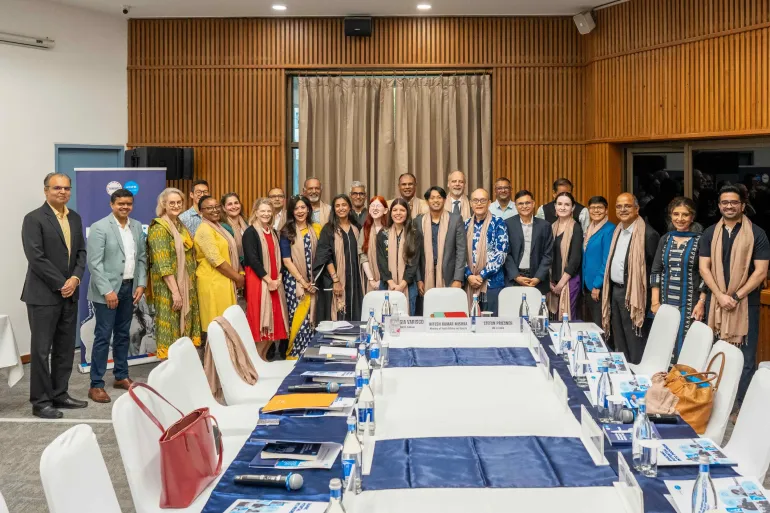
The Leaders Council is part of YuWaah’s governance structure, and is an exclusive group of senior decision-makers from across sectors focused on providing advisory guidance towards addressing the pressing issues faced by India’s youth today.
Co-chaired by:
- Dr. Pallavi Jain Govil, Secretary, Ministry of Youth Affairs and Sports
- Stefan Priesner, Resident Coordinator, UN in India
- Sanjeev Krishan, Chairperson, PwC India
This body meets twice a year to discuss potential strategies and best practices for strengthening the transition of young people from ‘learning’ to ‘earning’.
June 2026
Background
India's demographic dividend is widely seen as central to the country's development, with growing recognition that young people must be connected to opportunities that deepen their capabilities. India's working-age population is projected to exceed 980 million (98 crore) within the next decade (Economic Survey of India, 2025), yet barriers to their economic participation persist. Chief among them is the mismatch, sharpened by technological change, between the skills young people hold and those the market demands. Public and private sector interventions largely target discrete points on the youth development spectrum rather than the full learning-to-earning continuum, raising concerns about drop-offs along the way.
Rather than build parallel structures, the priority is to converge existing solutions and infrastructure into coherent journeys tailored to young people's needs. The integrated opportunities centre model was proposed to the Leaders Council as a physical hub of services enabling a seamless transition from skilling to economic opportunity, further reinforced by career guidance, mentorship, and active feedback loops to capture user insights.
Insights
Drawing on their expertise, stakeholders shared candid views on the gaps this model could address, the challenges it may face, and opportunities for convergence:
1. Bridging the Skilling–Employment Divide
Participants prioritised closer alignment between skilling programmes and market demand, seeing integrated opportunities centres as a key lever. This means training informed by employer and emerging-sector needs, such as the green and care economies, linked to internships and apprenticeships, with industry as an active partner in co-designing programmes and creating opportunities, particularly in Tier-2 and Tier-3 cities. Technology, especially AI, was flagged as central to closing this gap: helping young people explore career pathways and make faster, better-informed decisions through easier access to information.
2. Centering Youth Voices and Aspirations
Stakeholders agreed the centres must go beyond traditional skilling to support holistic development through mentoring, social-emotional support, and re-skilling/lifelong learning delivered by professionals trained to understand young people's varied realities. Youth should be treated as active partners in designing, implementing, and evaluating programmes, not merely as beneficiaries. Their involvement is especially critical to keeping the model responsive, including on issues like limited post-training support and the poor transferability of credentials and certifications.
3. Integrating Equity and Inclusion
Equity and inclusion must be built into the design and delivery of youth programmes from the outset. Participants highlighted the compounding barriers facing the most vulnerable, such as young women balancing caregiving responsibilities, or families' safety concerns discouraging them from sending daughters to training centres. Recommendations included embedding gender-responsive measures, delivering localised and accessible information, and building community-based support systems that reach the last mile.
4. Convergence and Shared-Value Partnerships
Participants called for systematically mapping existing government schemes and infrastructure that these centres could draw on, so young people experience skilling and employment as one continuous, navigable pathway rather than a fragmented system. Beyond convergence, cross-sectoral shared-value partnerships must be prioritised to combine public and private sector strengths into a seamless experience. Drawing on past public-private partnership experience, participants stressed the need for flexibility to allow course correction, a focus on emerging sectors, and stronger information-sharing to drive better outcomes.
Looking Ahead
The discussion underscored that strengthening young people's pathways to economic opportunity requires moving from siloed interventions to an integrated ecosystem. The Leaders Council aligned on the potential of this framework to close the gap in youth transitions. The next step is translating these collective insights into actionable partnerships and implementation pathways, while ensuring the model adapts to local context, and enables young people to navigate the journey from learning to earning.