UNICEF report highlights global megatrends influencing children’s future
Childhood ‘hangs in the balance’ unless urgent measures are adopted to protect children’s futures globally, according to the new report

- English
- हिंदी
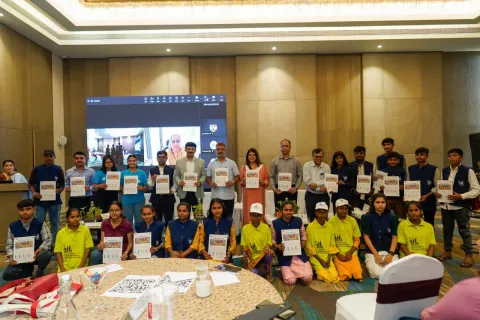
New Delhi, 20 November 2024 - UNICEF’S global flagship report, The State of the World’s Children 2024 report titled, ‘The Future of Children in a Changing World, was released here today by Cynthia McCaffrey, UNICEF India Representative together with Suruchi Bhadwal, Director, Earth Sciences and Climate Change program-The Energy Research Institute (TERI), two children and Kartik Verma, UNICEF India youth advocate.
The report looks ahead to 2050 and examines three global megatrends-demographic shifts, climate and environmental crises, and frontier technologies anticipated to fundamentally reshape children’s lives, rights, and opportunities between now and mid-century.
Reflecting on the projections in the report, Cynthia McCaffrey said, “The three megatrends highlighted by the State of the World’s Children report compel us to examine how to support countries in creating a future that advances the rights of every child. Decisions made today will shape the world our children inherit in 2050. Collectively, we have the opportunity and responsibility to build a prosperous and sustainable future for all children. Placing children and their rights at the centre, in all strategies, policies, and actions, is the way forward.”
The report projects that by 2050, the global child population will stabilize at around 2.3 billion, with a significant shift in regional distributions. India, China, Nigeria and Pakistan are expected to account for more than a third of the world’s child population by 2050. India will have approximately 350 million children, despite a decline of 106 million compared to today. Investment in education, healthcare, child benefits and skill development for children and young people are critical to addressing the challenges.
At the same time nearly one billion children already live in countries at high risk of climate hazards and this figure is expected to rise dramatically without significant interventions. Children are highly vulnerable to the climate and environmental crises, especially those who live in rural and low-income communities, with an anticipated eightfold increase in exposure to extreme heatwaves and significant risks from floods, wildfires, and cyclones. These climate-induced challenges worsen vulnerabilities impacting their health, education, and access to safe water. According to Children’s Climate Risk Index (CCRI), in 2021, India ranked 26th out of 163 ranked countries globally, with children particularly exposed to risks such as extreme heat, floods, droughts and air pollution.
Suruchi Bhadwal, Director of the Earth Sciences and Climate Change program at The Energy Research Institute (TERI), said, “Climate change affects children differentially through both direct and indirect impacts on health, making them vulnerable to its impacts. There is a strong need for children to join the fight against climate change. Children can contribute immensely to the climate agenda by being active agents of change.”
Frontier Technologies like Artificial Intelligence offer both promise and peril for children, who are already interacting with AI embedded in apps, toys, virtual assistants, games, and learning software. But the digital divide remains stark. In 2024, over 95 per cent of people in high-income countries are connected to the internet, compared to nearly 26 per cent in low-income countries.
Government investments in child survival and life expectancy, socioeconomic development, education, gender equality, conflict, urbanization, and the environment will determine the impact of these megatrends on children.
“The findings from the report are particularly important for India as it is projected that the country will be home to 15 per cent of the global child population. It is critical for India to plan for the future so that children can achieve their full potential.
“India has made significant progress towards children’s rights. To continue on this path, we need to meet the challenges through continued child centric investments in health, quality education, skilling and job opportunities, bridging the digital divide for equal access to technology. In the coming decades, with almost half of India's population projected to live in urban areas, investments in sustainable, child-friendly urban infrastructure will be needed.
“In all of this, importantly, we need to hear from children and young people themselves about the challenges they face so that the future we build is sustainable, equitable and peaceful.
“UNICEF, over 75 years continues to partner with India, supporting children to have equal access and opportunities in realizing their ambition, where young Indians are empowered to lead India to its second century,” said Cynthia McCaffrey, UNICEF India Representative.
Kartik Verma, shared insights from his recent participation at COP29 as a UNICEF India Youth Advocate, “Climate change is a child rights crisis – it is affecting our health, education, and overall well-being. At COP29, I witnessed young people worldwide presenting innovative solutions and demanding urgent action. Climate education must become a key part of our schools so that more children can become part of the solution.”
The State of the World’s Children 2024 calls for meeting the challenges and opportunities posed by the three megatrends by:
- Investing in education, services, and sustainable and resilient cities for children.
- Expanding climate resilience in infrastructure, technology, essential services and social support systems.
- Delivering connectivity and safe technology design for all children.
This year, The State of the World’s Children report is launched on 20 November, celebrated globally as World Children’s Day - UNICEF’s annual day of action for and by children, with a focus on ‘Listen to the Future,’ voices of children and young people on the world they want.
As in previous years, iconic monuments across the country, including those in New Delhi, lit up blue in support of child rights. The Rashtrapati Bhavan, India Gate, Parliament House, North and South Blocks of Raisina Hill, Qutub Minar, and UN Offices illuminated in solidarity #ForEveryChild on World Children’s Day. #GoBlue highlights the importance of inclusion, equality, and non-discrimination, reinforcing the commitment to a brighter future for every child.
Download the 2024 report on The State of the World's Children: https://www.unicef.org/reports/state-of-worlds-children/2024
Media contacts
About UNICEF
UNICEF promotes the rights and wellbeing of every child, in everything we do. Together with our partners, we work in 190 countries and territories to translate that commitment into practical action, focusing special effort on reaching the most vulnerable and excluded children, to the benefit of all children, everywhere.
UNICEF India relies on the support and donations from businesses and individuals to sustain and expand health, nutrition, water and sanitation, education and child protection programmes for all girls and boys in India. Support us today to help every child survive and thrive!
For more information on UNICEF India and its work visit https://www.unicef.org/india/. Follow us on Twitter, Facebook, Instagram, Google+ and LinkedIn