Supreme Court’s Juvenile Justice Committee and UNICEF India open national consultation on the next decade of juvenile justice
Judges, child welfare committees, juvenile justice boards, NGOs and state representatives meet to review a decade of the JJ Act and set priorities for rehabilitation, reintegration and child-sensitive justice
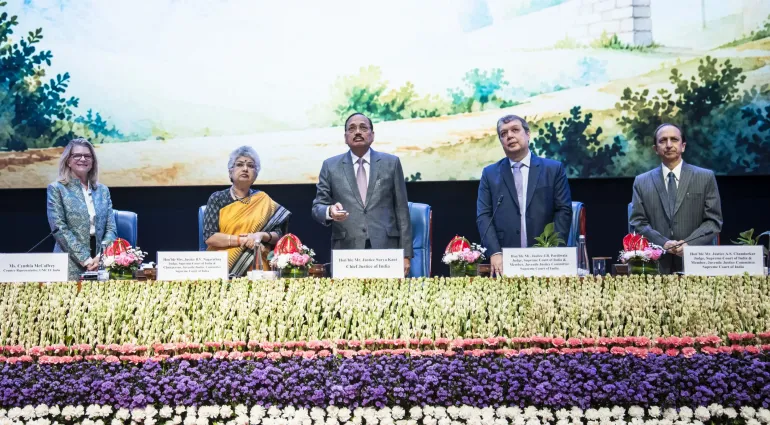
The National Annual Stakeholders Consultation on “Ten Years of the Juvenile Justice (Care and Protection of Children) Act, 2015: Progress, Challenges and Priorities for the Next Decade” organised by the Juvenile Justice Committee of the Supreme Court of India in association with UNICEF India, commenced today with its Inaugural Session, marking ten years of the Juvenile Justice (Care and Protection of Children) Act, 2015.
Hon’ble Mrs Justice B.V. Nagarathna, Judge, Supreme Court of India and Chairperson, Juvenile Justice Committee, delivered the Opening Remarks, emphasizing the constitutional vision of child rights and the imperative of judicial process re‑engineering under the new criminal laws and the Bharatiya Sakshya Adhiniyam. She underscored that just because a child has broken a law does not mean the law should break the child, calling for a shift from system‑strengthening to life‑transforming interventions.
“We need better data, stronger institutions, greater accountability, more effective protection services and adjudication
that is timely as well as child-sensitive.”
Ms. Cynthia McCaffrey, Country Representative, UNICEF India, in her Introductory Remarks, reaffirmed UNICEF’s partnership with the Indian judiciary and government in building stronger institutions for child protection and rehabilitation.
The highlight of the session was the release of the e‑Compendium of Landmark Judgments of the Supreme Court and High Courts on juvenile justice (2015–2026), by Hon’ble Mr. Justice Surya Kant, Chief Justice of India. The compendium reflects the judiciary’s commitment to safeguarding children’s rights and ensuring timely rehabilitation and family‑based care.
Reflecting on a decade of the Juvenile Justice Act, 2015, the Chief Justice observed: “For the past decade, we have measured the progress of juvenile justicethrough laws, institutions and cases. The next decade must be defined by the lives we transform—children returning to education, finding meaningful opportunities, reintegrating into society and building futures free from stigma.”
His address underscored the judiciary’s commitment to ensuring that child protection systems not only uphold legal safeguards but also actively enable rehabilitation, reintegration, and dignity for every child The inaugural proceedings have set the tone for two days of deliberations among judges, child welfare committees, juvenile justice boards, NGOs, and state representatives, aimed at consolidating best practices and charting the future course for juvenile justice in India.
Media contacts
About UNICEF
UNICEF strives to uphold the rights of every child, protecting them from harm and all forms of discrimination, so that they can grow up healthy and educated to reach their full potential. This work is in line with UNICEF’s globally recognized mandate and its support of national priorities.
For more information on UNICEF India and its work visit https://www.unicef.org/india/. Follow us on Twitter, Facebook, Instagram, Google+ and LinkedIn