Need for safe, inclusive and empowering AI framework for children
We should not look at AI with fear, but with understanding that it can bring a change in children’s future: S Krishnan, Secretary, Electronics and IT, GoI
- English
- हिंदी
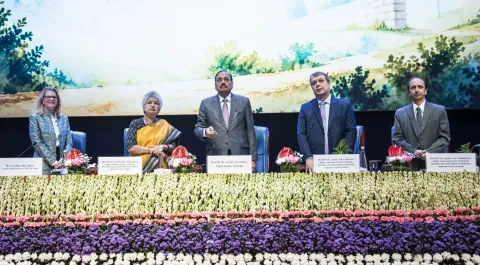
NEW DELHI: Prof. Ajay Kumar Sood, Principal Scientific Adviser, Govt of India today while addressing the session ‘AI & Children: Turning Principles into Practice for Safe, Inclusive and Empowering AI’, organized by FICCI, jointly with UNICEF during the ‘AI Impact Summit 2026’, said that digital penetration in India is increasing and children are increasingly exposed to Artificial Intelligence (AI) driven platforms. “It therefore underscores the need for a safe, inclusive and empowering framework tailored for their development,” he emphasized.
Prof Sood stated that AI systems are now shaping the learning pattern, information access, and behaviour responses, especially of children, is what we all stakeholders have to look at. “We still don’t know the long-term effects of growing up with AI companions, including personalized learning apps, algorithm-based feeds. More evidence is needed with new tools to understand the impact it has on a child’s overall development over time,” he noted.
He further said that often AI is referred as a double-edged sword, hence the governance objective should be to sharpen the edge of opportunities while blunting the edge of risk. AI can also help in strengthening societal inclusion by improving accessibility for all children. Prof Sood further cautioned over reliance on AI tools as it does weaken critical thinking and independent problem-solving techniques.
Highlighting the government initiatives on AI governance, Prof Sood said that India has taken a series of governance initiatives, including the India AI Mission, AI Governance framework and recent release of the whitepaper on Strengthening AI Safety using Techno-Legal framework.
Mr S Krishnan, Secretary, Ministry of Electronics and IT, Govt of India, said that the ‘AI Impact Summit’ is organized keeping the next generation in mind. The theme of the Summit is ‘People, Planet and Progress’, making sure that the human capital is developed to take advantage of AI. The next generation should have technology which is broad-based and cross-learning which can make the difference for various countries, including the global south to move up in the development chain.
He further stated that we should not look at AI with fear, but with the understanding that this can bring about a change in the children's future. “We need to think of a governance mechanism that guards our children and the nation from any ill effects that may be there. While being careful, we should ensure that the children get as many opportunities as possible to use the benefits of AI to shape their lives and the future of our world,” Secretary Krishnan added.
Her Excellency May-Elin Stener, Ambassador of Norway to India, Sri Lanka, Bhutan and the Maldives, said that safe and inclusive AI for children and young people is a priority for Norway. We have a clear vision where we focus on technology, including AI, to support and not undermine children's rights. A digital and AI-driven environment should be trustworthy, and it should empower the rights of children. “We have a strategy that highlights that it is important to address opportunities and challenges along with risks associated with digitalization,” she added.
Ms. Jyoti Vij, Director General, FICCI, said, “As Artificial Intelligence becomes deeply integrated into education, healthcare, governance, and daily digital interactions, it is increasingly shaping the experiences of millions of children across India and around the world.”
She further added that the Indian EdTech industry is playing a major role, and AI’s adaptive learning abilities have a big impact on education delivery. Leading Indian edtech platforms are continually looking to utilize AI’s adaptivity to analyse student performance and suggest tailored learning experiences to address specific areas of improvement, stated Ms. Vij.
Mr Thomas Davin, Global Director, UNICEF Office of Innovation, said, “AI is already reshaping the world our children are growing up in, often faster than our own ability to fully understand its long-term effects. We believe this technology can deliver transformational gains for children, but only if we treat this moment as a genuine societal shift and govern it accordingly. Child-centred AI is not optional — it is a responsibility shared by governments, industry, and all those shaping these systems.”
Opening the session, UNICEF India Youth Advocate Ms. Prasiddhi Singh read out the Children and Young People’s Statement, outlining their lived experience, needs, and aspirations. This statement drew insights from a global U-Report survey led by Generation Unlimited, which analysed responses from 54,000 children and young people across 184 countries. The statement was also shaped by focused group discussions with India’s children and youth.
The leaders stressed the urgent need to place children at the centre of AI design, deployment, and governance, so that rapidly evolving AI systems could be harnessed to expand opportunities for children, while safeguarding them from emerging digital risks. Delegates voiced how children’s rights must be embedded in AI governance as foundational principles and not as an afterthought. Failure to consider children and young people in today's governance structures will hinder equitable, safe systems in the future.
Governments worldwide needed to designate or strengthen watchdogs tasked with monitoring AI systems across both the public and private sectors, they added. Such bodies need to be interdisciplinary, combining expertise in technology, law, child rights, education, and data protection, the session concluded.
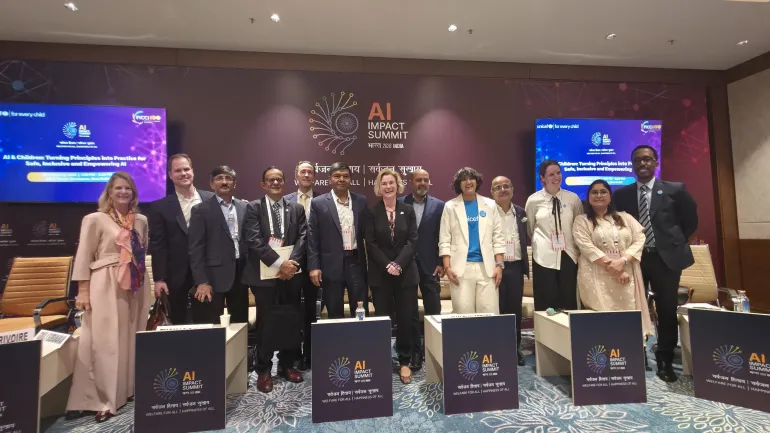
Ms. Henrietta Ridley, Chief AI, UNICEF; Dr. Sanjeev Sharma, Member Secretary, NCPCR; Mr. Thomas Davin, Global Innovation Director, UNICEF; Mr. Gokul V Subramaniam, President, Intel India; Mr. Hector De Rivoire, Director, Responsible AI Public Policy at Microsoft; Mr. Ajay Vij, Senior Country Managing Director, Accenture and Mr. Kumar Anurag Pratap, Vice President (CSR), Capgemini also shared their perspective during the panel discussion
Note to Editors:
Updated guidance for governments and businesses to create AI policies and systems that uphold children’s rights: https://www.unicef.org/innocenti/reports/policy-guidance-ai-children
Children and young people's statement on AI: https://www.generationunlimited.org/documents/statement-children-and-young-people-safe-inclusive-and-empowering-ai-future
Media contacts
About UNICEF
UNICEF strives to uphold the rights of every child, protecting them from harm and all forms of discrimination, so that they can grow up healthy and educated to reach their full potential. This work is in line with UNICEF’s globally recognized mandate and its support of national priorities.
For more information on UNICEF India and its work visit https://www.unicef.org/india/. Follow us on Twitter, Facebook, Instagram, Google+ and LinkedIn